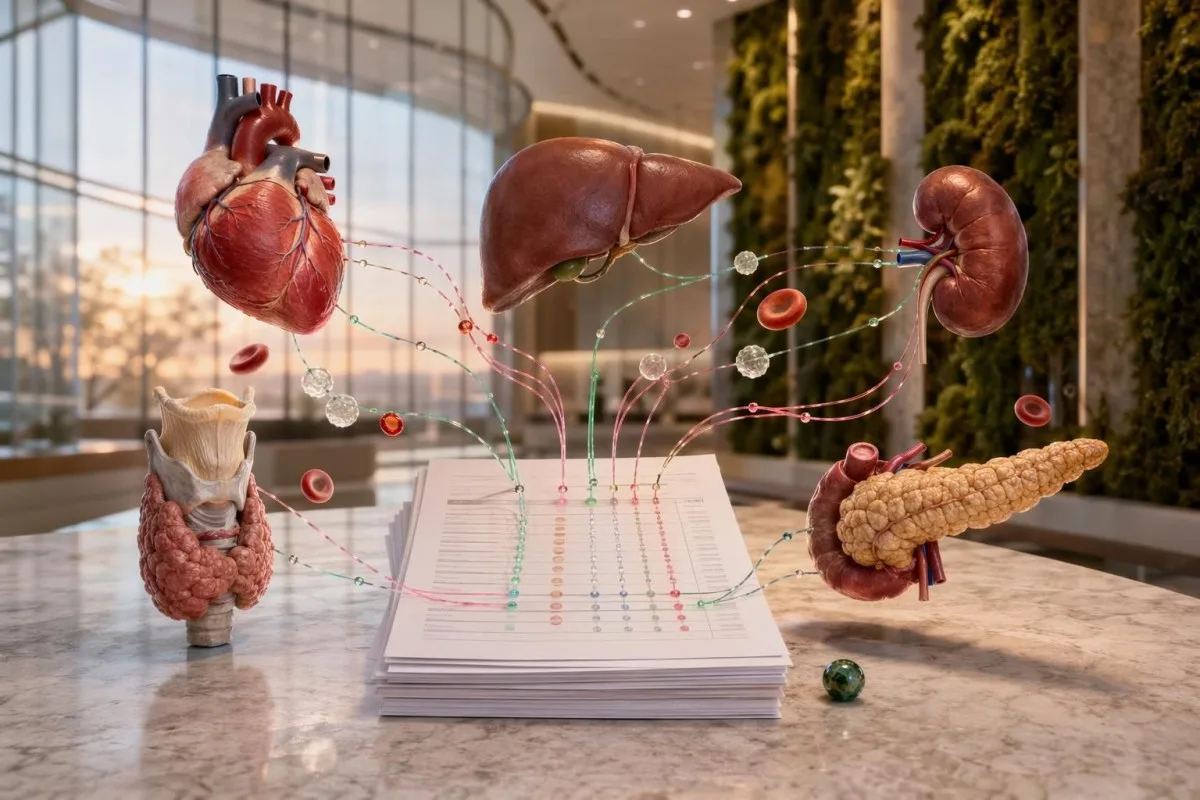
Un sol resultat normal pòt èsser rasserenant e totun mancar la istòria. L’historial de laboratòri de fòrça ans sovent mòstra la direccion, la velocitat e l’agrupament abans que una valor passè la franja de referéncia imprimida.


- Analitica de resultats d’analisi de sang compara de resultats repetits pendent de meses o d’ans, pas solament una valor marcada autra o bassa.
- Pendent de la tendéncia importa quand un marcador cambia de biais estable, coma quand eGFR s’abaisse mai de 5 mL/min/1,73 m² per an.
- Agrupaments de biomarcadors son sovent mai útils que de resultats isolats; un A1C creissent amb triglicerids e ALT pòdon suggerir un risc metabolic abans que la diabetis aparega.
- A1c 5.7-6.4% s’acompanha a la franja usuala de prediabetis, mas una pujada de 5,1% a 5,6% en 18 meses pòt ja meritar d’accions.
- ACR d’urina ≥30 mg/g es un senhal inicial de risc renal, encara quand la creatinina e l’eGFR semblan encara normals.
- Ferritina jos 30 ng/mL sovent sostèn una deficiéncia de fèrre en adults, subretot quand RDW s’afortís o MCV s’abaisse.
- Repetir las analisis es sol generalment quan cal quan un resultat es inesperat, crític o discordant amb los símptomes; lo moment va de lo meteis jorn a 12 setmanas.
- soroll de laboratòri de la desidratacion, l’exercici dur, l’estat de dejuni, los suplements e los cambiaments de l’assai pòdon imitar una malautiá se los trends son legits sensa discernir.
Qué aporta l’analítica de las analises de sang abans que un resultat vengue anormal
Analitica de resultats d’analisi de sang transforma los resultats repetits de laboratòri en senhals de risc precòces en mesurant la direccion, la velocitat e los patrons al cors dels marcaires. Un resultat de colesterol, de glucòsa, de reni, de fetge o de CBC pòt demorar dins la gamma del laboratòri mentre s’afasta de biais constant de vòstre basa personal. Kantesti es un Analizador de tèst de sang d'IA que legís l’istòria de laboratòri cargada coma una linha de temps, de biais que un valor tecnicament normal mas que cambia lèu se desestima pas coma soroll.
Sóm Thomas Klein, MD, e dins la revision clinica m’inquièti mens d’un sol LDL de 128 mg/dL que pas del fach que l’LDL passa de 82 a 128 mg/dL dins dos ans mentre ApoB e la talha de cintura creisson. Lo primièr nombre pòt pas desencadenar una alarma urgenta, mas la pendent indica que lo pacient a cambiat.
Una gamma de referéncia es bastida a partir de las estatisticas de la populacion, sovent lo 95% central dels resultats dins un grop seleccionat. Vòstre zona segura pòt èsser mai estrecha; una pujada de creatinina de 0.72 a 0.98 mg/dL pòt èsser significatiu dins una pichòta femna mai granda, encara se los dos nombres son dins la gamma imprimida.
Lo punt de partida pragmatic es de recampar al mens tres rapòrts istorics, idealament de 12 a 36 meses, e comparar las meteissas unitats. Nòstre guia a istòria de laboratòri d’un an a l’autre explica cossí far que los PDFs ancians sián encara utils en luòc de los laissar disparéisser dins los dorsièrs de corrièr electronic.
Perqué las pendents de las tendéncias pòdon èsser mai importantas que la franja normal
A pendent del trend es lo ritme a que un marcador de laboratòri cambia amb lo temps, generalament exprimida per mes o per an. Una pujada lenta e regulara pòt èsser mai utila clinicament que un resultat solament a la limit d’anormalitat, perque separa la variacion aleatòria del desplaçament biologic.
Per los resultats del reni, una davalada de eGFR mai granda que 5 mL/min/1.73 m² per an es generalament mai rapida que l’ageament esperat e deu èsser revisada. Una davalada de 92 a 74 dins tres ans pòt semblar normal sus cada rapòrt, mas la pendent es aproximativament de 6 mL/min/1.73 m² per an.
Per lo contraròtle de la glucòsa, m’atencionai quand HbA1c puja de 0.3-0.5 punts de percentatge dins un an, encara abans que siá arribat a 5.7%. Un pacient que passa de 5.1% a 5.6% a franchit una distància metabolica significativament, pas solament un error de redondiment.
La lectura de la pendent fonciona melhor quand las condicions de test son comparablas: lo meteis laboratòri se possible, un estat de dejuni similar, e pas cap de malautiá importanta dins los dos setmanas precedentas. Se volètz una metòda visuala, nòstre pendent dels trends de laboratòri guia mòstra cossí detectar los desplaçaments, las oscilacions e los patrons de plafon.
Cossí los agrupaments de biomarcadors transforman de petits cambiaments en senhals mai fòrts
A clúster de biomarcaires es un grop de cambiaments modestes de laboratòri que fan pensar a la meteissa fisiologia. Una sola anormalitat pichòta pòt èsser innocenta; tres cambiaments pichòts que se movon ensems son sovent ont lo risc se fa visible.
Lo clúster metabolic que vei sovent es: glucòsa en dejuni que creis, triglicerids que creisson, HDL que davala, e ALT que s’escapa de 22 a 38 IU/L. N’i a pas cap d’aquestes que siá dramatic, mas ensems suggerisson mai fòrtament una resisténcia a l’insulina e un risc de grassa al fetge que pas la glucòsa sola.
Kantesti AI tracte aquò coma un problèma de patròn, pas coma una caça al tresaur de senhals roges. Un ALT normal amb triglicerids superiors a 150 mg/dL e A1c que s’apròcha de 5.7% merita un conselh diferent que lo meteis ALT dins un atleta d’endurança magre après un bloc de trenament dur.
Los clústers pòdon tanben protegir los pacients de reaccion excessiva. Un ALP un pauc naut amb GGT normal, bilirubina normal, e calci normal es una istòria diferenta de ALP naut amb GGT naut e bilirubina directa que creis; nòstre guia a clústers de resultats abnormals dona mai d’exemples.
Perqué vòstre basa personal pòt batre la franja de la populacion
A baselina personal es la vostra valor de laboratòri tipic quand sètz ben, reposat/ada, e medicament estable. Pòt revelar un cambiament clinicament rellevant ben abans que una franja de referéncia d’una populacion marqui lo resultat coma naut o bas.
Un exemple comun es l’emoglobina. Un òme que a agut d’emoglobina 15,4 g/dL pendent una decada e puèi que davala a 13,6 g/dL pòt encara èsser sulc dins fòrça franges d’adults masculins, mas a perdut aperaquí 12% de la basa.
La meteissa logica s’aplica a TSH, creatinina, plaquetas, ferritina, e PSA. Dins mon experiéncia, los pacients que menan cinc ans de resultats fan la consulta doblas mai eficienta, perque podèm veire çò que es novèl, en luòc de discutir se un sol valor es normal.
Las analiticas de basa foncionan mal quand las unitats cambian sens conversion. LDL pòt aparéisser coma mg/dL o mmol/L, las franges de ferritina varián per laboratòri, e hs-CRP deu pas èsser mesclat amb CRP estandard; nòstre guia basala personala cobris aquelas trapaças.
Tendéncias dels lipids: LDL, ApoB, triglicerids e risc cardiac amagat
Las analiticas de tendéncia dels lipids seguisson se la carga de particulas aterogènas s’enauça, se mantèn estable, o se daissa pendent d’annadas. Segon la guia de colesterol 2018 AHA/ACC, ApoB pòt èsser util quand los triglicerids son de 200 mg/dL o mai, perque LDL-C pòt sosestimar lo risc ligat a las particulas (Grundy et al., 2019).
LDL-C de 190 mg/dL o mai es generalament tractat coma hipercolesterolèmia severa, encara abans d’utilizar un calculador de risc. ApoB al dessús de 130 mg/dL es tanben sovent considerat de risc naut, perque reflectís lo nombre de particulas aterogènas, pas lor contengut de colesterol.
Lo patròn que tròbi mai sovent pas reconegut es l’augment de LDL-C de 30-40 mg/dL aprèp la menopausa, la pujada de pes, lo desplaçament de la tiroida, o un cambiament de dieta. Se HDL tanben davala jos de 40 mg/dL dins los òmes o jos de 50 mg/dL dins las femnas, la istòria cardiovasculara se torna mens consolanta.
Los triglicerids al dessús de 150 mg/dL suggerisson un risc metabolic, mentre que de valors al dessús de 500 mg/dL fan pensar a un risc de pancreatitis e requerisson generalament una revísion clinica prompta. Per una explicacion mai prigonda al pacient, vesètz nòstre patrons del panèl lipidic.
Tendéncias de la glucosa e de l’A1C abans que la diabetis aparega
Las analiticas de tendéncia de la glucosa pòdon senhalar una resisténcia a l’insulina abans que HbA1c atenga lo limit de diabetis. Los ADA Standards of Care definisson la prediabètes coma HbA1c 5,7-6,4%, la glucosa plasmica dejun 100-125 mg/dL, o la glucosa a 2 oras 140-199 mg/dL (American Diabetes Association Professional Practice Committee, 2024).
La diabetis se diagnostica generalament quand HbA1c es de 6,5% o mai, la glucosa dejun es de 126 mg/dL o mai, o la glucosa a 2 oras es de 200 mg/dL o mai, confirmada quand es apropiat. Mas sovent ai una accion mai lèu quand A1c monta de 5,2% a 5,8% a costat dels triglicerids al dessús de 150 mg/dL.
L’insulina dejun es pas estandardizada pertot, e los clinicians despartisson sus los punts de tall. Totun, una insulina dejun persistentament al dessús d’environ 15-20 µIU/mL amb una glucosa normala pòt suggerir una compensacion, subretot quand HOMA-IR es al dessús de 2,5-3,0.
A1c pòt trompar dins l’abséncia de fèr, la malautiá del ren, la pregnesa, una pèrda de sang recenta, e certans variants d’emoglobina. Se A1c e las donadas del “finger-stick” o del CGM son en desacòrdi, nòstre A1c versus sucre en dejuni article explica çò que cal verificar aprèp.
Senhals de risc renal: eGFR, creatinina, cistatina C e ACR d’urina
Las analiticas de tendéncia del ren devon combinar eGFR, creatinina, cistatina C quand es disponible, e lo rapòrt albumina-creatinina urinària. KDIGO definís la malautiá cronica del ren per d’anomalias de l’estructura o de la foncion del ren que duran almens 3 meses, inclús eGFR jos de 60 mL/min/1,73 m² o ACR urinària de 30 mg/g o mai (KDIGO, 2024).
Kantesti es un servici d’interpretacion de tests de l’IA que legís la creatinina dins son contèxte amb l’edat, lo sèxe, la talha del còs, de senhals de massa muscular, e los resultats precedents. Una creatinina de 1,1 mg/dL pòt èsser normala per un òme muscular de 35 ans, mas preocupanta per una femna febla de 82 ans.
L’ACR urinària es un dels marcadors precòces mai utils, perque pòt montar abans que eGFR davale. Una ACR de 30-300 mg/g es una albuminuria moderadament aumentada, e una ACR al dessús de 300 mg/g es una albuminuria fòrça aumentada dins la màger part dels quadres de guias.
La cistatina C pòt reencadrar lo risc quand la creatinina es distorsionada per una massa muscular bassa, una massa muscular auta, o l’usatge de creatina. Per d’exemples a nivèl de pacient, nòstre guia de tendéncia dels rens explica perqué la creatinina pòt semblar calma mentre que lo risc cambia.
Trajectòrias d’enzims del fetge: quand una deriva leugièra d’ALT e de GGT importa
Las analiticas d’enzims del fetge cercan la persisténcia, la direccion, e lo patròn d’enzims, mai que de reagir a un sol ALT un pauc naut. ALT, AST, ALP, GGT, bilirubina, plaquetas, triglicerids, e A1c ensems sovent disen la vertadièra istòria del fetge.
Mantun laboratòris fixan límits superiors d’ALT al voltant de 40-50 IU/L, mas qualques grups d’hepatologia fan servir talles saludables més baixos propers a 30 IU/L pels òmes e 19 IU/L per las femnas. Aquesta diferéncia conta, perque un ALT persistent de 42 IU/L pòt èsser ignorat dins un laboratòri e revisat dins un autre.
So’m preocupa mai quand ALT, GGT, triglicerids dejunats e circumferéncia de cintura se movon ensems que quand AST es brèvament nauta aprèp d’exercici fòrça intens. Un corrèire de maraton amb AST 89 IU/L e CK 2.000 IU/L aprèp una corsa es un pacient fòrça diferent d’una persona amb AST 62 IU/L, GGT 110 IU/L, e bilirubina que creis.
Lo moment de la repetició depend de la istòria: de dos a quatre setmanas aprèp d’arrestar l’exercici pesant o l’exposicion a l’alcohol, mai lèu se i a icterícia, orina fosca, dolor severa, o toxicitat medicamentosa possible. Nòstre patrons d’enzimas del fetge guia va marcador per marcador.
Tendéncias de la CBC e del fèrre que revelan una deficiéncia iniciala
CBC e analiticas de fèrre pòdon revelar una manca abans que l’emoglobina siá clarament nauta. Ferritina, MCV, MCH, RDW, saturacion de transferrina, e recompte de plaquetas sovent s’esbalan dins un òrdre reconeissable.
Ferritina jos 30 ng/mL sostèn comunament la manca de fèrre dins los adults, encara quand l’emoglobina demòra normal. La saturacion de transferrina jos 20% apond pes, subretot quand i a fatiga, jambe inquieta, caiguda dels pels, periòdes fòrça abondants, embaràs, o donacions frequentas.
RDW sovent creis abans que MCV baissa, perque los elements celulàrs mai recents devenon mai variables en talha. Un pacient amb MCV que deriva de 91 cap a 82 fL e RDW que creis de 12.5% a 15.1% pòt estar en cors de manca de fèrre encara abans que l’anèmia siá present.
Las plaquetas pòdon montar pauc amb la manca de fèrre, de còps fins a la franja 400-500 x10⁹/L, çò que pòt èsser confondut amb un problèma d’inflamacion o de medul·la se los estudis de fèrre mancavan. Nòstre indicis de tendéncia de fèrre l’article cobís aqueste primièr patròn.
Deriva de la tiroida: legir TSH, T4 liure e anticorps a travèrs las visitas
L’analitica de tendéncia de la tiroida es mai utila quand TSH, free T4, simptòmas, moment de la medicacion, e estat d’anticorps son interpretats ensems. Un sol TSH de 4,2 mIU/L es mens informatiu que un TSH que creis de 1,6 a 4,2 pendent 18 meses.
Molts intervals de referéncia de TSH pels adults corren aproximativament de 0,4 a 4,0 mIU/L, mas l’edat, l’embaràs, l’ingesta de iòde, la biotina, e lo moment de la levotiroxina pòdon cambiar l’interpretacion. Free T4 jos l’interval amb TSH nauta sostèn una hipotiroïdisme overt; un free T4 normal amb TSH pauc nauta suggerís una malautiá subclinica.
La positivitats de l’anticòrps TPO cambia la prevision. En practica clinica, un pacient amb TSH 3,8 mIU/L e anticorps TPO positius es mai probable de progressar que un pacient amb lo meteis TSH e anticorps negatius, encara que lo calendari precís variarà.
Los suplementes de biotina pòdon abaisse falsament TSH o distorsionar los immunoassaigs, subretot a de dosatges de 5.000-10.000 mcg cada jorn. Se los nombres de tiroida fan un saut d’un biais estranh, revisatz lo moment del suplement e vesètz nòstre guia de deriva de la tiroida.
Separar lo vertadièr cambiament de la fam, l’idratança, l’exercici e lo “bruit” del laboratòri
Las modificacions dels analyses de sang al long del temps son solament significativas après aver verificat las fonts comunas de “bruit”. L’idracion, l’estat de dejun, l’exercici recent, l’infeccion, los cambiaments de medicacion, e las diferéncias d’assaig pòdon totes crear tendéncias falses.
La desidratacion pòt concentrar l’albumina, lo protein total, lo calci, l’emoglobina, l’hematocrit, BUN, e la creatinina. Una albumina nauta de 5,3 g/dL amb BUN nauta e orina concentrada me dit sovent mai sus l’estat de liquids que sus un rar problèma de proteïnas.
L’exercici dur pòt elevar CK dins los milèrs e empentar AST per dessús d’ALT pendent mantun jorn. Normalament demandi als atletes d’evitar una formacion anormalament intensa pendent 48-72 oras abans los analyses rutinièrs, levat se mesuram deliberadament la responsa a l’exercici.
Los metòdes del laboratòri cambian tanben. Un novèl assaig, un novèl interval de referéncia, o un cambiament de LDL calculat cap a LDL dirècte pòt far semblar que los valors son cambiat, sens que la fisiologia siá cambiada; nòstre contraròtles de variabilitat del laboratòri la pagina lista los culpables comuns.
Quand tornar far d’analisis e quand pas esperar
La repetició de las proves deu èsser temporizada segon lo risc clinic, e non solament segon l’angoissa del pacient. De còps cal una confirmacion del meteis jorn per de resultats anormals, mentre que fòrça petits desplaçaments son melhor repetits après 2-12 setmanas jos de condicions mai netas.
Lo potassi de 6,0 mmol/L o mai, lo sodi jos 125 mmol/L, la glucòsa mai de 250 mg/dL amb simptòmas, l’elevacion de troponina, o una fòrça nauta compta de neutrofils amb febra deu pas esperar un rendètz-vosament rutinari. Aquestes son de patrons urgents, subretot se lo pacient se sentís malament.
Abnormalitats leugièras sovent meritan de paciéncia. Un CRP de 12 mg/L aprèp una malautiá respiratòria, un ALT 55 IU/L aprèp una cambiament de medicament, o un WBC 12 x10⁹/L aprèp de corticoïdes pòdon necessitar una reïnspeccion aprèp la recuperacion, mai que pas una cascada d’imatgeria.
Thomas Klein, MD, conselha generalament de tornar far de resultats inesperats e a la limit amb lo meteis laboratòri, se possible. Nosautres repetir los tests anormals nòstre guide balha d’intervals practics per a CBC, CMP, tiroida, lipids, fèrre e marcaires de ren.
Cossí l’IA Kantesti legís l’istòria de laboratòri sens sobreestimar lo risc
L’enginhari d’analitica de Kantesti compara los valors al long del temps, las unitats, los intervals de referéncia, lo contèxte dels simptòmas, las listas de medicaments, e los clastres de biomarcaires relacionats. Kantesti es un plataforma d’interpretacion de biomarcaires per IA bastit per senhalar de trigas de seguiment sens transformar cada valor a la limit en un diagnostic.
En data del 1èr de junh de 2026, nòstra plataforma es estada utilizada per mai de 2M de personas dins 127+ païses e 75+ lengas. L’objectiu clinic es pas de remplaçar un mèstre; es de far la pròcha conversacion mai segura, mai clara e mai ben preparada.
L’IA de Kantesti verifica las conversions d’unitats, las combinasons impossiblas, de senhals d’error de laboratòri e de pièges d’hiperdiagnòsi abans de donar una interpretacion. Aquela metodologia es descricha dins nòstre guia de tecnologia e s’alinha amb nòstre publicat validacion medicala estandards.
Lo sistèma separa tanben los nivèls d’accion: discussió d’autosoins, reïnspeccion, rendètz-vosament amb lo mèstre, e revisió urgenta. Aquesta diferéncia importa, perque un pacient amb potassi 6,2 mmol/L necessita de guidatge diferent d’un pacient amb vitamina D 24 ng/mL.
Publicacions de recèrca e pròxims passos segurs per los pacients
L’usatge mai segur de las analiticas de sang es de menar de tendéncias estructuradas a un clinician, pas de se diagnosticar solament dempuèi un graf. A Kantesti, nòstre procès de revision medicala es supervisat per de mèdces e d’assessors que se concentran sus la calibracion, los seuils de seguretat e l’interpretacion reala del pacient.
Nòstre conselh medical revisa cossí s’encadran las explicacions adreçadas als pacients, subretot quand los resultats poirien implicar un càncer, un risc de trombòsi, una davalada dels ronyons o una malaltia endocrina. Un lengatge caliu aquí no es pas solament estètic; reduch la panica e melhora la seguida.
El treball de referéncia a escala de població de Kantesti inclutz de casos anonimizats dins 127 païses e de casos de trampa deliberats ont l’overdiagnòstic seriá aisit. La via completa de validacion es tanben resumida dins lo benchmark d’IA per als lectors que volon los estàndards clins que i a darrièr lo producte.
Doncas, que deuètz far amb vòstres valors d’analisi de sang que cambian? Desatz cada rapòrt, anotatz las condicions de la mesa a l’òbra, tornatz verificar los resultats inesperats a l’interval adequat, e portatz las questions de tendéncia al vòstre clinician amb datas exactas, unitats e símptomes.
Questions frequentas
Les anàlisis de sang pòdon trobar un risc quand totes mos resultats son normals?
Òc, l’analítica de proves de sang pòt identificar patrons de risc encara quand cada resultat encara se tròba dins l’interval de referéncia imprimit. Un A1c que s’augmenta de 5.1% a 5.6%, un eGFR que s’abaisse de 92 a 74 mL/min/1.73 m² pendent tres ans, o una ferritina que davala de 80 a 32 ng/mL pòdon totes èsser de tendéncias significativas. Lo resultat, el, es pas una diagnòstic per se meteis, mas es una rason per revisar lo contèxte e considerar una repeticion de las proves.
De quantes analíticas de sang ai besonh per una tendéncia fisabla?
Tres resultats al cap d’almens 12 meses son generalament lo minim per una tendéncia utila, e cinc o mai resultats pendent 2-5 ans son melhor. Dos resultats pòdon mostrar un possible cambiament, mas non pòdon pas separar de biais fisable la pendentor de la variacion aleatòria. Las tendéncias son mai fòrtas quand s’utilizan las meteissas unitats, un estat de dejuni similar, e preferentament lo meteis laboratòri.
Quines alteracions en un anàlisi de sang, al llarg del temps, m’han de preocupar més?
Pentes rapidas, anomalias repetidas, e clustèrs demandan la màger atencion. Dins d’exemples i a l’eGFR que davala mai de 5 mL/min/1,73 m² per an, l’HbA1c que s’enauça de 0,3-0,5 punts de percentatge dins un an, l’LDL-C que s’augmenta de 30-40 mg/dL, o la ferritina que davala jos 30 ng/mL amb RDW creissent. Los simptòmas urgents totjorn prevalon sus l’analisi de tendéncia.
Quand cal repetir una analisi de sang anormala?
Els resultats crítics o relacionats amb la seguretat poden requerir una repetició de la prova el mateix dia o atenció urgent, com ara el potassi ≥6,0 mmol/L, el sodi <125 mmol/L, o glucòsa ≥250 mg/dL amb símptomes. Las anomalias lleugeras inesperadas sovent se tornan verificar après 2-12 setmanas, segon lo marcador e la causa probable. Tornar far la mesura sota de condicions mai netas, coma una hidratacion normala e pas d’exercici intens durant 48-72 oras, fa que lo segond resultat siá mai util.
L’exercici, lo dejuni, o la desidratacion pòdon crear de tendéncias falçes dins los analises de sang?
Òc, l’exercici, lo dejuni e la desidratacion pòdon crear de cambiaments aparentes dels analisis de sang al cors del temps que son pas una malautiá. La desidratacion pòt elevar l’albumina, la proteïna totala, BUN, la creatinina, l’emoglobina e l’hematocrit, mentre que l’exercici intens pòu elevar CK e AST pendent mantun jorns. Lo status de dejuni pòt cambiar los triglicerids e la glucosa, doncas las comparasons de tendéncia devon enregistrar se avètz manjat e çò que s’es passat dins las 72 oras precedentas.
L’interpretacion d’analisi de sang per IA remplaça mon mèdecin?
Non, l’interpretacion d’analisi de sang per IA non remplaça pas un mèstre, subretot per de simptòmas urgents, la gestacion, de preocupacions de cancer, de dolor de pit, de signes d’infeccion severa, o de valors criticas de laboratòri. Lo melhor usatge es d’organizar de resultats de mantun an, de marcar las pendents e los gropes, e de preparar de questions melhoras per una revision clinica. Un clinician encara deu ligar lo patron de laboratòri amb los resultats de l’examen, los medicaments, l’imatgeria e lo risc personal.
E se mon AST A1C seguís pas las mesuras de glucòsa de la mejana?
L'A1C pòt èsser enganaire amb de malautiás que tocan las globulas rojas, que sián la deficiença de fèrre, la pèrda de sang recenta, o una transfusion. Portatz lo vòstre jornal de glucòsa a lo vòstre clinician, que poiriá emplegar un test de laboratori de glucòsa o un autre signe, coma lo fructosamina, per clarificar lo desajustament.
Deuriáu arrestar los supplements de biotina abans de far un anàlisi de sang?
Possiblament. La biotina en dozes nautas, sovent venduda per los pels e las ungles, pòt interferir amb d’unes assajos de tiroida e de còr e causar de resultats falsament nauts o falsament bais; digatz a vòstre clinician e a la laboratòri totes los supplements e demandatz se cal pausar la biotina abans del test.
Devèri inclure los ancians rapòrts de laboratòri de diferents laboratòris dins mon istoric de tendéncias?
Òc, los rapòrts ancians pòdon èsser utiles se i a la data, las unitats e la franja de referéncia. Pòdon existir de petites diferéncias entre laboratòris, doncas los exàmens de seguiment planificats son melhoras de far al meteis laboratòri quand es possible.
Obtén uèi una analisi de sang amb IA
Joinhètz mai de 2 milions d’utilizaires al mond que confian en Kantesti per una analisi instantanèa e precisa dels analisis de laboratòri. Mandatz vòstres resultats analisi de sang e recebetz una interpretacion complèta de 15,000+ biomarcadors en segondas.
📚 Publicacions de recerca citadas
Klein, T., Mitchell, S., & Weber, H. (2026). Validacion clinica de l’Kantesti AI Engine (2.78T) sus 100,000 casos d’analisi de sang anonimizats dins 127 païses: un benchmark de populacion, pre-registrat, basat sus rubrica, incluent de trap cases d’hiperdiagnòsi — V11 Second Update. Kantesti IA Recèrca Medicala.
Klein, T., Mitchell, S., & Weber, H. (2026). IA multilingüe d'ajuda a la decision clinica per la tria precòça de l'Hantavirus: concepcion, validacion d'engenhariá e desplegament real sus 50 000 rapòrts de bilans sanguins interpretats. Kantesti IA Recèrca Medicala.
📖 Referéncias mèdicas externes
Comitat de Pratica Professionala de l’American Diabetes Association (2024). 2. Diagnòstic e classificacion del diabètes: Estàndards de la cura dins lo diabètes — 2024. Diabetes Care.
Grupa de trabalh KDIGO (2024). Guia de practica clinica KDIGO 2024 per l'evaluacion e la gestion de la malautiá cronica renala. Kidney International.
⚕️ Avertiment medical
Aqueste article es solament per tòcas educatius e constituís pas de conselh medical. Consultatz totjorn un professional de la sant qualificat per las decisions de diagnostica e de tractament.
Senhals de confiança E-E-A-T
Experiéncia
Revisión clinica menada pel metge de las practicas d’interpretacion de las analisis.
Expertisa
Fòcus sus la medicina de laboratòri sus cossí los biomarcadors se comportan dins un contèxte clinic.
Autoritat
Escrich pel Dr. Thomas Klein amb revisión pel Dr. Sarah Mitchell e Prof. Dr. Hans Weber.
Fisança
Interpretacion basada sus d’evidéncias amb de camins de seguiment clars per reduzir l’alarmisme.