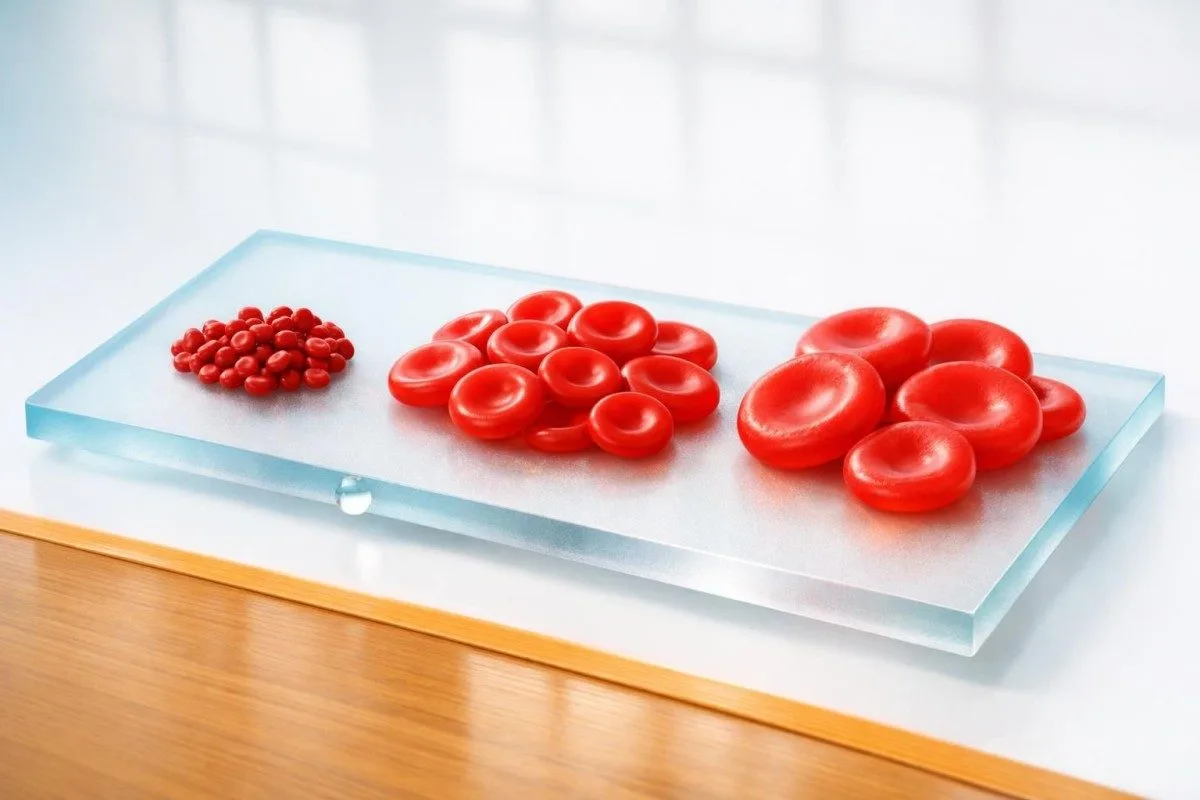
The MCV blood test tells you the average size of your red blood cells. In adults, 80-100 fL is typical; below 80 fL suggests microcytosis, above 100 fL suggests macrocytosis, and the next useful tests usually depend on ferritin, iron saturation, B12, folate, reticulocytes, thyroid, kidney, and liver clues.


- Normal MCV in most adults is 80-100 fL, although some labs use slightly narrower ranges such as 79-96 fL.
- Low MCV usually means microcytosis and most often points to iron deficiency or thalassemia trait.
- High MCV means macrocytosis; B12 deficiency, alcohol use, liver disease, hypothyroidism, and medications are the commonest causes.
- Ferritin below 30 ng/mL often supports iron deficiency, and with inflammation many clinicians treat ferritin below 100 ng/mL plus transferrin saturation below 20% as iron-restricted erythropoiesis.
- MCV blood test low with a high RBC count makes thalassemia trait more likely than iron deficiency.
- Normal MCV does not exclude anemia; early iron deficiency, kidney disease, inflammation, blood loss, hemolysis, or mixed deficiencies can all look normocytic.
- MCV above 115 fL deserves prompt review, especially if B12 is low or white cells and platelets are also reduced.
- Reticulocytes are larger immature red cells, so recovery after bleeding or hemolysis can raise MCV even when vitamin levels are normal.
What the MCV blood test measures on a CBC
The MCV blood test measures the average volume of your red blood cells in femtoliters (fL). In most adults, 80-100 fL is the usual reference range; below 80 fL suggests microcytosis and above 100 fL suggests macrocytosis. I tell patients—I'm Thomas Klein, MD, Kantesti's CMO—that MCV is a pattern finder, not a diagnosis by itself, and our MCV blood test review always starts with the rest of the CBC.
A CBC can show normal hemoglobin with abnormal MCV, or the reverse. That is why I rarely interpret MCV without the CBC differential; white-cell and platelet changes sometimes reveal a marrow problem that a single RBC index hides.
Most adult labs report 80-100 fL, but some European analyzers use roughly 79-96 fL or 82-98 fL. Newborns naturally run much higher—often 95-121 fL—so adult cutoffs should never be pasted onto infant results.
MCV is calculated from hematocrit ÷ RBC count × 10 on many analyzers. That math matters because a spuriously low RBC count from cold agglutinins can make the MCV look falsely high, a lab quirk patients almost never hear about.
As of April 10, 2026, Kantesti AI reads MCV alongside RDW, reticulocytes, iron studies, B12, thyroid markers, and kidney function because the same 72 fL means something different in a 22-year-old runner than in a 78-year-old with CKD. A number by itself is blunt; the pattern is where the medicine lives.
Low MCV means microcytosis—but not always iron deficiency
A low MCV means your red cells are smaller than usual, and in adults that usually starts below 80 fL. The commonest causes are iron deficiency and thalassemia trait, but chronic inflammation, lead exposure, copper deficiency, and some marrow disorders can also do it.
When I review MCV 72-78 fL with MCH low and RDW high, iron deficiency jumps up the list. Our MCH pattern guide explains why hemoglobin content often falls before patients feel much beyond fatigue or restless legs.
Thalassemia trait often looks different: the MCV can be very low—sometimes 64-74 fL—while the RBC count stays normal or high, often above 5.0 × 10^12/L. I recently reviewed a 26-year-old teacher with MCV 68 fL, hemoglobin 11.9 g/dL, and RBC 5.8 × 10^12/L; hemoglobin electrophoresis confirmed trait, and iron tablets would never have fixed the issue.
Mentzer's index—MCV ÷ RBC count—is a rough screening tool first popularized in Mentzer's 1973 Lancet paper. A value below 13 leans toward thalassemia trait and above 13 leans toward iron deficiency, but in my experience it gets far less reliable when deficiency and inherited traits overlap.
Low MCV can also coexist with a normal hemoglobin early on. Before calling it anemia, I compare the result with the hemoglobin normal range and ask about menstrual losses, blood donation, endurance training, acid-suppressing medication, and family origin.
Best next-step tests after an MCV blood test low result
If your MCV blood test low result comes with low hemoglobin, the best next tests are usually ferritin, serum iron, transferrin saturation, and often CRP or ESR. In practice, ferritin is the first fork in the road: below 15 ng/mL is strongly diagnostic in otherwise healthy adults, while many clinicians act on below 30 ng/mL because it catches earlier deficiency.
Ferritin can mislead when inflammation, obesity, liver disease, or recent infection is present. Camaschella's 2015 New England Journal of Medicine review remains useful here: a ferritin of 45 ng/mL may sound safe, yet if transferrin saturation is below 20% and inflammatory markers are raised, I still worry about iron-restricted erythropoiesis; our ferritin reference guide unpacks that nuance.
The full iron panel matters because pattern beats any single number. In our experience reviewing uploaded reports on Kantesti, low serum iron + high TIBC + low saturation is far more convincing for iron deficiency than a lone serum iron value, and our iron studies guide shows why fasting status can muddy the picture.
Who needs a source-hunt? Adult men and postmenopausal women with new iron deficiency usually need an explanation for blood loss, often gastrointestinal, while premenopausal women more often have heavy bleeding, postpartum depletion, low intake, or malabsorption such as celiac disease.
One practical pearl: tea, calcium supplements, and proton-pump inhibitors can all reduce iron absorption enough to matter in borderline cases. I have also seen low-MCV patients with perfectly decent diets whose real issue was H. pylori, which is still under-recognized outside gastroenterology.
When ferritin looks normal but iron deficiency still exists
Ferritin is an acute-phase reactant, so inflammation can drag it upward while the marrow is still functionally iron-starved. A common real-world pattern is MCV 79 fL, ferritin 60 ng/mL, transferrin saturation 12%, and a raised CRP; that is not classic textbook iron deficiency, but most hematologists would still take it seriously.
High MCV points to macrocytosis—B12 is only one cause
A high MCV means larger red cells, usually above 100 fL, and the main causes are vitamin B12 deficiency, folate deficiency, alcohol use, liver disease, hypothyroidism, reticulocytosis, and medication effects. Once the MCV climbs above 115 fL, megaloblastic anemia or marrow disease moves higher on my list.
B12 deficiency is common and often under-tested. A serum B12 below 200 pg/mL or below 148 pmol/L is usually low, but a borderline level of 200-400 pg/mL can still be functionally deficient, which is why clinicians often add methylmalonic acid or homocysteine; our B12 test guide goes deeper.
Alcohol deserves more respect here. I have seen weekend drinking push MCV into the 101-105 fL range even before AST or GGT became dramatic, whereas established liver disease tends to show macrocytosis plus enzyme changes, low platelets, or folate depletion—see our liver enzyme patterns article if that part of the panel is off.
Hypothyroidism can cause a surprisingly bland macrocytosis, especially in older adults. An MCV of 102 fL with fatigue, weight gain, constipation, and a TSH above 4-5 mIU/L is enough for me to check the thyroid story before assuming a vitamin problem; our high TSH explainer is useful here.
The trap is mixed deficiency. Iron deficiency can pull MCV down while B12 or folate pushes it up, leaving a seemingly normal 88-94 fL that hides both problems; that is one reason a normal MCV never fully reassures me when symptoms and the rest of the CBC disagree.
Normal MCV does not rule out anemia
A normal MCV does not rule out anemia. Normocytic anemia means the average cell size stays between 80 and 100 fL, but the oxygen-carrying capacity is still low because of kidney disease, inflammation, early iron deficiency, blood loss, hemolysis, or mixed nutritional problems.
Kidney disease is a classic example because low erythropoietin lowers red cell production without shrinking the cells. If hemoglobin is down and the MCV is 86-92 fL, I look at creatinine, urea, and the broader renal panel vs CMP question before blaming diet alone.
An eGFR below 60 mL/min/1.73 m² for more than 3 months can support CKD-related anemia, although symptoms vary widely. Our eGFR guide explains why a borderline creatinine can still matter in small, older, or sarcopenic patients.
Inflammation can also keep MCV normal while iron is functionally unavailable. A raised CRP above 5 mg/L or an elevated ESR alongside low transferrin saturation often means the marrow has iron on paper but cannot use it efficiently.
Here is a nuance most search results miss: a perfectly normal MCV can be an average of small cells plus large cells. I see that after bariatric surgery, in inflammatory bowel disease, and in patients taking folate intermittently while bleeding chronically.
How to read MCV with RDW, RBC count, and reticulocytes
The fastest way to interpret MCV is to pair it with RDW, RBC count, and reticulocytes. In day-to-day practice, low MCV + high RDW favors iron deficiency, low MCV + high RBC count favors thalassemia trait, and high MCV + high reticulocytes favors bleeding or hemolysis recovery.
RDW measures size variation, and most labs call 11.5-14.5% normal. A rising RDW often means the marrow is releasing a mixed population of cells, which is why our RDW guide pairs so naturally with MCV rather than treating it as an afterthought.
Reticulocytes are bigger cells—often around 103-126 fL—so a marrow that is responding briskly can nudge MCV upward even when B12 and folate are fine. That is one reason a recent bleed, hemolysis, or recovery after iron therapy can confuse the picture; our reticulocyte and hematology marker guide shows the math.
Platelets add an extra clue. Reactive thrombocytosis—say platelets 450-650 × 10^9/L—often travels with iron deficiency, whereas thalassemia trait usually does not raise platelets unless something else is going on.
Some labs now report Ret-He or CHr, meaning reticulocyte hemoglobin content. It is not yet universal, but when available, I find it especially useful in dialysis patients, pregnancy, and inflammatory bowel disease because it can flag iron-restricted erythropoiesis before the MCV shifts.
A quick pattern shortcut I actually use
Low MCV plus high RBC count usually makes me think inherited trait; low MCV plus high RDW and low ferritin usually makes me think iron deficiency. High MCV plus low reticulocytes and falling white cells or platelets is the combination that pushes me toward marrow evaluation rather than another month of vitamin guessing.
Common reasons MCV shifts without a serious disease
Not every abnormal MCV means a dangerous condition. Alcohol use, pregnancy, smoking, reticulocytosis, sample delay, cold agglutinins, and severe hyperglycemia can all distort the number before a true disease label is justified.
A delayed EDTA sample can let red cells swell in the tube, nudging MCV upward by 2-4 fL on some analyzers. That is a very practical reason I sometimes repeat a borderline 101 fL result before launching an expensive workup.
Cold agglutinins are a classic lab artifact: cells clump, the machine counts fewer RBCs, and the calculated MCV looks falsely high while the MCHC may also spike. When I see MCV high + RBC count oddly low + MCHC above 36 g/dL, I ask the lab whether the sample was warmed and rerun.
Severe hyperglycemia can also transiently swell cells osmotically. And despite what many websites imply, dehydration usually affects hemoglobin and hematocrit more than MCV itself, though it can muddy interpretation of the whole CBC—our guide to dehydration-related false highs explains that distinction.
Pregnancy is another subtle one. MCV may rise by about 2-4 fL during a normal pregnancy, so a borderline macrocytosis there is not the same story as an MCV 106 fL in a 68-year-old with weight loss.
When an abnormal MCV needs urgent medical review
An abnormal MCV needs urgent review when it comes with severe symptoms, very low hemoglobin, neurologic changes, jaundice, or other low blood counts. In adults, hemoglobin below 8 g/dL, MCV above 110-115 fL, fainting, chest pain, shortness of breath at rest, or new numbness in the feet should move this from curious to urgent.
Low MCV becomes more concerning when the anemia is worsening quickly or when there is obvious blood loss—black stools, coffee-ground-like vomiting, or heavy menstrual bleeding soaking protection hourly. Those are not wait-and-see findings, and our blood test symptoms decoder is built around exactly these red flags.
High MCV with low white cells or platelets worries me because that combination can reflect marrow failure, medication toxicity, copper deficiency, or a myelodysplastic process. A peripheral smear and reticulocyte count are often more informative here than repeating MCV alone.
Persistent fatigue deserves respect, especially when it is new and paired with breathlessness, palpitations, exercise intolerance, or brain fog. If the CBC is only part of a broader workup, our blood tests for fatigue guide can help frame the next conversation with your clinician.
One small but important caveat: neurologic symptoms from B12 deficiency can show up even before hemoglobin falls much. That is why a patient with MCV 103 fL, tingling, and gait imbalance should not be reassured by a barely normal CBC.
Older adults deserve a lower threshold for follow-up
Progressive macrocytosis in someone over 60, especially with declining platelets or neutrophils, deserves more respect than an isolated one-off lab blip. In my practice, that is the group where I am quickest to order a smear, review medications carefully, and consider hematology referral.
How Kantesti AI interprets MCV beyond a single number
Kantesti AI interprets the MCV blood test by reading the number in context—hemoglobin, hematocrit, RBC count, RDW, reticulocytes, ferritin, B12, creatinine, thyroid markers, and liver tests. A standalone 78 fL or 103 fL is often ambiguous; a trend across two or three CBCs is much more clinically useful.
As of April 10, 2026, our AI blood test platform has helped more than 2 million users across 127+ countries review CBC patterns, and I push our team to keep the language medically strict but patient-readable. Thomas Klein, MD, still reviews these articles with the same rule I use in clinic: if a result changes management, say exactly why.
Accuracy matters because MCV is easy to overcall. Our medical validation standards explain how Kantesti's neural network is benchmarked and why we deliberately separate probable iron deficiency, possible thalassemia trait, likely alcohol-related macrocytosis, and clinician-review-needed patterns rather than collapsing them into one vague alert.
And there is a human layer on top. Our Medical Advisory Board reviews the clinical framing, especially around anemia, pregnancy, pediatrics, and marrow red flags where small wording changes can alter patient behavior.
Most people do not type numbers into a spreadsheet; they upload a PDF or phone snapshot. If you want that workflow, our blood test PDF upload guide shows how we extract CBC markers and trend them across time instead of treating each report as an island.
A practical follow-up plan after an abnormal result
The practical next step after an abnormal MCV is to match the cell-size pattern to the most efficient confirmatory tests. Low MCV usually points to ferritin and iron studies, high MCV usually points to B12, folate, TSH, liver tests, and medication review, and normal MCV anemia usually needs reticulocytes, kidney function, inflammation markers, and sometimes hemolysis labs.
If low MCV looks like iron deficiency, I usually repeat the CBC and iron panel after 4-8 weeks of treatment or sooner if symptoms worsen. Ferritin often rises before the hemoglobin fully catches up, and the reticulocyte response can appear within 7-10 days when therapy is working.
If high MCV looks nutritional, repeating B12-related labs after treatment can be reasonable in 1-3 months, but neurologic symptoms should be followed clinically, not just numerically. Alcohol-related macrocytosis can take 6-12 weeks to settle after reduction or abstinence, which is longer than many patients expect.
If the pattern still feels muddy, that is exactly what About Us exists to clarify: Kantesti is not a generic content site but a clinically reviewed lab interpretation company. You can try the free demo with a CBC report and see how our system explains MCV together with the rest of your panel.
Bottom line: the number tells you the direction, not the diagnosis. In my experience, the smartest question is not Is my MCV low or high? but What pattern does it create with the rest of my blood work?
Research and clinical validation notes
These publications support how we think about clinical communication, validation, and patient-facing interpretation at Kantesti. They are not MCV-specific trials, but they show the standards behind how our medical content and validation process are built.
At Kantesti, our clinical team uses formal publication and validation frameworks rather than anonymous copywriting. Kantesti LTD. (2026). Women's Health Guide: Ovulation, Menopause & Hormonal Symptoms. Figshare. https://doi.org/10.6084/m9.figshare.31830721. ResearchGate: publication search. Academia.edu: title search.
Kantesti LTD. (2026). Clinical Validation Framework v2.0 (Medical Validation Page). Zenodo. https://doi.org/10.5281/zenodo.17993721. ResearchGate: publication search. Academia.edu: title search.
Frequently Asked Questions
What does MCV blood test low mean?
A low MCV means the average red blood cell size is below the lab reference range, usually below 80 fL in adults. The two most common explanations are iron deficiency and thalassemia trait, although chronic inflammatory states, lead exposure, copper deficiency, and some marrow disorders can also cause microcytosis. If hemoglobin is also low, the usual next tests are ferritin, transferrin saturation, and often CRP or ESR. A low MCV by itself is a pattern clue, not a final diagnosis.
Can you have iron deficiency with a normal MCV?
Yes, you can have iron deficiency with a normal MCV, especially early in the process or when another factor pushes cell size upward at the same time. I see this with mixed iron plus B12 deficiency, recent bleeding, pregnancy, and inflammatory illness. A patient can have ferritin below 30 ng/mL and still show an MCV of 82-90 fL. That is why ferritin and iron saturation matter even when the cell size looks ordinary.
Why is my MCV high but hemoglobin normal?
A high MCV with normal hemoglobin often means macrocytosis without overt anemia, and the usual causes are alcohol use, early B12 or folate deficiency, hypothyroidism, liver disease, medication effects, or reticulocytosis. Mild elevations such as 101-103 fL are common and are not automatically dangerous. The next useful tests are usually B12, folate, TSH, liver enzymes, and a medication review. If the MCV keeps rising or other blood counts fall, the workup should widen.
How high is too high for MCV?
An MCV above 100 fL is generally considered high in adults, but the level that really changes my urgency is usually 110-115 fL or higher. At that point, I worry more about megaloblastic anemia, significant B12 deficiency, marrow disorders, or marked reticulocytosis. High MCV becomes even more concerning if white cells or platelets are low, or if there are neurologic symptoms such as tingling or gait imbalance. Context still matters, but very high values deserve prompt review.
What tests should I ask for after a low MCV result?
After a low MCV result, the most useful next tests are usually ferritin, serum iron, TIBC or transferrin, transferrin saturation, and often CRP or ESR. If the RBC count is high despite a very low MCV, clinicians often add hemoglobin electrophoresis to look for thalassemia trait. In adult men and postmenopausal women, the conversation should also include where iron might be getting lost, especially from the gastrointestinal tract. If symptoms are significant, a reticulocyte count and peripheral smear can add useful speed.
Can alcohol raise MCV even if other liver tests are normal?
Yes, alcohol can raise MCV even when ALT, AST, and GGT are still within range or only mildly changed. In practice, I often see alcohol-related macrocytosis in the 101-105 fL range before the rest of the liver panel fully declares itself. The MCV can take 6-12 weeks to drift back down after alcohol reduction or abstinence. That delay is one reason patients sometimes think nothing changed when it actually did.
Does a high MCV mean cancer?
No, a high MCV does not mean cancer by itself. Most cases are explained by B12 deficiency, folate deficiency, alcohol use, liver disease, hypothyroidism, medications, or reticulocytosis. The reason clinicians sometimes widen the workup is that persistent macrocytosis with low white cells, low platelets, weight loss, or a very high MCV above 110-115 fL can occasionally point toward a marrow disorder such as myelodysplasia. The pattern around the number matters much more than the number alone.
Get AI-Powered Blood Test Analysis Today
Join over 2 million users worldwide who trust Kantesti for instant, accurate lab test analysis. Upload your blood test results and receive comprehensive interpretation of 15,000+ biomarkers in seconds.
📚 Referenced Research Publications
Klein, T., Mitchell, S., & Weber, H. (2026). Women's Health Guide: Ovulation, Menopause & Hormonal Symptoms. Kantesti AI Medical Research.
Klein, T., Mitchell, S., & Weber, H. (2026). Clinical Validation Framework v2.0 (Medical Validation Page). Kantesti AI Medical Research.
⚕️ Medical Disclaimer
This article is for educational purposes only and does not constitute medical advice. Always consult a qualified healthcare provider for diagnosis and treatment decisions.
E-E-A-T Trust Signals
Experience
Physician-led clinical review of lab interpretation workflows.
Expertise
Laboratory medicine focus on how biomarkers behave in clinical context.
Authoritativeness
Written by Dr. Thomas Klein with review by Dr. Sarah Mitchell and Prof. Dr. Hans Weber.
Trustworthiness
Evidence-based interpretation with clear follow-up pathways to reduce alarm.