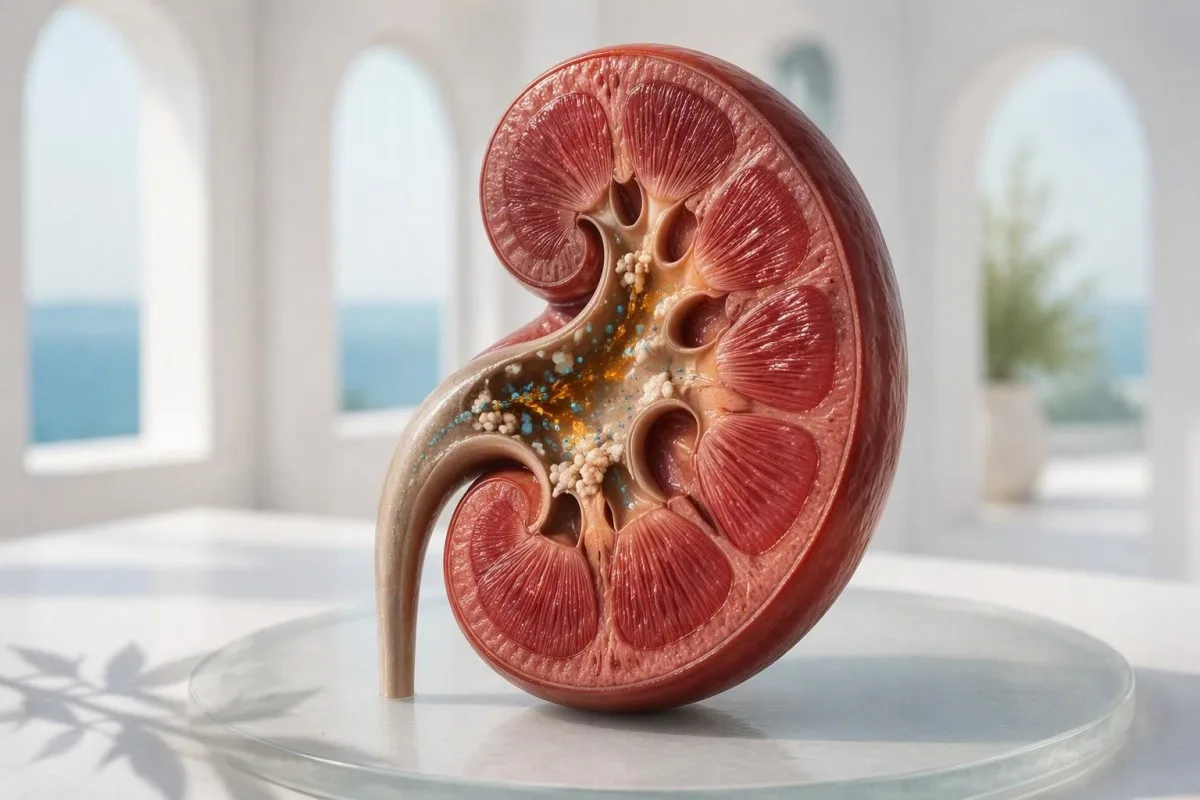
Төмен цитрат нәтижесі – бұл өздігінен диагноз емес, бүйрек тасының өзгеретін қауіп факторы. Келесі тиімді қадам – оны зәр көлемі, рН, кальций, натрий, оксалат және сіздің тас тарихыңызбен бірге талдау.


- Гипоцитраттылық әдетте 320 мг/24 сағаттан төмен зәр цитратын білдіреді, бірақ зертханалық және жыныс бойынша нысаналы көрсеткіштер әртүрлі болады.
- Несептегі цитраттың төмен болуы кальций тасының қаупін арттырады, себебі цитрат зәрдегі еркін кальциймен байланысып, кристалдардың өсуін баяулатады.
- Практикалық мақсат қайталанатын кальций тастары пайда болатын адамдар үшін, әдетте, күніне кемінде 600 мг цитратты, зәр көлемі мен рН-мен бірге бағаланады.
- Калий цитраты әдетте тәулігіне 30–60 мЭк мөлшерінде бөлінген дозаларда тағайындалады; ол калий мен бүйрек функциясын бақылауды қажет етеді.
- Диеталық сілті жемістер мен көкөністерден цитратты арттыра алады, ал өте жоғары жануарлар ақуызының, натрийдің артық мөлшерінің және калийдің аз мөлшерінің әсерінен төмендеуі мүмкін.
- Созылмалы диарея және дисталді бүйрек өзектерінің ацидозы жоғары тиімді себептер болып табылады, өйткені олар қышқылды ұстап қалуға және сілтіні несеппен жоғалтуға әкеледі.
- Жинау сапасы маңызды: дене мөлшеріне шаққанда төмен 24 сағаттық креатинин толық емес жинауды білдіруі мүмкін және цитрат нәтижелерін сенімсіз етеді.
- Шұғыл бағалау қызба, бүйрек маңындағы ауырсыну, құсуды тоқтата алмау немесе обструкция күдігі бар бір жұмыс істейтін бүйрегі бар адамдарға қажет.
Зәрдегі цитраттың төмен нәтижесінің нақты мәні неде
Несептегі цитраттың төмендігі, гипоцитратурия деп аталады, несепте кальций кристалдарының түзілуін тежеуге жеткіліксіз цитрат бар екенін білдіреді. Ересектерде көптеген тас зертханалары гипоцитратурияны 24 сағаттық жинақта 320 мг-нан аз деп анықтайды; қайталанатын кальций тастары бар адам үшін мен әдетте 600 мг/тәулік немесе одан жоғары нәтижені қалаймын, егер несептің рН тым жоғары болмаса.
Цитрат - бұл жартылай диетадан алынатын және бүйрек өзектерімен реттелетін табиғи түрде кездесетін несеп анионы. Ол кальциймен кешенге айналып, оксалат немесе фосфатпен қосылуға дайын еркін кальций мөлшерін азайтады. Тәулігіне 180 мг нәтиже жай ғана диеталық көрсеткіш емес; бұл белгілі кальций оксалатының тас түзілу ортасын қолайлы ететін несеп химиясындағы өлшенетін өзгеріс.
Нөмірге бөлімше қажет: 900 мл жинақтан алынған 24 сағаттық несеп цитратының нәтижесі 2,8 л несептегі цитраттың сол экскрециясынан басқаша мағынаны білдіреді. Төмен көлем барлық тас түзуші еріген заттарды концентрациялайды, сондықтан 24 сағаттық несеп жинау жөніндегі нұсқаулық биологияның бұзылғандығын болжамас бұрын оқылуы керек.
2026 жылдың 20 қыркүйегінде мен әлі күнге дейін төмен нәтиже оларға лимонад ішіп, жалғастыру керектігі айтылған пациенттерді көремін. Бұл кеңес шамалы жетіспеушілік үшін қолайлы болуы мүмкін, бірақ ол қышқыл-сілті теңгерімсіздіктерін, ішек ауруларын, дәрі-дәрмектердің әсерін және толық емес жинауларды өткізіп жібереді. Томас Кляйн, MD, нәтижені жеке диагноз ретінде емес, үлгіге негізделген шолуды қажет ететін кілт ретінде қарастырар еді.
24 сағаттық зәрдегі цитрат сынақтарының диапазондары және емдеу мақсаттары
24 сағаттық несеп цитраты тесті әдетте тәулігіне 320 мг-нан төмен деп саналады, бірақ алдын алу емдеу мақсаты зертхананың төменгі шегінен жоғары болады. Бірнеше зертханалар жынысқа арналған анықтамалық интервалдарды қолданады, және ең мағыналы мақсат тастың құрамына және несептің рН-на байланысты.
Қолдануға болатын клиникалық белгі - көптеген әйелдер үшін тәулігіне 450 мг-нан жоғары, ал көптеген ерлер үшін тәулігіне 550 мг-нан жоғары цитрат, бірақ бұл әмбебап диагностикалық шектеулер емес. Американдық урологиялық қауымдастықтың нұсқаулығы бір анықтамалық интервалды финиш сызығы ретінде қарастырудан гөрі, толық метаболикалық профилді қолдануды баса көрсетеді (Pearle et al., 2014).
Қайталанатын кальций оксалаты тастары үшін мен жиі тәулігіне кем дегенде 600 мг жұмыс мақсатын талқылаймын, егер оған несептің рН тым жоғары болмаса қол жеткізуге болады. Кальций фосфаты тастарымен ауыратындарда, тәулігіне 6,8-тен жоғары несеп рН фосфаттың шамадан тыс қанығуын арттыруы мүмкін, сондықтан көбірек сілті автоматты түрде жақсы емес; біздің түсіндіруімізді қараңыз несеп рН үлгілері.
Кантести - бұл AI қан анализінің анализаторы that can place serum bicarbonate, potassium, calcium, creatinine, and glucose beside a stone-risk panel, but a urine citrate result itself still requires the ordering clinician's interpretation. That distinction matters, because normal serum tests do not exclude a clinically relevant low urinary citrate value.
Why reference intervals differ
Citrate assays and reference populations differ between laboratories, and citrate excretion also tracks body size, diet, and collection quality. A laboratory flag is useful, but the stone-prevention question is whether the measured citrate is adequate for that person's calcium, oxalate, urine volume, and pH profile.
Неліктен цитрат кальцийлі бүйрек тастарынан қорғайды
Citrate lowers low citrate kidney stone risk by binding urinary calcium and by directly slowing calcium oxalate crystal nucleation, growth, and aggregation. It is particularly relevant for calcium oxalate stones, which account for roughly 70% to 80% of kidney stones in many adult series.
Chemically, citrate forms soluble calcium-citrate complexes, reducing calcium ion activity rather than merely changing the total calcium number. This is why a person can have normal urine calcium, around 150 mg per day, and still form stones when citrate is 150 mg per day and urine volume is low.
Citrate also creates a less favorable surface for calcium oxalate crystals to stick together. That second effect is easy to overlook: a patient may improve citrate from 220 to 480 mg per day without any visible change in serum calcium, yet their supersaturation calculation can fall materially.
The AUA guideline recommends potassium citrate for recurrent calcium stone formers with low or relatively low urinary citrate (Pearle et al., 2014). In my practice, the combination that concerns me most is citrate below 250 mg per day plus urine volume below 1.5 L per day; together they often explain recurrence better than either finding alone. The companion article on кальций оксалат кристалдарына арналған нұсқаулықта explains why a routine urinalysis cannot quantify this risk.
Жинақтаудың толық болмауы цитраттың төмен нәтижесін тудыруы мүмкін бе?
Yes—an incomplete or improperly timed 24-hour collection can falsely lower urine citrate, calcium, sodium, oxalate, and total volume together. Before changing medication, clinicians should compare measured urine creatinine with expected daily creatinine excretion for the person's size and muscle mass.
Most laboratories use 24-hour creatinine as a plausibility check, not a perfect lie detector. Roughly 15–20 mg/kg per day in women and 20–25 mg/kg per day in men is often expected, but age, frailty, vegetarian diet, muscularity, and amputation shift that estimate substantially.
A 62-kg woman whose urine creatinine is 450 mg per day may have an incomplete collection, whereas that same value in an older sarcopenic patient may be plausible. One missing morning or post-workout void can meaningfully change a citrate result because excretion varies over the day.
I ask patients to collect on an ordinary workday, maintain their usual food and fluid pattern, and record any missed samples rather than quietly guessing. Review urine creatinine and dilution before interpreting an unexpectedly extreme result; repeating two collections is often more informative than repeating one.
Гипоцитраттылықтың тағамдық себептері
The most common dietary hypocitraturia causes are a high net acid load from animal protein, low fruit and vegetable intake, potassium-poor diets, and low fluid intake. The kidney reabsorbs more citrate during acid stress because citrate can be metabolized to generate bicarbonate.
Animal protein is not forbidden for stone formers, but very high intakes can lower urine pH and citrate while increasing uric acid. A practical first review is portion size: consuming 250–350 g of meat daily while eating few plants can create a substantially different urinary profile than a mixed diet with 75–100 g of protein spread across meals.
Citrus contains citrate, yet the form matters. Lemon and lime juice contain abundant citric acid, but not every commercial lemonade provides meaningful alkali because sugar, dilution, and the accompanying cation alter the effect. Unsweetened lemon juice may help fluid intake, while potassium-rich produce usually has a more dependable alkali effect.
Кантести - бұл AI қан талдауы нәтижесін түсіндіру платформасы that helps users connect serum potassium, bicarbonate, uric acid, and kidney-function results with dietary patterns, rather than claiming that one food fixes a stone disorder. For realistic meal changes, our kidney nutrition safety guide also covers when potassium-rich foods need supervision in chronic kidney disease.
Зәрдегі цитратты азайтатын метаболикалық және ішек аурулары
Chronic diarrhea, inflammatory bowel disease, bowel resection, malabsorption, and distal renal tubular acidosis can cause marked hypocitraturia through bicarbonate loss or sustained acid retention. These causes deserve more attention than diet alone because they can drive recurrent stones despite good hydration.
With chronic loose stools, bicarbonate is lost through the gastrointestinal tract; the kidneys respond by reclaiming citrate, often lowering urine citrate well below 200 mg per day. Fat malabsorption adds a separate calcium oxalate risk because unbound oxalate becomes more available for intestinal absorption.
Distal renal tubular acidosis, especially incomplete distal RTA, classically produces a pattern of urine pH persistently above 5.5, low citrate, calcium phosphate stones, and sometimes low serum bicarbonate. Serum CO2 below 22 mmol/L or potassium below 3.5 mmol/L strengthens the case, but incomplete forms can have normal routine bicarbonate between episodes; our renal tubular acidosis overview explains the work-up.
Sjögren syndrome is one autoimmune condition clinicians consider when distal RTA appears, particularly with dry eyes, dry mouth, low potassium, or recurrent calcium phosphate stones. The association is real but not common enough to screen everyone with a citrate of 290 mg per day; targeted review is more sensible, as discussed in our Sjögren testing article.
Цитраттың төмендеуімен байланысты дәрі-дәрмектер мен қоспалар
Carbonic anhydrase inhibitors such as topiramate and acetazolamide are classic medication causes of low urine citrate because they alter renal bicarbonate handling. Potassium-wasting diuretics, chronic laxative use, and poorly managed diarrhea can also lower citrate indirectly.
Topiramate can raise urine pH, lower citrate, and increase calcium phosphate stone risk; this is a recognizable pattern rather than a reason to stop an effective neurological medicine without advice. In a patient taking 100 mg twice daily for migraine, I would ask about stone history before treatment and repeat urine chemistry after dose changes or a first stone.
Acetazolamide has a similar acid-base effect, while loop diuretics can increase urinary calcium and thiazides can lower potassium, potentially worsening hypocitraturia if potassium is not replaced. Prescription potassium citrate sometimes offsets this, but serum potassium and creatinine must guide the decision.
Supplements can confuse the picture. High-dose vitamin C, often 1,000 mg daily or more, may increase urinary oxalate in susceptible people rather than correcting low citrate; review our evidence-based kidney supplement safety notes. Never discontinue seizure, glaucoma, or diuretic medication based solely on a home interpretation.
Тастың қауіп-қатерін бағалау панелінің қалған бөлігімен цитратты қалай оқуға болады
Low urine citrate is most actionable when interpreted with urine volume, calcium, oxalate, sodium, uric acid, pH, and supersaturation. A citrate value of 280 mg per day carries more risk when paired with 2.8 L of urine calcium or high oxalate supersaturation than when all other values are favorable.
Urine volume is usually the first lever: many stone clinics aim for at least 2.0–2.5 L of urine daily, which commonly requires about 2.5–3.0 L of fluid intake depending on heat and activity. A marathon runner or outdoor worker may need considerably more, and a pale urine color alone does not prove a 24-hour target was met.
Urine sodium above 100 mmol per day often signals an intake that will make hypercalciuria harder to control; sodium-driven calcium excretion can overwhelm a modest improvement in citrate. Urine oxalate above 40 mg per day points toward diet, malabsorption, vitamin C use, or less commonly a primary metabolic disorder.
Кантештидікі AI арқылы қуаттандырылған қан талдауын жүргізу құралы can identify related serum clues such as high calcium, low bicarbonate, impaired eGFR, or high uric acid, but it cannot determine stone composition from blood alone. Pair the urine panel with a stone analysis whenever one is available and read the негізгі метаболизм панелінің бүйрек туралы белгілері in that context.
Зәрдегі цитратты арттыра алатын тамақ және сұйықтық шаралары
Increasing fruits and vegetables, reducing excessive sodium and animal-protein load, and producing at least 2 to 2.5 L of urine daily are the safest first measures for mild low urine citrate. These changes should be individualized for people with diabetes, advanced kidney disease, heart failure, or potassium restrictions.
I favor an addition plan over a deprivation plan: add two servings of fruit and three servings of vegetables most days, then reduce the foods displacing them. Melon, bananas, potatoes, beans, squash, leafy greens, oranges, and many legumes provide potassium precursors that tend to generate alkali after metabolism.
Use fluid scheduling rather than thirst alone. A 500 mL drink with breakfast, lunch, dinner, and evening, plus 250–500 mL around exercise, is easier for most patients than carrying an enormous bottle and forgetting it. The goal is measured urine output, not heroic single-day water intake.
Calcium should usually remain in the diet at roughly 1,000–1,200 mg daily with meals; cutting calcium too low can increase intestinal oxalate absorption. People often confuse a calcium oxalate stone with a need for zero calcium, so our guide to stone-related urine crystals is useful before making major dietary restrictions.
Калий цитратымен емдеу қашан қолданылады
Potassium citrate is commonly used for recurrent calcium stones with hypocitraturia, usually starting around 30–60 mEq daily in two or three divided doses. The dose is adjusted to urine citrate, urine pH, tolerance, serum potassium, and kidney function—not simply to eliminate a laboratory flag.
Extended-release tablets are often taken with meals to reduce upper gastrointestinal upset. A clinician may start at 10–20 mEq two or three times daily, then repeat a 24-hour urine study after about 8–12 weeks; doses above 100 mEq per day are uncommon and need careful oversight.
A 2015 Cochrane review found citrate salts reduced recurrent calcium-containing stone events, although the underlying trials varied in quality and treatment adherence was a recurring problem (Phillips et al., 2015). The evidence supports treatment, but it does not tell us that every borderline value requires a prescription.
Potassium citrate is not casual supplementation. It can be unsafe with eGFR below 30 mL/min/1.73 m², baseline hyperkalemia, potassium-sparing diuretics, ACE inhibitors, ARBs, or severe delayed gastric emptying unless the prescriber judges benefits and monitoring appropriate. Our төмен eGFR белгілерінің нұсқаулығы explains why kidney reserve changes medication choices.
Қашан төмен цитрат урологияға немесе нефрологияға бақылауды қажет етеді
Specialist follow-up is appropriate after recurrent stones, bilateral stones, a first stone before age 25, calcium phosphate stones, marked hypocitraturia below 100 mg daily, impaired kidney function, or a suspected systemic cause. One uncomplicated first calcium oxalate stone with citrate of 290 mg per day can often begin with primary-care review and a repeat collection.
A urologist can confirm stone type, assess anatomy and obstruction, and decide whether imaging or preventive medication is needed. A nephrologist is particularly valuable when low citrate accompanies metabolic acidosis, potassium abnormalities, reduced eGFR, uncontrolled hypertension, or concern for renal tubular disease.
Thomas Klein, MD, has seen a recurring pattern in stone clinics: patients with three “ordinary” stones over five years are sometimes reassured repeatedly because creatinine is normal. Normal creatinine does not rule out a preventable urine chemistry disorder, particularly in smaller adults or people with preserved filtration despite recurrent obstruction.
Bring the actual 24-hour report, stone analysis, medication list, and a 3-day food record to the appointment. If you use algorithm-assisted interpretation, check how clinical safeguards are applied; our медициналық валидация стандарттары describe why results should trigger clinician discussion rather than replace it.
Жүктілік, балалар және созылмалы бүйрек ауруы кезіндегі төмен цитрат
Low urine citrate in pregnancy, children, or chronic kidney disease needs individualized assessment because standard adult stone-prevention targets and potassium citrate dosing may not apply. Pregnancy changes filtration and urinary mineral handling, while children require weight-based dosing and an inherited-disorder review.
In children with recurrent stones, clinicians look more carefully for cystinuria, primary hyperoxaluria, bowel disorders, and inherited tubular conditions. A single low citrate value can follow a difficult collection day, so pediatric metabolic testing is often repeated with specialist support before labeling a child with a chronic disorder.
Pregnancy does not make flank pain benign. Hydronephrosis can be physiologic, but fever, escalating pain, or reduced urine output needs urgent obstetric and urologic assessment; see our guide to pregnancy kidney filtration changes for context around blood tests.
In chronic kidney disease, dietary potassium increases and potassium citrate may be appropriate for selected patients but can also produce dangerous hyperkalemia. A serum potassium above 5.0 mmol/L, rising creatinine, or use of a renin-angiotensin system blocker warrants prescriber-led planning rather than a generic citrus or supplement protocol.
Тағамды өзгертуден гөрі, жедел медициналық көмекке мұқтаж белгілер
Fever or chills with flank pain, vomiting that prevents fluid intake, inability to pass urine, confusion, or pain in a person with one kidney requires urgent medical assessment. A stone plus urinary obstruction can become an infected obstructed system, which is a time-sensitive emergency even when the urine citrate result is old or incidental.
Seek same-day emergency care for a temperature of 38.0°C or higher with suspected renal colic, especially if there is shaking, weakness, or rapid heart rate. Pain intensity alone is unreliable: a small ureteral stone can hurt severely, while a more dangerous obstructing stone may intermittently hurt less.
Visible blood in urine can occur with a stone, but persistent hematuria still needs assessment after the acute episode resolves. Smoking history, age over 35–40, unexplained weight loss, or repeated blood without documented stones broadens the evaluation; our несептегі қан жөніндегі нұсқаулық explains the usual testing pathway.
Do not use leftover antibiotics, high-dose sodium bicarbonate, or unlimited potassium supplements to self-treat a suspected stone. If you have diabetes, immunosuppression, a solitary kidney, pregnancy, or known CKD, the threshold for urgent assessment should be lower.
Цитраттың төмен нәтижесінен кейін 90 күндік практикалық жоспар
After a reliable low citrate result, the usual next step is to address fluid, diet, medications, and possible acid-base causes, then repeat a 24-hour urine panel in about 8 to 12 weeks. A repeat test should be done on the plan you can actually sustain, not during an unusually strict “perfect week.”
First, confirm collection completeness and obtain stone analysis if a specimen exists. Second, aim for urine output of at least 2.0–2.5 L daily, add plant-based potassium sources if medically safe, moderate sodium, and review medication contributors with the prescriber. Third, check serum bicarbonate, potassium, calcium, creatinine/eGFR, and uric acid when the clinical picture suggests an underlying disorder.
At the repeat test, compare citrate, volume, pH, sodium, calcium, oxalate, uric acid, and supersaturation rather than celebrating one improved number. For example, citrate rising from 180 to 520 mg per day is encouraging, but a simultaneous urine pH of 7.1 in a calcium phosphate stone former calls for a different conversation.
Kantesti — AI зертханалық талдау интерпретациясы қызметінде жарияланады, can organize the blood-side trends and generate questions for your clinician across 75+ languages, while the stone-risk panel remains a specialist-guided urine test. Our медициналық консультативтік кеңес reviews the clinical principles behind these safety boundaries; treatment decisions belong with the clinician who knows your stone type, medicines, and kidney function.
Жиі қойылатын сұрақтар
Несептегі цитраттың қандай деңгейі төмен болып саналады?
Ересектерде несептегі цитраттың 320 мг/тәулік-тен аз болуы әдетте гипоцитратурия деп аталады, бірақ жеке зертханалар әртүрлі анықтамалық интервалдарды қолданады. Қайталанатын кальций тастарын алдын алу үшін, зертхананың рН және тастың түрі мүмкіндік берсе, көптеген клиницистер тәулігіне кем дегенде 600 мг мақсат етеді. Тәулігіне 200–319 мг нәтижесі жиі жеңіл, өзгертуге болатын жетіспеушілік болып табылады, ал 100 мг/тәулік-тен аз мән созылмалы қышқылдың іркілісін, ішек жоғалуын, дәрі-дәрмек әсерлерін немесе жинау қателерін жақынырақ іздеуді талап етеді. Нәтижесі әрқашан несеп көлемімен, рН-мен, кальциймен, оксалатпен, натриймен және тастың құрамымен бірге оқылуы керек.
Сийдіктегі цитраттың аз болуы бүйрек тастарын тудыруы мүмкін бе?
Цитраттың төмен деңгейі кальцийлі бүйрек тастарының қаупін арттырады, себебі цитрат еркін кальциймен байланысып, кальций оксалат кристалдарының өсуі мен шоғырлануын баяулатады. Бұл кепілдік емес, қауіп факторы: күніне 320 мг-нан аз цитраты бар кейбір адамдар ешқашан тас түзбейді, ал басқаларында цитраттың төмен деңгейі, төмен зәр көлемі, жоғары оксалат немесе жоғары зәр кальцийімен біріккендіктен тас пайда болады. Цитрат күніне 250 мг-нан төмен және зәр шығару күніне 1,5 л-ден аз болғанда қауіп әдетте жоғары болады. Тасты талдау және толық 24 сағаттық зәр панелі қай комбинация қолданылатынын анықтайды.
Лимон шырыны несеп цитратын көтере ме?
Қантсыз лимон немесе лайм шырыны кейбір адамдарға сұйықтықты көбірек ішуге көмектеседі және зәр химиясын аздап жақсартады, бірақ ол гипоцитратты сенімді түрде түзетпейді. Цитрус шырынында лимон қышқылы бар, ал калий цитраты зәр цитратын неғұрлым болжамды түрде көтеретін сілті жүктемесін қамтамасыз етеді. Практикалық тамаққа бағытталған тәсіл – жемістер мен көкөністерді көбейту, сонымен бірге күн сайын кем дегенде 2,0–2,5 л зәр шығару, егер дәрігер сұйықтықтарды немесе калийді шектемесе. Қант қосылған лимонад бүйрек тастарын емдеу емес және жүйелі түрде тұтынған кезде метаболикалық қауіпті арттыруы мүмкін.
Зәрдегі цитратты не төмендете алады?
Топирамат пен ацетазоламид несептегі цитраттың төмен болуының танымал себептері болып табылады, себебі олар бүйрек бикарбонатты өңдеуге әсер етеді және несептің рН-ын жоғарылатуы мүмкін. Ілмекті диуретиктер несептегі кальцийді арттыруы мүмкін, ал калийді жоғалтатын диуретиктер сарысулық калийді төмендеткенде жанама түрде әсер етуі мүмкін. Қабылдауға арналған дәрі-дәрмектерді ұзақ уақыт қолдану және созылмалы диарея тудыратын дәрі-дәрмектер асқазан-ішек бикарбонатының жоғалуы арқылы цитратты төмендетуі мүмкін. Цитрат нәтижесіне байланысты тағайындалған дәріні тоқтатпаңыз; қайталап несеп сынағын, калийді алмастыруды немесе алдын алу терапиясын тағайындаушы дәрігерден сұраңыз.
Калий цитраты қанша уақыт жұмыс істейді?
Калий цитраты несептің pH-ын және цитраттың шығарылуын бірнеше күн ішінде өзгерте бастайды, бірақ клиницистер әдетте тұрақты дозада 8–12 аптадан кейін толық 24 сағаттық несеп профилін қайта бағалайды. Тиісті бастапқы дозалар күніне 30–60 мЭк., тамақпен бірге бөліп қабылдау, содан кейін несеп цитраты, pH, қандағы калий және бүйрек функциясына сәйкес реттеледі. Мақсат - мүмкіндігінше ең жоғары цитрат мәніне жету емес, себебі шамамен 6,8-тен жоғары несеп pH кальций фосфатты тас түзушілер үшін пайдасыз болуы мүмкін. Асқазан-ішек жолдарының жанама әсерлері және калийдің жоғарылауы дозаны реттеуді талап ететін басты себептер болып табылады.
Зәрдегі цитраттың аз мөлшері болғанда, нефрологқа қашан қаралу керек?
Тас қайта пайда болған жағдайда, екі жақты тастар, 25 жасқа дейінгі тастар, кальций фосфат тастары, күніне 100 мг-нан төмен цитрат, төмендеген eGFR, төмен сарысудағы бикарбонат немесе калий ауытқулары болса, урологқа немесе нефрологқа қаралыңыз. Ішек операциясынан, созылмалы диареядан кейін немесе тастар қайта пайда болған кезде топирамат қолданғаннан кейін мамандардың бағалауы да ақылға қонымды. Қабырға ауруымен, құсумен, зәр шығара алмаумен немесе бір бүйрегі бар адамда симптомдармен бірге 38,0°C немесе одан жоғары температура болса, кәдімгі мамандардың қабылдауына қарағанда, шұғыл көмек қажет. Аз мөлшердегі цитраты бар алғашқы қарапайым тас әдетте бастапқы медициналық қараумен және қайта жинаумен басталуы мүмкін.
Бүгін AI арқылы қан талдауы нәтижесін алыңыз
Kantesti-ті лезде әрі дәл зертханалық талдау үшін сенетін бүкіл әлем бойынша 2 миллионнан астам пайдаланушыға қосылыңыз. Қан анализінің нәтижелерін ж.үктеп, бірнеше секунд ішінде 15,000+ биомаркерлерінің жан-жақты түсіндірмесін алыңыз.
📚 Сілтеме жасалған ғылыми жарияланымдар
Кляйн, Т., Митчелл, С., & Вебер, Х. (2026). Klein, T. (2026). BUN/Creatinine Ratio Explained: Kidney Function Test Guide. Zenodo. DOI: 10.5281/zenodo.18207872. Kantesti AI медициналық зерттеулер.
Кляйн, Т., Митчелл, С., & Вебер, Х. (2026). Klein, T. (2026). Urobilinogen in Urine Test: Complete Urinalysis Guide 2026. Zenodo. DOI: 10.5281/zenodo.18226379. Kantesti AI медициналық зерттеулер.
📖 Сыртқы медициналық сілтемелер
⚕️ Медициналық ескерту
Бұл мақала тек білім беру мақсатында ғана және медициналық кеңес болып табылмайды. Диагноз және ем туралы шешімдер үшін әрдайым білікті медицина қызметкеріне жүгініңіз.
E-E-A-T сенім сигналдары
Тәжірибе
Дәрігер басқаратын зертханалық талдауды түсіндіру жұмыс ағындарын клиникалық шолу.
Сараптама
Биомаркерлердің клиникалық контексте қалай әрекет ететініне зертханалық медицина фокусы.
Билік
Доктор Томас Клейн жазған, доктор Сара Митчелл және профессор доктор Ханс Вебер шолған.
Сенімділік
Дабыл қаупін азайту үшін айқын бақылау жолдарымен дәлелге негізделген түсіндіру.