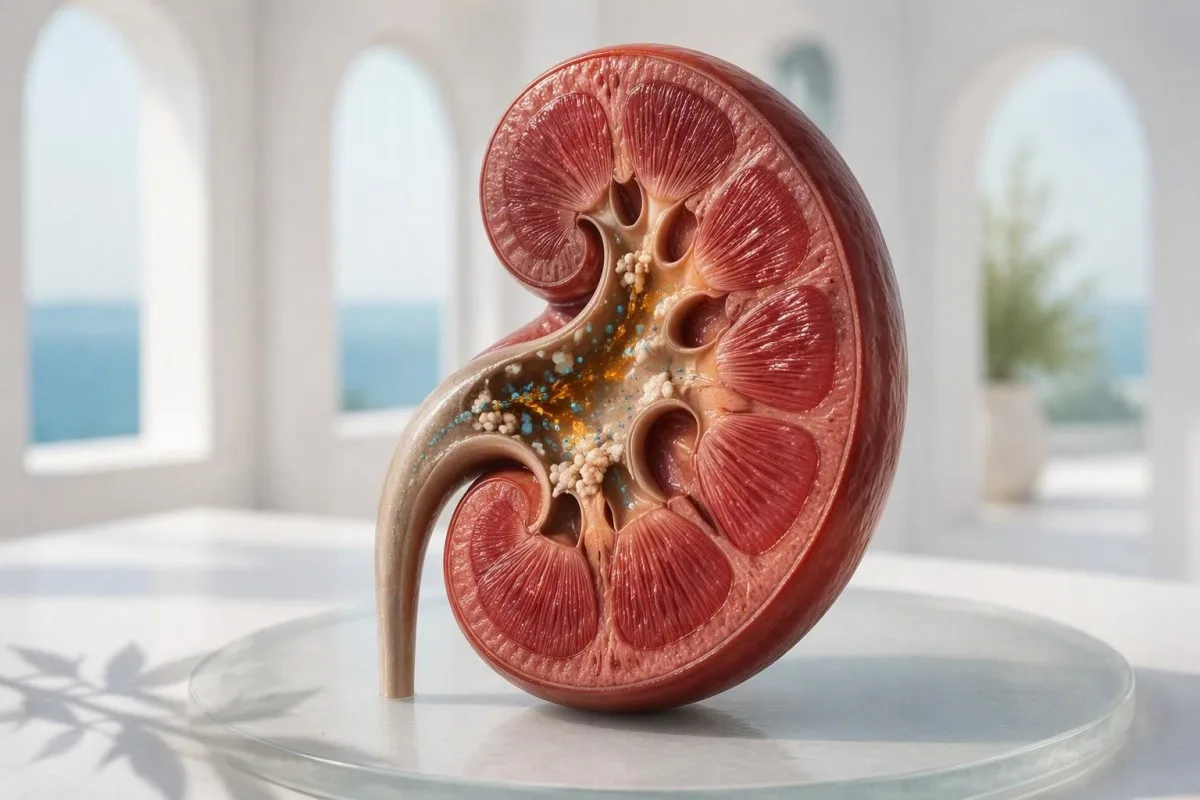
A low citrate result is a modifiable kidney-stone risk factor, not a diagnosis on its own. The useful next step is to interpret it alongside urine volume, pH, calcium, sodium, oxalate, and your stone history.


- Hypocitraturia usually means urine citrate below 320 mg per 24 hours, although laboratory and sex-specific targets vary.
- Sitrat urin sing kurang raises calcium stone risk because citrate binds free urinary calcium and slows crystal growth.
- A practical target for recurrent calcium stone formers is often at least 600 mg citrate per day, interpreted with urine volume and pH.
- Potassium citrate is commonly prescribed at 30–60 mEq daily in divided doses; it requires potassium and kidney-function monitoring.
- Dietary alkali from fruits and vegetables can raise citrate, while very high animal-protein intake, sodium excess, and low potassium intake can lower it.
- Diare kronis and distal renal tubular acidosis are high-yield causes because they produce acid retention and urinary alkali loss.
- Collection quality matters: a low 24-hour creatinine for body size can signal an incomplete collection and make citrate results unreliable.
- Penilaian sing mendesak is needed for fever with flank pain, persistent vomiting, inability to pass urine, or one functioning kidney with suspected obstruction.
What a Low Urine Citrate Result Actually Means
Low urine citrate, called hypocitraturia, means the urine contains too little citrate to restrain calcium crystal formation. In adults, many stone laboratories define hypocitraturia as less than 320 mg in a 24-hour collection; for a person with recurrent calcium stones, I generally want to see a value nearer 600 mg per day or above, provided urine pH is not already too high.
Citrate is a naturally occurring urinary anion made partly from diet and regulated by the kidney tubules. It complexes with calcium, reducing the amount of free calcium available to combine with oxalate or phosphate. A result of 180 mg per day is not simply a dietary score; it is a measurable change in urinary chemistry that can make a familiar calcium oxalate stone environment more permissive.
The number needs a denominator: a 24-hour urine citrate result from a 900 mL collection means something different from the same citrate excretion in 2.8 L of urine. Low volume concentrates every stone-forming solute, which is why the pengumpulan urin 24 jam should be read before assuming the biology is abnormal.
As of September 20, 2026, I still see patients told that a low result means they should drink lemonade and move on. That advice can be reasonable for a modest shortfall, but it misses acid-base disorders, bowel disease, medication effects, and incomplete collections. Thomas Klein, MD, would treat the result as a clue that needs a pattern-based review rather than a standalone diagnosis.
24-Hour Urine Citrate Test Ranges and Treatment Targets
A 24-hour urine citrate test is usually considered low below 320 mg per day, but a preventive treatment target is often higher than the laboratory lower limit. Several laboratories use sex-specific reference intervals, and the most meaningful target depends on stone composition and urine pH.
A useful clinical benchmark is citrate above 450 mg per day for many women and above 550 mg per day for many men, although these are not universal diagnostic cutoffs. The American Urological Association guideline emphasizes using the complete metabolic profile rather than treating one reference interval as a finish line (Pearle et al., 2014).
For recurrent calcium oxalate stones, I often discuss a working target of at least 600 mg per day when it can be achieved without pushing urine pH too far upward. In calcium phosphate stone formers, sustained urine pH above about 6.8 can increase phosphate supersaturation, so more alkali is not automatically better; see our explanation of urine pH patterns.
Kantesti iku sawijining Analisa tes getih AI that can place serum bicarbonate, potassium, calcium, creatinine, and glucose beside a stone-risk panel, but a urine citrate result itself still requires the ordering clinician's interpretation. That distinction matters, because normal serum tests do not exclude a clinically relevant low urinary citrate value.
Why reference intervals differ
Citrate assays and reference populations differ between laboratories, and citrate excretion also tracks body size, diet, and collection quality. A laboratory flag is useful, but the stone-prevention question is whether the measured citrate is adequate for that person's calcium, oxalate, urine volume, and pH profile.
Why Citrate Protects Against Calcium Kidney Stones
Citrate lowers low citrate kidney stone risk by binding urinary calcium and by directly slowing calcium oxalate crystal nucleation, growth, and aggregation. It is particularly relevant for calcium oxalate stones, which account for roughly 70% to 80% of kidney stones in many adult series.
Chemically, citrate forms soluble calcium-citrate complexes, reducing calcium ion activity rather than merely changing the total calcium number. This is why a person can have normal urine calcium, around 150 mg per day, and still form stones when citrate is 150 mg per day and urine volume is low.
Citrate also creates a less favorable surface for calcium oxalate crystals to stick together. That second effect is easy to overlook: a patient may improve citrate from 220 to 480 mg per day without any visible change in serum calcium, yet their supersaturation calculation can fall materially.
The AUA guideline recommends potassium citrate for recurrent calcium stone formers with low or relatively low urinary citrate (Pearle et al., 2014). In my practice, the combination that concerns me most is citrate below 250 mg per day plus urine volume below 1.5 L per day; together they often explain recurrence better than either finding alone. The companion article on kristal kalsium oksalat explains why a routine urinalysis cannot quantify this risk.
Could an Incomplete Collection Cause a Low Citrate Result?
Yes—an incomplete or improperly timed 24-hour collection can falsely lower urine citrate, calcium, sodium, oxalate, and total volume together. Before changing medication, clinicians should compare measured urine creatinine with expected daily creatinine excretion for the person's size and muscle mass.
Most laboratories use 24-hour creatinine as a plausibility check, not a perfect lie detector. Roughly 15–20 mg/kg per day in women and 20–25 mg/kg per day in men is often expected, but age, frailty, vegetarian diet, muscularity, and amputation shift that estimate substantially.
A 62-kg woman whose urine creatinine is 450 mg per day may have an incomplete collection, whereas that same value in an older sarcopenic patient may be plausible. One missing morning or post-workout void can meaningfully change a citrate result because excretion varies over the day.
I ask patients to collect on an ordinary workday, maintain their usual food and fluid pattern, and record any missed samples rather than quietly guessing. Review urine creatinine and dilution before interpreting an unexpectedly extreme result; repeating two collections is often more informative than repeating one.
Dietary Causes of Hypocitraturia
The most common dietary hypocitraturia causes are a high net acid load from animal protein, low fruit and vegetable intake, potassium-poor diets, and low fluid intake. The kidney reabsorbs more citrate during acid stress because citrate can be metabolized to generate bicarbonate.
Animal protein is not forbidden for stone formers, but very high intakes can lower urine pH and citrate while increasing uric acid. A practical first review is portion size: consuming 250–350 g of meat daily while eating few plants can create a substantially different urinary profile than a mixed diet with 75–100 g of protein spread across meals.
Citrus contains citrate, yet the form matters. Lemon and lime juice contain abundant citric acid, but not every commercial lemonade provides meaningful alkali because sugar, dilution, and the accompanying cation alter the effect. Unsweetened lemon juice may help fluid intake, while potassium-rich produce usually has a more dependable alkali effect.
Kantesti iku sawijining platform interpretasi hasil tes getih AI that helps users connect serum potassium, bicarbonate, uric acid, and kidney-function results with dietary patterns, rather than claiming that one food fixes a stone disorder. For realistic meal changes, our kidney nutrition safety guide also covers when potassium-rich foods need supervision in chronic kidney disease.
Metabolic and Gut Conditions That Lower Urine Citrate
Chronic diarrhea, inflammatory bowel disease, bowel resection, malabsorption, and distal renal tubular acidosis can cause marked hypocitraturia through bicarbonate loss or sustained acid retention. These causes deserve more attention than diet alone because they can drive recurrent stones despite good hydration.
With chronic loose stools, bicarbonate is lost through the gastrointestinal tract; the kidneys respond by reclaiming citrate, often lowering urine citrate well below 200 mg per day. Fat malabsorption adds a separate calcium oxalate risk because unbound oxalate becomes more available for intestinal absorption.
Distal renal tubular acidosis, especially incomplete distal RTA, classically produces a pattern of urine pH persistently above 5.5, low citrate, calcium phosphate stones, and sometimes low serum bicarbonate. Serum CO2 below 22 mmol/L or potassium below 3.5 mmol/L strengthens the case, but incomplete forms can have normal routine bicarbonate between episodes; our renal tubular acidosis overview explains the work-up.
Sjögren syndrome is one autoimmune condition clinicians consider when distal RTA appears, particularly with dry eyes, dry mouth, low potassium, or recurrent calcium phosphate stones. The association is real but not common enough to screen everyone with a citrate of 290 mg per day; targeted review is more sensible, as discussed in our Sjögren testing article.
Medicines and Supplements Linked to Low Citrate
Carbonic anhydrase inhibitors such as topiramate and acetazolamide are classic medication causes of low urine citrate because they alter renal bicarbonate handling. Potassium-wasting diuretics, chronic laxative use, and poorly managed diarrhea can also lower citrate indirectly.
Topiramate can raise urine pH, lower citrate, and increase calcium phosphate stone risk; this is a recognizable pattern rather than a reason to stop an effective neurological medicine without advice. In a patient taking 100 mg twice daily for migraine, I would ask about stone history before treatment and repeat urine chemistry after dose changes or a first stone.
Acetazolamide has a similar acid-base effect, while loop diuretics can increase urinary calcium and thiazides can lower potassium, potentially worsening hypocitraturia if potassium is not replaced. Prescription potassium citrate sometimes offsets this, but serum potassium and creatinine must guide the decision.
Supplements can confuse the picture. High-dose vitamin C, often 1,000 mg daily or more, may increase urinary oxalate in susceptible people rather than correcting low citrate; review our evidence-based kidney supplement safety notes. Never discontinue seizure, glaucoma, or diuretic medication based solely on a home interpretation.
How to Read Citrate With the Rest of a Stone-Risk Panel
Low urine citrate is most actionable when interpreted with urine volume, calcium, oxalate, sodium, uric acid, pH, and supersaturation. A citrate value of 280 mg per day carries more risk when paired with 2.8 L of urine calcium or high oxalate supersaturation than when all other values are favorable.
Urine volume is usually the first lever: many stone clinics aim for at least 2.0–2.5 L of urine daily, which commonly requires about 2.5–3.0 L of fluid intake depending on heat and activity. A marathon runner or outdoor worker may need considerably more, and a pale urine color alone does not prove a 24-hour target was met.
Urine sodium above 100 mmol per day often signals an intake that will make hypercalciuria harder to control; sodium-driven calcium excretion can overwhelm a modest improvement in citrate. Urine oxalate above 40 mg per day points toward diet, malabsorption, vitamin C use, or less commonly a primary metabolic disorder.
Kantesti kang Piranti analisis tes getih berbasis AI can identify related serum clues such as high calcium, low bicarbonate, impaired eGFR, or high uric acid, but it cannot determine stone composition from blood alone. Pair the urine panel with a stone analysis whenever one is available and read the petunjuk ginjel panel metabolisme dhasar in that context.
Food and Fluid Steps That Can Raise Urinary Citrate
Increasing fruits and vegetables, reducing excessive sodium and animal-protein load, and producing at least 2 to 2.5 L of urine daily are the safest first measures for mild low urine citrate. These changes should be individualized for people with diabetes, advanced kidney disease, heart failure, or potassium restrictions.
I favor an addition plan over a deprivation plan: add two servings of fruit and three servings of vegetables most days, then reduce the foods displacing them. Melon, bananas, potatoes, beans, squash, leafy greens, oranges, and many legumes provide potassium precursors that tend to generate alkali after metabolism.
Use fluid scheduling rather than thirst alone. A 500 mL drink with breakfast, lunch, dinner, and evening, plus 250–500 mL around exercise, is easier for most patients than carrying an enormous bottle and forgetting it. The goal is measured urine output, not heroic single-day water intake.
Calcium should usually remain in the diet at roughly 1,000–1,200 mg daily with meals; cutting calcium too low can increase intestinal oxalate absorption. People often confuse a calcium oxalate stone with a need for zero calcium, so our guide to stone-related urine crystals is useful before making major dietary restrictions.
When Potassium Citrate Treatment Is Used
Potassium citrate is commonly used for recurrent calcium stones with hypocitraturia, usually starting around 30–60 mEq daily in two or three divided doses. The dose is adjusted to urine citrate, urine pH, tolerance, serum potassium, and kidney function—not simply to eliminate a laboratory flag.
Extended-release tablets are often taken with meals to reduce upper gastrointestinal upset. A clinician may start at 10–20 mEq two or three times daily, then repeat a 24-hour urine study after about 8–12 weeks; doses above 100 mEq per day are uncommon and need careful oversight.
A 2015 Cochrane review found citrate salts reduced recurrent calcium-containing stone events, although the underlying trials varied in quality and treatment adherence was a recurring problem (Phillips et al., 2015). The evidence supports treatment, but it does not tell us that every borderline value requires a prescription.
Potassium citrate is not casual supplementation. It can be unsafe with eGFR below 30 mL/min/1.73 m², baseline hyperkalemia, potassium-sparing diuretics, ACE inhibitors, ARBs, or severe delayed gastric emptying unless the prescriber judges benefits and monitoring appropriate. Our pandhuan gejala eGFR sing kurang explains why kidney reserve changes medication choices.
When Low Citrate Needs Urology or Nephrology Follow-Up
Specialist follow-up is appropriate after recurrent stones, bilateral stones, a first stone before age 25, calcium phosphate stones, marked hypocitraturia below 100 mg daily, impaired kidney function, or a suspected systemic cause. One uncomplicated first calcium oxalate stone with citrate of 290 mg per day can often begin with primary-care review and a repeat collection.
A urologist can confirm stone type, assess anatomy and obstruction, and decide whether imaging or preventive medication is needed. A nephrologist is particularly valuable when low citrate accompanies metabolic acidosis, potassium abnormalities, reduced eGFR, uncontrolled hypertension, or concern for renal tubular disease.
Thomas Klein, MD, has seen a recurring pattern in stone clinics: patients with three “ordinary” stones over five years are sometimes reassured repeatedly because creatinine is normal. Normal creatinine does not rule out a preventable urine chemistry disorder, particularly in smaller adults or people with preserved filtration despite recurrent obstruction.
Bring the actual 24-hour report, stone analysis, medication list, and a 3-day food record to the appointment. If you use algorithm-assisted interpretation, check how clinical safeguards are applied; our standar validasi medis describe why results should trigger clinician discussion rather than replace it.
Low Citrate in Pregnancy, Children, and Chronic Kidney Disease
Low urine citrate in pregnancy, children, or chronic kidney disease needs individualized assessment because standard adult stone-prevention targets and potassium citrate dosing may not apply. Pregnancy changes filtration and urinary mineral handling, while children require weight-based dosing and an inherited-disorder review.
In children with recurrent stones, clinicians look more carefully for cystinuria, primary hyperoxaluria, bowel disorders, and inherited tubular conditions. A single low citrate value can follow a difficult collection day, so pediatric metabolic testing is often repeated with specialist support before labeling a child with a chronic disorder.
Pregnancy does not make flank pain benign. Hydronephrosis can be physiologic, but fever, escalating pain, or reduced urine output needs urgent obstetric and urologic assessment; see our guide to pregnancy kidney filtration changes for context around blood tests.
In chronic kidney disease, dietary potassium increases and potassium citrate may be appropriate for selected patients but can also produce dangerous hyperkalemia. A serum potassium above 5.0 mmol/L, rising creatinine, or use of a renin-angiotensin system blocker warrants prescriber-led planning rather than a generic citrus or supplement protocol.
Symptoms That Need Urgent Care Rather Than a Diet Change
Fever or chills with flank pain, vomiting that prevents fluid intake, inability to pass urine, confusion, or pain in a person with one kidney requires urgent medical assessment. A stone plus urinary obstruction can become an infected obstructed system, which is a time-sensitive emergency even when the urine citrate result is old or incidental.
Seek same-day emergency care for a temperature of 38.0°C or higher with suspected renal colic, especially if there is shaking, weakness, or rapid heart rate. Pain intensity alone is unreliable: a small ureteral stone can hurt severely, while a more dangerous obstructing stone may intermittently hurt less.
Visible blood in urine can occur with a stone, but persistent hematuria still needs assessment after the acute episode resolves. Smoking history, age over 35–40, unexplained weight loss, or repeated blood without documented stones broadens the evaluation; our getih ing urin explains the usual testing pathway.
Do not use leftover antibiotics, high-dose sodium bicarbonate, or unlimited potassium supplements to self-treat a suspected stone. If you have diabetes, immunosuppression, a solitary kidney, pregnancy, or known CKD, the threshold for urgent assessment should be lower.
A Practical 90-Day Plan After a Low Citrate Result
After a reliable low citrate result, the usual next step is to address fluid, diet, medications, and possible acid-base causes, then repeat a 24-hour urine panel in about 8 to 12 weeks. A repeat test should be done on the plan you can actually sustain, not during an unusually strict “perfect week.”
First, confirm collection completeness and obtain stone analysis if a specimen exists. Second, aim for urine output of at least 2.0–2.5 L daily, add plant-based potassium sources if medically safe, moderate sodium, and review medication contributors with the prescriber. Third, check serum bicarbonate, potassium, calcium, creatinine/eGFR, and uric acid when the clinical picture suggests an underlying disorder.
At the repeat test, compare citrate, volume, pH, sodium, calcium, oxalate, uric acid, and supersaturation rather than celebrating one improved number. For example, citrate rising from 180 to 520 mg per day is encouraging, but a simultaneous urine pH of 7.1 in a calcium phosphate stone former calls for a different conversation.
Kantesti, sawijining layanan interpretasi tes lab AI, can organize the blood-side trends and generate questions for your clinician across 75+ languages, while the stone-risk panel remains a specialist-guided urine test. Our dewan penasehat medis reviews the clinical principles behind these safety boundaries; treatment decisions belong with the clinician who knows your stone type, medicines, and kidney function.
Pitakonan sing Sering Ditakoni
Tingkat sitrat urin sing dianggep kurang iku pira?
Sitrat urine sangisore 320 mg saben 24 jam lumrahe diarani hipositraturia ing wong diwasa, sanajan laboratorium individu nggunakake interval referensi sing beda. Kanggo pencegahan watu kalsium sing bola-bali, akeh klinisi ngarahake paling ora 600 mg saben dina nalika pH urine lan jinis watu ngidini. Asil 200–319 mg saben dina asring minangka kekurangan sing entheng lan bisa diowahi, dene nilai sangisore 100 mg saben dina mbutuhake panelusuran sing luwih jero kanggo retensi asam kronis, mundhut usus, efek obat, utawa kesalahan koleksi. Asil kudu tansah diwaca bebarengan karo volume urine, pH, kalsium, oksalat, natrium, lan komposisi watu.
Apa sitrat urin sing sithik bisa nyebabake watu ginjel?
Cithrat urin sing endhek nambah risiko watu ginjel kalsium amarga cithrat ngiket kalsium bebas lan ngurangi pertumbuhan lan gumpalan kristal kalsium oksalat. Iki minangka faktor risiko tinimbang jaminan: sawetara wong kanthi cithrat kurang saka 320 mg saben dina ora nate ngasilake watu, nalika wong liya ngasilake watu amarga cithrat sing endhek gabung karo volume urin sing endhek, oksalat sing dhuwur, utawa kalsium urin sing dhuwur. Risiko asring paling dhuwur nalika cithrat kurang saka 250 mg saben dina lan output urin kurang saka 1,5 L saben dina. Analisis watu lan panel urin 24 jam sing lengkap nemtokake kombinasi endi sing ditrapake.
Apa jus lemon ngunggahake sitrat urin?
Jus lemon utawa jeruk nipis tanpa pemanis bisa mbantu sawetara wong nambah asupan cairan lan bisa mbantu kimia urin, nanging ora bisa ngatasi hipocitraturia sing signifikan kanthi andal. Jus jeruk ngandhut asam sitrat, dene kalium sitrat nyedhiyakake beban alkali sing luwih bisa ditebakake nambah sitrat urin. Pendekatan panganan dhisik sing praktis yaiku nambah woh-wohan lan sayuran nalika ngasilake paling ora 2,0–2,5 L urin saben dina, kajaba dhokter wis ngwatesi cairan utawa kalium. Lemonade manis dudu perawatan watu ginjel lan bisa nambah risiko metabolisme nalika dikonsumsi kanthi rutin.
Obat-obatan apa waé sing bisa nurunaké sitrat urin?
Topiramate lan acetazolamide minangka sabab sing dingerteni banget saka sitrat urin sing kurang amarga ngowahi penanganan bikarbonat ginjel lan bisa nambah pH urin. Diuretik loop bisa nambah kalsium urin, nalika diuretik sing mbuwang kalium bisa nyumbang kanthi ora langsung nalika mudhunake kalium serum. Panggunaan laxative kronis lan obat-obatan sing nyebabake diare terus-terusan uga bisa nyuda sitrat liwat mundhut bikarbonat gastrointestinal. Aja mandhegake obat sing diresepake amarga asil sitrat; takon marang sing menehi resep manawa tes urin maneh, penggantian kalium, utawa terapi pencegahan cocog.
How long does potassium citrate take to work?
Potassium citrate begins changing urine pH and citrate excretion within days, but clinicians commonly reassess the full 24-hour urine profile after 8–12 weeks on a stable dose. Typical starting doses are 30–60 mEq per day divided with meals, then adjusted according to urine citrate, pH, serum potassium, and kidney function. The aim is not the highest possible citrate value, because urine pH above about 6.8 may be counterproductive for calcium phosphate stone formers. Gastrointestinal side effects and potassium elevation are the main practical reasons dosing may need adjustment.
When should I see a kidney stone specialist for low citrate?
See a urologist or nephrologist for recurrent stones, bilateral stones, stones before age 25, calcium phosphate stones, low citrate below 100 mg per day, reduced eGFR, low serum bicarbonate, or potassium abnormalities. Specialist assessment is also sensible after bowel surgery, chronic diarrhea, or use of topiramate when stones recur. Fever of 38.0°C or higher with flank pain, vomiting, inability to urinate, or symptoms in a person with one kidney requires urgent care rather than a routine specialist appointment. A first uncomplicated stone with mildly low citrate can often start with primary-care review and a repeat collection.
Entuk Analisis Tes Getih Berbasis AI Dina Iki
Gabung karo luwih saka 2 yuta pangguna ing saindenging jagad sing percaya Kantesti kanggo analisis tes lab sing instan lan akurat. Unggah asil tes getihmu lan tampa interpretasi lengkap saka 15,000+ biomarker sajrone sawetara detik.
📚 Publikasi Riset sing Dirujuk
Klein, T., Mitchell, S., & Weber, H. (2026). Klein, T. (2026). BUN/Creatinine Ratio Explained: Kidney Function Test Guide. Zenodo. DOI: 10.5281/zenodo.18207872. Riset Medis AI Kantesti.
Klein, T., Mitchell, S., & Weber, H. (2026). Klein, T. (2026). Urobilinogen in Urine Test: Complete Urinalysis Guide 2026. Zenodo. DOI: 10.5281/zenodo.18226379. Riset Medis AI Kantesti.
📖 Referensi Medis Eksternal
⚕️ Penafian Medis
Artikel iki mung kanggo tujuan edukasi lan ora dadi saran medis. Tansah konsultasi karo panyedhiya layanan kesehatan sing mumpuni kanggo keputusan diagnosis lan perawatan.
Sinyal Kepercayaan E-E-A-T
Pengalaman
Tinjauan klinis sing dipimpin dokter babagan alur kerja interpretasi lab.
Keahlian
Fokus kedokteran laboratorium babagan carane biomarker tumindak ing konteks klinis.
Kewibawaan
Ditulis dening Dr. Thomas Klein kanthi ditinjau dening Dr. Sarah Mitchell lan Prof. Dr. Hans Weber.
Kapercayan
Interpretasi adhedhasar bukti kanthi tindak lanjut sing cetha kanggo nyuda rasa kaget.