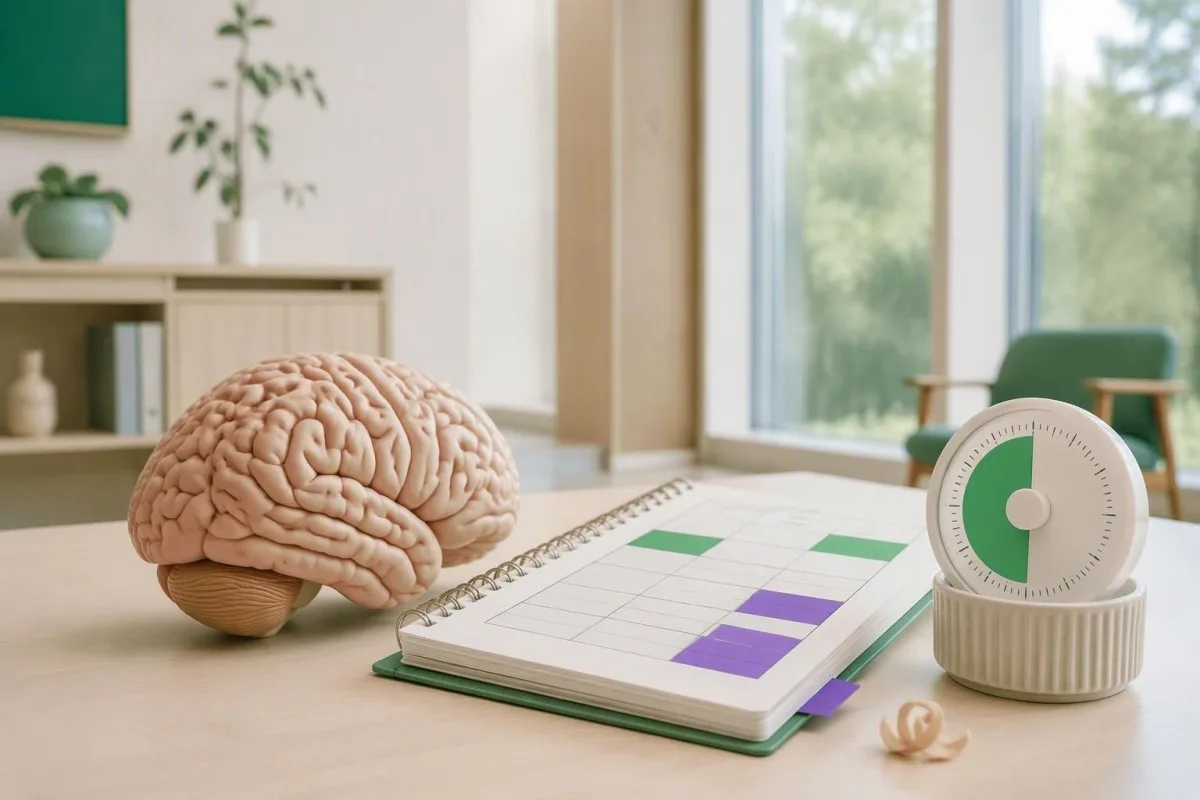
Adult ADHD involves persistent inattention and/or hyperactivity-impulsivity, with several symptoms beginning before age 12 and difficulties affecting at least 2 settings. Time blindness and disorganization can be clues, but recent concentration problems may reflect poor sleep, stress, illness or medication. Diagnosis requires a clinical assessment; bloodwork cannot confirm or exclude ADHD.


- Adult diagnostic threshold under DSM-5-TR is at least 5 of 9 symptoms in either diagnostic domain for people aged 17 or older, alongside the other diagnostic requirements.
- Developmental history must support several symptoms before age 12; recognizing ADHD at 42 is different from symptoms first appearing at 42.
- Persistence and impairment matter: symptoms generally persist for at least 6 months, occur in at least 2 settings and interfere with functioning.
- Time blindness describes difficulty estimating time and managing transitions; it is not a separate diagnostic criterion or a measurable blood abnormality.
- Sleep assessment belongs in the workup: most adults need roughly 7–9 hours, but adequate time in bed does not exclude sleep apnea or another sleep disorder.
- Screening questionnaires identify people who may need assessment; even the 6-item ASRS screener cannot establish an adult ADHD diagnosis alone.
- Targeted bloodwork may investigate contributors such as thyroid disease, iron deficiency or vitamin B12 deficiency; there is no diagnostic ADHD blood-test cutoff.
- Vitamin B12 context matters: NICE NG239 classifies total B12 of 180–350 ng/L as indeterminate, requiring interpretation alongside symptoms and risk factors.
- Immediate action is needed for sudden confusion, new weakness, difficulty speaking or a seizure—not a routine ADHD appointment.
What makes adult ADHD symptoms more than ordinary distraction?
ADHD symptoms in adults are a persistent pattern of inattention and/or hyperactivity-impulsivity that interferes with functioning, rather than occasional distraction. The diagnostic story includes several symptoms before age 12, symptoms across at least 2 settings and difficulties not better explained by another condition.
Under DSM-5-TR, adults aged 17 or older need at least 5 symptoms in the inattentive domain, the hyperactive-impulsive domain, or both; symptoms must persist for at least 6 months. Five checked boxes are not enough, because the clinician must establish impairment, developmental onset and alternative explanations rather than simply count complaints.
The useful distinction is not whether you ever lose your keys, but whether a recurring pattern creates consequences across 2 or more settings: late bills at home, missed handovers at work or repeated interruptions in relationships. NICE NG87 recommends a full clinical, psychosocial and developmental assessment rather than diagnosis from a rating scale alone (NICE, 2018).
I’m Dr. Thomas Klein, Chief Medical Officer at Kantesti egyesült királyságbeli szervezetének; my priority here is separating developmental symptoms from treatable medical contributors. Kantesti is an AI blood test analyzer that can help explain laboratory findings, but no result can establish ADHD; our discussion of csökkent motiváció orvosi okairól szóló ismertetőnk addresses a different part of that assessment.
How do inattention and disorganization show up in adult life?
Adult inattentive symptoms often appear as difficulty starting, sequencing and finishing tasks—not an inability to pay attention to anything. A person may manage an engaging 90-minute project while repeatedly failing to complete a 5-minute administrative task, although that contrast alone does not diagnose ADHD.
Executive difficulties can involve losing track of an intention when another task intervenes: opening a banking app, answering a message and forgetting the payment entirely. Ask whether the problem involves remembering information, remembering to act, or sequencing 3 required steps; these are different difficulties, and a clinician should not automatically label all of them memory loss.
Consider a hypothetical 36-year-old who performs well during emergencies but needs a partner to manage appointments, bills and household supplies. That dependence may conceal impairment rather than prove its absence, especially if the arrangement consumes several hours each week; assessment should examine the support required, not just the final outcome.
Externalizing 1 next action—rather than writing an ambitious list of 20 tasks—can reduce the burden of holding a sequence in mind. A visible tray for unfinished paperwork may help more than another supplement; our review of supplements marketed for memory explains why cognitive complaints do not automatically justify a nutritional treatment.
What is time blindness, and does it point to ADHD?
Time blindness is an informal description of difficulty estimating elapsed time, anticipating deadlines and switching activities at the right moment. Repeatedly treating a 40-minute journey as a 15-minute journey can support an executive-function concern, but time blindness is neither a standalone ADHD criterion nor specific to ADHD.
Late arrival often reflects a chain of underestimated transitions rather than one inaccurate estimate: finishing work, finding keys, getting ready and traveling. For 7 days, record predicted and actual times for the same routine; a consistent gap is more informative for planning than the broad statement that you are always late.
Hyperfocus can make transitions difficult because an absorbing activity crowds out awareness of other obligations; it does not rule out ADHD, and it is not a formal diagnostic symptom. A 2-hour stretch of uninterrupted gaming or research says little about whether someone can regulate attention when the task is boring, interrupted or emotionally uncomfortable.
A timer should mark when to change activity, not merely when an appointment begins; allowing separate preparation and departure cues often makes a schedule more usable. After travel across 3 time zones, however, a disrupted body clock may temporarily worsen attention and timing, so consider the context described in our jet lag and testing guide before assuming a developmental explanation.
Can adult ADHD look restless or emotionally reactive?
Adult hyperactivity may appear as internal restlessness, excessive talking, difficulty waiting or a constant need to stay occupied rather than obvious running around. Impulsivity includes interrupting, acting without considering consequences and difficulty taking turns; assessment counts these within the 9-symptom hyperactive-impulsive domain.
An adult who stays outwardly still may describe 3 competing urges during a meeting: speaking immediately, checking a message and moving on to the next task. The clinician asks about the frequency and consequences of these experiences, because subjective busyness also occurs with anxiety, sleep loss and demanding work.
Emotional dysregulation and sensitivity to criticism can accompany ADHD, but neither is sufficient for diagnosis, and rejection sensitivity is not a separate DSM-5-TR ADHD criterion. Brief frustration after an interruption differs from a distinct episode lasting several days with unusually elevated mood, increased activity and reduced need for sleep; that pattern warrants assessment for bipolar disorder.
A 2-week record of triggers, duration, sleep and behavior can help separate rapid reactions from sustained mood episodes, without treating the diary as a diagnostic test. Our guide to medical contributors to mood swings explains the narrower role of laboratory investigation when emotional changes accompany physical symptoms.
Why can lifelong ADHD remain undiagnosed until adulthood?
Signs of undiagnosed ADHD may remain hidden when family structure, strong ability or unusually intensive effort compensates for symptoms. A diagnosis at age 45 can be valid, but the assessment should find evidence of several symptoms before age 12 rather than assume that recently noticed symptoms began recently.
Childhood evidence can include unfinished homework, lost equipment, excessive talking or needing repeated supervision—not just poor grades. A report card describing 2 relevant behaviors may help, but missing records or unavailable parents should not automatically prevent assessment; clinicians weigh the consistency and detail of the developmental account.
Masking and compensation can carry a substantial cost even when visible performance looks good: arriving 30 minutes early to avoid lateness, working through evenings or depending on rigid routines. NICE NG87 notes that ADHD can be under-recognized in girls and women (NICE, 2018), and quiet inattentive symptoms deserve the same careful assessment as more disruptive behavior.
Hormonal transitions may alter sleep, mood and perceived executive difficulties, but a new concentration problem at 48 still requires an alternative-cause assessment. At Kantesti, we treat hormone results as contextual findings, not ADHD evidence; our hormonal symptoms and menopause guide explains why a single laboratory value cannot reconstruct a lifelong attention pattern.
How can poor sleep imitate or worsen ADHD symptoms?
Sleep deprivation, sleep apnea and circadian disruption can impair attention, working memory and impulse control, making them important ADHD alternatives or coexisting conditions. Most adults need roughly 7–9 hours of sleep, but spending 8 hours in bed does not guarantee restorative sleep.
A sleep history should cover snoring, witnessed pauses, waking headaches, irregular schedules and daytime sleepiness—not just bedtime. Obstructive sleep apnea can occur without obesity; if someone repeatedly dozes during 20-minute meetings or while driving, the immediate issue is sleep-related safety and assessment, not whether they also identify with ADHD descriptions.
Narkolepszia may be mistaken for poor attention when the underlying problem is irresistible sleepiness, sometimes accompanied by emotion-triggered muscle weakness. Clinicians may use overnight sleep studies followed by a multiple sleep latency test, commonly involving 5 nap opportunities; our narcolepsy assessment guide explains preparation and why insufficient sleep can distort interpretation.
A 2-week sleep diary can reveal whether concentration tracks shift changes or late nights, although improvement after better sleep does not exclude coexisting ADHD. Some laboratory results also vary with sleep and sampling circumstances; our guide to rossz alvást követő eredményekhez separates those effects from the clinical diagnosis.
How do stress, anxiety and depression differ from ADHD?
Stress, anxiety and depression can all cause concentration problems, but their timing and accompanying symptoms often differ from developmental ADHD. A clear deterioration over 3 months after bereavement, burnout or a depressive episode deserves assessment on its own terms, even when an ADHD screening questionnaire is positive.
Anxiety-related inattention may involve attention repeatedly returning to a threat or worry, whereas depressive concentration problems often accompany low mood, reduced pleasure and slowed thinking. Clinicians ask what occupies the mind during a 10-minute failed task; the mechanism is more informative than the shared description of being unable to focus.
ADHD and mood disorders can coexist, so finding 1 plausible explanation does not end the assessment. Our article on bloodwork for low mood covers selected medical contributors, but neither depression nor ADHD can be confirmed by a routine laboratory panel.
A 2-week comparison of concentration, mood, sleep and workload can reveal useful associations, not prove causation. Sudden confusion, new weakness, difficulty speaking, a seizure or thoughts of self-harm with immediate danger require urgent help; a rapid neurological or psychiatric change should never be normalized as ordinary ADHD distractibility.
Which medicines and substances can affect concentration?
Sedating medicines, anticholinergic medicines and substance effects can impair alertness or memory and may resemble ADHD symptoms. A concentration change beginning within 2 weeks of starting a medicine or increasing its dose makes a medication review especially useful, although timing alone does not establish the cause.
First-generation antihistamines, benzodiazepines, some sleep medicines, opioids and certain antiseizure medicines can affect cognition; individual responses vary. Write down the dose in mg, time taken and whether symptoms peak 1–4 hours afterward, but do not abruptly stop prescribed treatment—withdrawal, seizures or recurrence of the underlying illness can be dangerous.
Gyógyszeres kezelés monitorozása is specific to the drug and clinical circumstances, not a universal attention panel. Lithium treatment may require kidney, thyroid and calcium assessment alongside lithium levels; our lítium monitorozási útmutatónkat explains why a treatment-related thyroid problem can add fatigue and cognitive complaints without proving ADHD.
Alcohol, cannabis, caffeine excess and withdrawal can complicate both sleep and attention; disclose use honestly rather than trying to present a perfect assessment history. For a 70-year-old taking several medicines, new cognitive symptoms call for particular care with interactions and anticholinergic burden, as explained in our idősebb felnőttek gyógyszerhatásairól megbeszélés.
When can thyroid testing help explain poor concentration?
Pajzsmirigy-vizsgálat may help when concentration problems accompany fatigue, cold intolerance, weight change, constipation, tremor or palpitations. A typical adult TSH reference interval is approximately 0.4–4.0 mIU/L, but laboratories differ, and no TSH result confirms ADHD or establishes the cause of brain fog by itself.
a TSH-t és a szabad T4-et are interpreted together when investigating thyroid dysfunction; elevated TSH with low free T4 generally supports primary hypothyroidism. A TSH of 7 mIU/L with normal free T4 has a different meaning from the same TSH with low free T4, as our thyroxine and TSH explanation leírja.
A mildly abnormal thyroid result does not automatically explain every attention complaint, and treating it does not guarantee that longstanding organizational difficulties disappear. Whether to treat szubklinikus hypothyreosis depends on factors such as repeated results, symptoms, age and pregnancy status; our subclinical hypothyroidism treatment guide explains why a TSH above 10 mIU/L often changes the discussion.
Kantesti is an AI lab test interpretation service that can contextualize thyroid findings, including reference intervals and related results, without converting them into an ADHD verdict. When considering a TSH result of 5.2 mIU/L, my first questions concern free T4, prior measurements, illness and medication—not whether this number explains a 20-year history of missed deadlines.
Can iron or vitamin B12 deficiency contribute to brain fog?
Iron deficiency and vitamin B12 deficiency can contribute to fatigue or cognitive complaints and may deserve targeted testing when the history suggests them. Ferritin below approximately 15 µg/L strongly supports depleted iron stores in otherwise healthy adults, but neither low ferritin nor low B12 is an ADHD biomarker.
Iron deficiency can exist before anemia, so a normal hemoglobin does not guarantee adequate stores; ferritin may also rise during an inflammatory response and conceal depletion. A ferritin of 12 µg/L with persistent tiredness deserves a cause-focused discussion, including menstrual or gastrointestinal losses, as our early low-ferritin symptoms guide magyaráz.
NICE NG239 classifies total vitamin B12 below 180 ng/L, approximately 133 pmol/L, as confirmed deficiency, and 180–350 ng/L as an indeterminate result, while allowing validated local thresholds (NICE, 2024). Symptoms, diet, metformin use and absorption risks influence the next step; our határértékű B12 utánkövetési útmutató explains why neurological symptoms can matter even without anemia.
Testing is most useful when it answers a specific question: why is this person exhausted, developing tingling or losing iron repeatedly? Ferritin, transferrin saturation and the CBC may need combined interpretation, as our teljes vaskutatási útmutató describes; correcting a ferritin of 10 µg/L may improve fatigue, but it cannot retrospectively confirm or disprove childhood ADHD.
How does a clinician establish an adult ADHD diagnosis?
Adult ADHD diagnosis requires a clinician with appropriate ADHD training to evaluate current symptoms, developmental history, impairment and competing or coexisting conditions. NICE NG87 recommends assessment across everyday settings and explicitly rejects diagnosis from rating scales alone; symptoms in at least 2 settings form part of the diagnostic picture.
A structured interview may examine every symptom using both childhood and adult examples, then ask what the difficulties actually cost in time, money, safety or relationships. Missing 3 appointments because of organizational problems is different from missing them because transport was unavailable; the outward event does not establish its underlying cause.
Collateral information from a partner, sibling or parent can strengthen the assessment when available and shared with permission, but imperfect childhood recall is common. School records, employment patterns and detailed examples across 2 settings may help a clinician judge consistency; diagnosis should not depend on producing one particular document or having a relative willing to participate.
A person can need support while diagnostic uncertainty remains; the clinician may investigate sleep, adjust a relevant medicine or revisit the developmental history before reaching a conclusion. Kantesti’s technikai validálást és felügyeletet concern laboratory interpretation and its limitations, not proof that our AI can diagnose ADHD from a panel or a 6-item questionnaire.
What can ADHD questionnaires, blood tests and brain scans tell you?
Screening questionnaires can identify symptoms worth investigating, but blood tests, routine brain scans and genetic panels cannot independently establish ADHD. The 6-item Adult ADHD Self-Report Scale screener is a triage tool; its result must be interpreted alongside developmental history, impairment and alternative explanations.
Kessler and colleagues developed the WHO ASRS short screener for identifying adults who may need further evaluation (Kessler et al., 2005). The original 6-item version uses item-specific scoring, not a simple universal total; different ASRS versions should not be mixed, and a positive result during severe insomnia or anxiety still requires a clinical explanation.
Neuropsychological testing can clarify learning, memory or other cognitive concerns, but a normal attention task does not exclude ADHD, and poor performance does not prove it. Routine MRI or EEG is not an ADHD confirmation test; a 30-minute controlled task cannot reproduce every real-world demand, and feeling more focused after a stimulant is also not diagnostic.
Kantesti is an AI blood test interpretation platform that explains available laboratory findings rather than measuring attention, dopamine function or developmental history. Our mesterséges intelligencia értelmezési technológiai útmutatója elmagyarázza, hogyan súlyozza Kantesti neurális hálózata a szomszédos biomarkereket, a trend irányát és a belső konzisztenciát. A tapasztalatom szerint ez a legfontosabb a describes that workflow; there is no validated clinical blood-dopamine cutoff that turns a 6-month concentration complaint into an adult ADHD diagnosis.
What should you bring to an ADHD assessment, and what helps now?
Prepare for assessment with specific examples, a medication list, sleep information and any available childhood evidence—not a rehearsed diagnosis. A practical starting point is a 2-week record covering concentration, sleep, workload and consequences, with at least one example from home and one from work, study or relationships.
Write down 3 difficulties, what happens immediately before each one and what support currently prevents a worse outcome. For example, needing a partner to remind you about every payment is relevant even when no bills are overdue; documenting compensation helps the clinician avoid confusing successful scaffolding with effortless functioning.
Low-risk supports do not require a confirmed diagnosis: use one capture system for tasks, break work into a visible next action and set a separate transition cue before appointments. A 15-minute starting block is a practical experiment, not an ADHD treatment dose; measure whether it reduces missed tasks rather than expecting a perfect productivity streak.
My advice as Dr. Thomas Klein is to pursue assessment when persistent difficulties affect safety, work, study or relationships, while discussing sleep and medical contributors in parallel. At Kantesti, our orvosi tanácsadó csapatot supports understanding the limits of laboratory information; once treatment is considered, blood pressure, pulse, weight and relevant medical history deserve attention, and NICE does not recommend routine treatment blood tests without a clinical indication.
Research publications, clinical evidence and interpretation limits
ADHD guidance and validated screening research support this article’s diagnostic discussion; related laboratory publications do not establish an ADHD blood test. As of October 22, 2026, the 2 Figshare publications listed here are related reading on other health topics, not ADHD trials, diagnostic validation studies or substitutes for specialist assessment.
A miénk orvosi tartalmi szabványok distinguish clinical recommendations, supporting evidence and company-related publications; 2 registered DOIs do not imply independent peer review or ADHD diagnostic accuracy. Kantesti’s related emésztési tünetek útmutatója concerns gastrointestinal symptoms, not evidence that stool changes identify ADHD.
Diarrhea after fasting, black specks in stool & GI guide 2026. (n.d.). Figshare. https://doi.org/10.6084/m9.figshare.31438111. utal. A ResearchGate címszerkesztő is provided as a discovery link, not a verified publication profile. An Academia.edu címkeresés likewise does not verify authorship or peer-review status.
Women’s health guide: Ovulation, menopause & hormonal symptoms. (n.d.). Figshare. https://doi.org/10.6084/m9.figshare.31830721. utal. A ResearchGate publikációs keresés is supplied because no verified direct profile was provided. An Academia.edu publikáció keresés is an additional discovery route; this related guide does not validate ADHD diagnosis or establish hormone-based diagnostic thresholds.
Gyakran Ismételt Kérdések
Melyek a felnőtteknél leggyakrabban figyelmen kívül hagyott ADHD-tünetek?
A felnőttkori ADHD gyakran figyelmen kívül hagyott jellemzői közé tartozik a feladatok megszervezésének, a szándékok megjegyzésének, az idő becslésének és a teljesen elmélyítő tevékenységektől való elszakadásnak a nehézsége. A belső nyugtalanság és az impulzív közbeszólások feltűnőbbek lehetnek, mint a nyílt fizikai hiperaktivitás. A DSM-5-TR szerint a 17 éves vagy idősebb személyeknek legalább 5 tünettel kell rendelkezniük az alkalmazható diagnosztikai tünetcsoportban, a fejlődési kezdetre, a fennállásra és a funkcióromlásra vonatkozó követelmények mellett. Az időérzékelés zavara, a hiperfókusz és az érzelmi reaktivitás hasznos támpont lehet, de önmagában egyik sem igazolja az ADHD-t.
Kezdődhet felnőttkorban az ADHD?
A szokásos ADHD-diagnosztikai kritériumok szerint bizonyíték szükséges arra, hogy több tünet már 12 éves kor előtt fennállt, még akkor is, ha a diagnózist először felnőttkorban állítják fel. Egy 40 évesen diagnosztizált személy kompenzálhatta a gyermekkori nehézségeit, amíg a munka, a gyermeknevelés vagy más követelmények meg nem növekedtek. A valóban felnőttkorban kezdődő koncentrációs problémák indokolttá teszik az alvászavarok, hangulatzavarok, gyógyszerhatások, valamint egyéb orvosi vagy neurológiai okok felmérését. Az iskolai dokumentumok hiánya nem akadályozza automatikusan az orvost abban, hogy értékelje a hiteles fejlődéstörténetet.
Hogyan különböztethetem meg az ADHD-t az alváshiánytól vagy a stressztől?
Az ADHD-t több környezetet érintő fejlődési mintázat támasztja alá, míg az alvással vagy stresszel összefüggő koncentrációs problémák gyakran az alvás, a munkaterhelés vagy az érzelmi egészség változásával járnak együtt. Az alvásról, a figyelemről, a hangulatról és a napi terhelésről vezetett 2 hetes napló segíthet a klinikusnak az összefüggések felismerésében. A legtöbb felnőttnek nagyjából 7–9 óra alvásra van szüksége, de az alvási apnoe megfelelő ágyban töltött idő mellett is ronthatja a pihentető alvást. Az ADHD, a stressz és az alvászavarok egyidejűleg is fennállhatnak, ezért a jobb alvás nyomán bekövetkező javulás nem feltétlenül zárja ki az ADHD-t.
Diagnosztizálható az ADHD vérvizsgálattal?
Semmilyen vérvizsgálat nem tudja megerősíteni vagy kizárni az ADHD-t, és a vér dopaminszintjére, ferritinszintjére, pajzsmirigyhormon-szintjére vagy vitaminszintjére nincs validált diagnosztikai küszöbérték. A célzott vizsgálatok azonosíthatják a koncentrációs problémák egyéb kiváltó tényezőit, például a pajzsmirigybetegséget, a vashiányt vagy a B12-vitamin-hiányt. A NICE NG239 az összesített 180–350 ng/L-es B12-vitamin-szintet bizonytalannak minősíti, de ez a tartomány a B12-vitamin vizsgálatára vonatkozik, nem az ADHD diagnózisára. Az ADHD továbbra is klinikai diagnózis, amely a tüneteken, a fejlődési előzményeken, a működésbeli akadályozottságon és az alternatív magyarázatok mérlegelésén alapul.
A pozitív online ADHD-teszt azt jelenti, hogy ADHD-m van?
A pozitív online ADHD-szűrés azt jelenti, hogy indokolt lehet a további kivizsgálás; nem állapít meg diagnózist. Az eredeti, 6 tételes ASRS-szűrő kérdőív tételspecifikus pontozást alkalmaz, és az átfogóbb klinikai kórtörténet részeként kell értelmezni. A szorongás, a depresszió, az alváshiány és a szerhasználat hatásai átfedő válaszokat eredményezhetnek. Egy képzett klinikus értékeli a tünetek fejlődési időszakban történő megjelenését, a legalább 2 környezetben jelentkező nehézségeket, valamint azt, hogy egy másik állapot jobban magyarázza-e a tüneteket.
Does feeling better on stimulant medication prove ADHD?
Feeling more alert or focused after a stimulant does not prove ADHD because stimulant effects are not specific to the disorder. Diagnosis still requires a developmental history, persistent symptoms and clinically meaningful impairment. Under DSM-5-TR, symptoms must generally persist for at least 6 months, with several present before age 12. Never use someone else’s prescription or take a stimulant as a diagnostic experiment; treatment decisions require a clinician’s assessment and safety review.
Végezzen mesterséges intelligencia által támogatott vérvizsgálat-elemzést még ma
Csatlakozzon világszerte több mint 2 millió felhasználóhoz, akik az Kantesti-t bízzák meg azonnali, pontos laborvizsgálat-elemzésért. Töltse fel a vérvizsgálat eredményeit, és kapjon átfogó értelmezést az 15,000+ biomarkerekről másodpercek alatt.
📚 Hivatkozott kutatási publikációk
Klein, T., Mitchell, S., & Weber, H. (2026). Hasmenés böjtölés után, fekete foltok a székletben és emésztőrendszeri útmutató 2026. Kantesti mesterséges intelligencia orvosi kutatás.
Klein, T., Mitchell, S., & Weber, H. (2026). Női egészségügyi útmutató: Ovuláció, menopauza és hormonális tünetek. Kantesti mesterséges intelligencia orvosi kutatás.
📖 Külső orvosi hivatkozások
National Institute for Health and Care Excellence (2018). Attention deficit hyperactivity disorder: diagnosis and management. NICE guideline NG87.
National Institute for Health and Care Excellence (2024). B12-vitamin-hiány 16 év felett: diagnózis és kezelés. NICE NG239 irányelv.
⚕️ Orvosi nyilatkozat
A cikk kizárólag oktatási célokat szolgál, és nem minősül orvosi tanácsadásnak. A diagnózisra és a kezelési döntésekre vonatkozóan mindig konzultáljon szakképzett egészségügyi szolgáltatóval.
E-E-A-T bizalmi jelzések
Tapasztalat
Orvosok által vezetett klinikai áttekintés a laboratóriumi értelmezési munkafolyamatokról.
Szakértelem
Laboratóriumi medicina fókusz: hogyan viselkednek a biomarkerek klinikai környezetben.
Tekintélyesség
Dr. Thomas Klein írta, Dr. Sarah Mitchell és Prof. Dr. Hans Weber általi felülvizsgálattal.
Megbízhatóság
Bizonyítékokon alapuló értelmezés, világos követési útvonalakkal a riadalom csökkentésére.