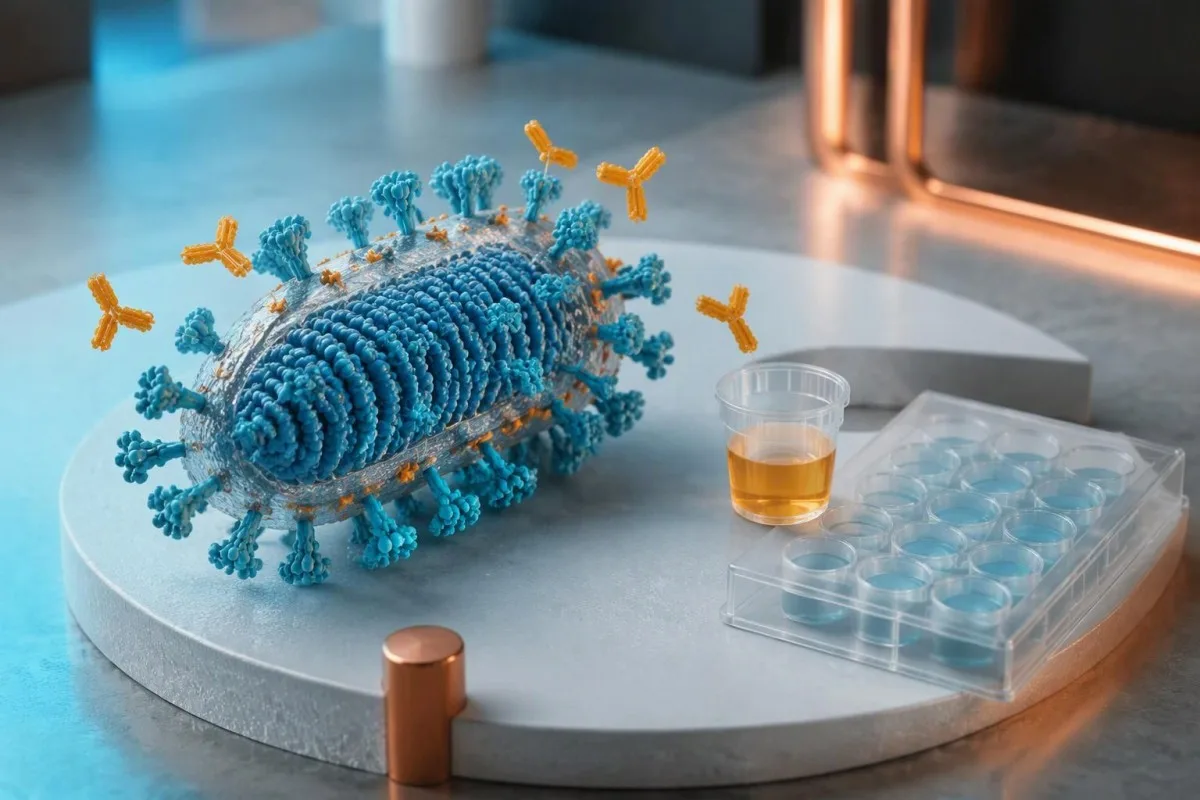
A result of at least 0.5 IU/mL generally indicates an adequate vaccine response—not guaranteed protection. Repeat testing and boosters depend on exposure risk, immune status, and your vaccination schedule.


- Adequate response: A rabies neutralizing antibody concentration of at least 0.5 IU/mL meets the widely accepted vaccine-response threshold.
- Not a safety guarantee: A result of 0.5 IU/mL or higher does not replace urgent assessment after a possible rabies exposure.
- Below threshold: A result below 0.5 IU/mL may trigger a booster, repeat testing, or review of vaccination timing—not a diagnosis of rabies.
- Functional testing: RFFIT and FAVN measure virus-neutralizing activity; an unrelated antibody screen or dilution titer is not automatically interchangeable.
- U.S. pre-exposure vaccination: ACIP recommends a 2-dose primary series on days 0 and 7, with additional measures determined by risk category.
- Occupational monitoring: U.S. risk category 1 requires titers every 6 months; category 2 requires titers every 2 years.
- Previously vaccinated exposure: People meeting the definition of previously vaccinated generally receive post-exposure vaccine on days 0 and 3, without rabies immunoglobulin.
- Immediate action: Wash a possible exposure site with soap and running water for about 15 minutes, and seek same-day medical or public-health advice.
What does a rabies antibody titer actually mean?
A rabies antibody titer of at least 0.5 IU/mL generally indicates an adequate neutralizing antibody response to vaccination. A lower result may require a booster or repeat testing, depending on your circumstances; neither result diagnoses rabies or removes the need for urgent assessment after a possible exposure.
Neutralizing antibodies interfere with rabies virus entering susceptible cells, and the laboratory reports their activity against an international reference standard. The 0.5 IU/mL threshold describes an adequate measured response; it does not measure every component of immunity, including memory cells that may respond after another vaccine dose.
Toradh de 1.2 IU/mL, for example, clears the usual adequacy threshold but cannot predict an individual's outcome after an untreated exposure. Our explanation of toraidhean antibody deimhinneach explores why vaccine antibodies, infection antibodies, and autoimmune antibodies answer different clinical questions.
Tha Kantesti na Anailisiche deuchainn fala AI that helps contextualize a reported 0.5 IU/mL threshold alongside the laboratory method and vaccination history. The useful task is organizing evidence—not declaring someone protected from a bite, scratch, or saliva exposure on the strength of one laboratory number.
As Thomas Klein, Chief Medical Officer at Kantesti, I would begin with 3 ceistean: why was the test ordered, when was the last vaccine dose, and has a possible exposure occurred? Our buidheann agus misean clionaigeach explain the service; emergency exposure decisions belong with clinicians and public-health authorities.
Which rabies titer test and units should you check?
RFFIT agus FAVN are functional assays that measure rabies virus-neutralizing antibodies, commonly reported in IU/mL. Before interpreting a result, confirm the assay, units, collection date, and laboratory conclusion; a generic positive antibody result is not automatically equivalent to a neutralizing concentration of at least 0.5 IU/mL.
RFFIT means rapid fluorescent focus inhibition test; FAVN means fluorescent antibody virus neutralization test. Both assess how diluted serum prevents virus-associated activity in cultured cells, then relate that activity to a reference preparation so a concentration such as 0.8 IU/mL has a standardized interpretation.
A dilution result such as 1:32 cannot be converted into IU/mL using a universal multiplication rule. The conversion depends on assay calibration and laboratory procedures, which is why our guide to toraidhean càileachdail an aghaidh toraidhean tomhasach separates a positive screen from a measured antibody concentration.
The unit conversion 0.5 IU/mL = 500 mIU/mL is mathematically valid when both reports describe the same calibrated analyte. By contrast, an assay index of 0.5, an optical-density value of 0.5, and 0.5 IU/mL are different measurements, even though their printed numbers look identical.
Older reports may reference complete neutralization at a 1:5 dilution, reflecting earlier U.S. criteria rather than the current ACIP concentration threshold. Do not reinterpret that notation yourself; ask the testing laboratory whether its result meets the applicable modern neutralizing-antibody standard and whether a numerical IU/mL result is available.
Why is rabies titer 0.5 IU/mL the accepted threshold?
Rabies titer 0.5 IU/mL is an accepted benchmark for an adequate vaccine-induced neutralizing antibody response, not a proven boundary between protection and infection. WHO uses this benchmark, and ACIP adopted at least 0.5 IU/mL as its minimum acceptable titer in the 2022 U.S. pre-exposure recommendations.
An 2022 ACIP recommendation explicitly recognizes that a definitive antibody correlate of protection against rabies has not been established in humans. Its 0.5 IU/mL benchmark provides a practical, internationally aligned response standard rather than a claim of absolute immunity (Rao et al., 2022).
Consider hypothetical results of 0.49 and 0.51 IU/mL: they fall on different sides of the administrative cutoff, but they do not represent abruptly different immune systems. Assay variability, rounding, and timing matter near the threshold; the laboratory and occupational-health clinician should interpret the original report rather than a rounded screenshot.
Toradh de 8 IU/mL is not eight times as clinically protective as 1 IU/mL, and a high vaccine-associated titer is not itself a toxicity signal. There is no standard upper concentration at which a rabies titer alone requires treatment; recent vaccination often explains a strong response.
Thresholds also belong to their own diseases: the rabies benchmark is 0.5 IU/mL, whereas hepatitis B vaccine-response assessment uses a different analyte and unit convention. Our guide to hepatitis B vaccine titers helps prevent the common mistake of transferring one vaccine's booster rules to another.
When should you repeat a rabies antibody test?
Repeat testing is useful when the first sample was poorly timed, below 0.5 IU/mL, technically inconclusive, or required by a risk-based monitoring schedule. When confirming a response in someone with altered immunity, ACIP recommends sampling no sooner than 1 week, preferably 2–4 weeks, after vaccination or a booster.
A sample collected 2 days after a booster may be too early to assess the full response. The date printed on the laboratory report is therefore not a minor detail: it determines whether the number describes baseline immunity, an evolving booster response, or a later monitoring result.
Recent rabies immunoglobulin can contribute passively supplied antibodies, so a concentration of 0.6 IU/mL shortly after treatment may not exclusively represent antibodies produced by the patient's own immune system. Give the clinician both vaccine dates and the immunoglobulin date before deciding whether a follow-up sample answers the intended question.
For a patient with normal immunity, routine response testing after every properly completed vaccination course is generally unnecessary unless occupational requirements or another specific indication applies. Repeating an adequate titer every few weeks can add cost and confusion without changing management; the correct interval comes from risk, not anxiety.
The most useful comparison includes 3 dates: last vaccine dose, sample collection, and previous sample collection. Our explanation of blood test timing effects shows why a falling value measured months later should not be interpreted like a failure to respond immediately after vaccination.
Who needs scheduled rabies titer monitoring?
Scheduled rabies titers mainly serve people with continuing occupational or activity-related risk. Under U.S. ACIP guidance, risk category 1 requires testing every 6 months, category 2 every 2 years, and category 3 uses a one-time titer during years 1–3 or an appropriately timed booster instead of recurring routine titers.
Risk category 1 includes certain personnel working with live or concentrated rabies virus, where unrecognized exposure can occur. Testing every 6 months is recommended because the consequence of missed exposure differs from that of an ordinary traveler; a titer below 0.5 IU/mL triggers a booster under the U.S. framework.
Risk category 2 includes people frequently handling bats, entering high-density bat environments, or conducting relevant animal necropsies where exposure may be unrecognized. The U.S. titer interval is every 2 years, with a booster if the result is below 0.5 IU/mL (Rao et al., 2022).
Risk category 3 generally concerns sustained risk from exposures likely to be recognized, such as many veterinary duties, lasting more than 3 years. The one-time titer option and the alternative booster are designed to establish longer-term immune responsiveness; category assignment depends on actual activities, not simply a job title.
A traveler with only 2 weeks of planned animal contact does not automatically need the same monitoring as a rabies-virus researcher. Our guide to sgrùdaidhean antibody banachdach siubhail can support preparation, but country-specific rabies advice and access to post-exposure care should determine the preventive plan.
Does a two-dose rabies vaccine series need a booster?
A U.S. 2-dose pre-exposure series on days 0 and 7 does not automatically require a booster for everyone. For risk category 3, ACIP recommends either a one-time titer during years 1–3 or a booster between day 21 and year 3; higher-risk categories follow their scheduled titer monitoring.
Risk category 4 involves recognized-exposure risk expected to last no more than 3 years, and ACIP does not require routine titers or a booster after its recommended 2-dose primary series. If that person's activities continue beyond the original risk period, the risk category and follow-up plan need reassessment.
A category 3 patient choosing the year 1–3 titer option needs a booster if the concentration is below 0.5 IU/mL. Someone choosing the alternative booster within day 21 to year 3 does not also need the one-time titer solely to satisfy that option, although impaired immunity changes confirmation requirements.
People who completed the older 3-dose U.S. pre-exposure series generally do not need to restart vaccination because ACIP changed the primary schedule in 2022. For category 3, the old third dose generally satisfies the long-term immunogenicity provision; categories 1 and 2 still need their applicable surveillance titers.
Vaccine documentation carries different weight across diseases, which is why measles titer interpretation cannot supply rabies booster rules. Likewise, varicella immunity testing involves different assay limitations; a rabies result of 0.5 IU/mL must be interpreted within its own vaccination framework.
What causes a rabies antibody titer below 0.5 IU/mL?
A rabies antibody titer below 0.5 IU/mL may reflect waning circulating antibodies, sampling before the response develops, an incomplete schedule, or reduced vaccine responsiveness. It does not establish rabies infection. The next step is to review the timing and vaccine record before deciding whether a booster and confirmation test are needed.
Immunosuppressive treatment can reduce antibody production, particularly therapies affecting B cells or substantial immune suppression from illness or medication. A hypothetical result of 0.18 IU/mL in someone receiving B-cell-depleting treatment deserves specialist planning, not the same follow-up assumptions used for an otherwise well veterinary worker.
Tha Kantesti na seirbheis eadar-mhìneachaidh deuchainn-lann AI that can help organize a 0.18 IU/mL result with medication history and vaccination dates. A normal total IgG concentration cannot prove an adequate rabies-specific response; our guide to IgG, IgA agus IgM a’ mìneachadh an eadar-dhealachaidh sin.
Toradh de 0.3 IU/mL several years after vaccination does not necessarily mean the original course failed; circulating antibodies may decline while immune memory remains. Nevertheless, if the person's monitoring category requires at least 0.5 IU/mL, possible immune memory is not a reason to ignore the recommended booster.
Repeated concentrations below 0.5 IU/mL after appropriately timed boosters warrant consultation with the treating clinician and public-health specialists. Our frèam dearbhaidh agus stiùiridh explains why interpretation needs explicit boundaries: an automated report cannot determine an individualized rescue vaccination schedule or establish protection in an immunocompromised patient.
Can an adequate titer replace care after an animal exposure?
No: a rabies antibody titer of 0.5 IU/mL or higher does not replace urgent exposure assessment or indicated post-exposure prophylaxis. After a possible bite, scratch, or saliva contact with broken skin or a mucous membrane, wash the affected site and obtain same-day medical or public-health advice.
Wash the affected site for approximately 15 minutes with soap and running water when feasible, then seek assessment rather than waiting for a send-out titer. WHO's 2018 position paper places prompt local cleansing and timely post-exposure prophylaxis at the center of prevention after relevant exposure (WHO, 2018).
A hypothetical veterinarian with a 2.4 IU/mL titer from last month still needs assessment after a bite from a suspect animal. The clinician considers species, country, animal behavior, contact details, vaccine documentation, and whether testing or supervised observation is available; the old titer is supporting information, not permission to do nothing.
Bat contact requires particular care because small exposures may be difficult to recognize, especially in a sleeping person or someone unable to give a reliable account. Finding a bat nearby is not automatically equivalent to exposure, but uncertainty about direct contact should be discussed promptly; do not attempt to catch or handle the animal yourself.
A healthy dog, cat, or ferret may qualify for 10-day observation under public-health supervision in an appropriate setting; this rule should not be transferred to wildlife. Our guide to testing after HIV PEP concerns a different virus, but reinforces the same principle: exposure prevention and laboratory reassurance answer different questions.
How does previous vaccination change rabies post-exposure care?
People who meet the definition of previously vaccinated generally receive rabies vaccine on days 0 and 3 after an exposure, without rabies immunoglobulin. Under the usual U.S. regimen, an unvaccinated immunocompetent person receives vaccine on days 0, 3, 7, and 14 plus rabies immunoglobulin when indicated.
Human rabies immunoglobulin is dosed at 20 IU/kg in the U.S. regimen for people who need it; clinicians infiltrate as much as anatomically feasible around the exposure site and manage any remainder according to local guidance. It must not share the first vaccine's administration site, and it is not routinely used for previously vaccinated people.
When initially omitted, rabies immunoglobulin can generally be given through day 7 after the first vaccine dose, not indefinitely afterward. The four-dose U.S. schedule and special approach to altered immunity are described in the ACIP post-exposure recommendations (Rupprecht et al., 2010); these are clinical protocols, not instructions for self-treatment.
Euslaintich le dìonachd lag receiving the U.S. unvaccinated regimen generally need a fifth vaccine dose on day 28 and assessment of the antibody response after completion. Our discussion of deuchainn airson galairean tric describes broader immune assessment, but no routine immune panel substitutes for rabies-specific management.
As Thomas Klein, I would treat a 2-dose pre-exposure record with missed long-term follow-up as a documentation question requiring resolution, not assume it qualifies for the shortened exposure regimen. Under ACIP's category 3 framework, exposure before appropriate realignment can require management as unvaccinated; pregnancy is not a reason to withhold indicated rabies prophylaxis.
Can a rabies antibody test diagnose or exclude rabies?
A routine vaccine-monitoring rabies antibody test cannot independently diagnose or exclude rabies. Suspected clinical rabies requires urgent specialist and public-health investigation using multiple specimen types; a vaccine-associated result above 0.5 IU/mL does not settle the diagnosis, and a negative serum antibody result cannot rule it out.
Diagnostic investigation commonly uses several specimens, including saliva, a nuchal skin specimen, serum, and cerebrospinal fluid, with specialist molecular or antibody testing as appropriate. These samples answer different questions; a single serum concentration of 0.7 IU/mL cannot replace the broader investigation when clinical suspicion is present.
In an unvaccinated patient, rabies antibodies may contribute to diagnostic evidence, but vaccination and passively administered immunoglobulin complicate serum interpretation. A hypothetical positive result of 1.0 IU/mL after recent prophylaxis cannot be treated as proof of active disease without knowing what was given and evaluating the other findings.
No routine antibody screening test reliably rules out rabies during the symptom-free incubation period. Ordering a titer 3 days after an animal exposure therefore answers the wrong question if the aim is to avoid post-exposure treatment; exposure circumstances, not early serology, determine the preventive decision.
New neurological symptoms after a relevant exposure require urgent clinical evaluation, irrespective of a previous 0.5 IU/mL result. Our guide to PCR timing and negatives illustrates a general testing principle—not interchangeable rabies advice: specimen choice and disease stage determine what a negative result can exclude.
What if your rabies titer falls between tests?
A falling rabies antibody titer often reflects declining circulating antibodies after vaccination, not a newly diagnosed illness or a complete loss of immune memory. Interpretation depends on whether the current concentration remains at least 0.5 IU/mL, how much time has passed, and whether your risk category requires ongoing monitoring.
A hypothetical change from 6.0 to 0.9 IU/mL over 2 years remains above the accepted response threshold despite an 85% numerical fall. The percentage decrease looks striking, but the occupational decision usually follows the current concentration and applicable schedule—not a requirement to preserve the original post-vaccine peak.
Atharrachadh bho 0.7 to 0.4 IU/mL has a different practical meaning for someone whose category requires surveillance, because the later result falls below the booster threshold. It does not prove that protection disappeared on a particular date, and it should never be used to retrospectively judge an exposure as harmless.
Cross-laboratory comparisons can be misleading when assay procedures, calibration, reporting limits, or rounding differ. If results of 0.48 and 0.62 IU/mL conflict, ask about the methods and collection timing before assuming a meaningful biological rise; using the same laboratory where practical can simplify follow-up.
Record at least 4 mion-fhiosrachadh for each result: concentration, units, assay, and time since vaccination. Our meaningful laboratory change guide explains comparison pitfalls, but generic change formulas should not override the rabies-specific 0.5 IU/mL threshold or an occupational-health protocol.
How should you prepare and read the laboratory report?
A rabies titer test usually does not require fasting, but the performing laboratory's collection and transport instructions take priority. Read the full report for the neutralization method, concentration in IU/mL, sample date, and interpretation; a result reading 0.5 IU/mL needs its original context rather than a cropped image.
Send-out testing may take days or longer, depending on transport, assay scheduling, and the laboratory's workload; request the actual turnaround rather than assuming a 24-hour result. If an exposure has occurred, clinical assessment should proceed immediately instead of waiting for the neutralization assay to return.
An optical-reading error that changes 0.05 to 0.5 IU/mL changes the apparent adequacy classification tenfold. Our Liosta-sgrùdaidh airson mearachdan tar-sgrìobhaidh ann am PDF highlights why decimal points, inequality symbols, and units should be checked against the source document before using any digital interpretation.
Kantesti AI can help structure 4 report elements—the assay, concentration, units, and sample timing—for discussion with a clinician. Our tha stiùireadh teicneòlas mion-sgrùdaidh describes the workflow; the source laboratory remains authoritative for assay validity, and software cannot verify a vaccination course merely from an antibody number.
Ma tha an aithisg ag ràdh less than 0.1 IU/mL, do not enter 0.1 as an exact measurement or silently replace it with zero. Similarly, a result above an assay's reporting limit is not a precise concentration; preserve the inequality and ask whether further quantification would actually change the monitoring decision.
Are human rabies titers the same as pet travel tests?
Human vaccine-response monitoring and pet travel certification may both use a 0.5 IU/mL benchmark, but their rules are not interchangeable. Animal travel programs can specify approved laboratories, vaccination timing, identification, waiting periods, and document validity; a human laboratory result does not satisfy those administrative requirements.
FAVN testing is familiar from animal travel, which can make online searches for a human rabies antibody titer confusing. A page discussing 0.5 IU/mL for a pet may describe an import requirement, not the clinical advice needed by a veterinarian, traveler, or person recently assessed after an exposure.
For a human result of 0.8 IU/mL, the relevant questions are vaccine-response adequacy, testing indication, immune status, and exposure history. For an animal certificate, the same concentration may still be insufficient administratively if identification, sample timing, laboratory approval, or destination-specific paperwork is wrong.
Other animal-associated antibody titers also use different interpretations: a Bartonella dilution such as 1:128 is not comparable to rabies neutralizing activity in IU/mL. Our guide to Tiùnagan anti-bodhaigeartachd Bartonella helps distinguish an infection investigation from a vaccine-response assay despite similar-looking laboratory terminology.
International human vaccination recommendations can also differ in administration routes and schedules; WHO's 2018 position paper includes intradermal approaches not identical to the U.S. day 0 and day 7 intramuscular PrEP framework. Ask the relevant travel clinic or public-health service to assess the actual documented course rather than translating it through pet-import instructions.
What should you do next with your rabies antibody result?
Match your rabies antibody result to its purpose before taking action: at least 0.5 IU/mL usually satisfies vaccine-response monitoring, while a lower result needs context-specific follow-up. After a possible exposure, seek urgent assessment regardless of the number; bring the full vaccine record, laboratory report, and details of the animal contact.
For a routine occupational result of 0.65 IU/mL, confirm your next monitoring date instead of arranging an unnecessary immediate booster. For 0.25 IU/mL, contact the service responsible for your risk category and discuss a booster, confirmation testing where appropriate, and any interim workplace precautions required by local policy.
Mar 15 Dàmhair 2026, this article describes the WHO 2018 and ACIP 2022 frameworks; local public-health instructions should be checked for subsequent changes and country-specific requirements. Thomas Klein's editorial approach here is to separate response monitoring from exposure care, because neither a 0.5 IU/mL result nor an online interpretation can replace that clinical distinction.
Tha Kantesti na àrd-ùrlar mìneachaidh deuchainn fala AI that helps organize results such as 0.25 IU/mL for clinical discussion, not prescribe exposure prophylaxis. Our bòrd comhairleachaidh meidigeach describes the people involved in clinical governance; individual exposure assessment remains the responsibility of an appropriate healthcare or public-health professional.
The 2 companion publications listed below are general laboratory education, not evidence for rabies recommendations. An iùl mìneachaidh co-mheas nan dubhagan agus stiùireadh eadar-mhìneachaidh urinalysis nas fharsainge cover separate tests; their repository DOIs should not be mistaken for rabies vaccine studies or independent validation of this article.
Research publications: relevance and verification
The 2 Zenodo references below are presented separately from the 3 topic-specific medical references. Their ResearchGate and Academia.edu links are title searches, not verified copies of those publications; publication authorship and dates should be checked against repository metadata before using them in a formal bibliography.
Ceistean Bitheanta
A bheil titer antibodyan an aghaidh rabies de 0.5 IU/mL gu leòr?
Tha titer de antibodies neodachaidh an aghaidh confaidh de 0.5 IU/mL no nas àirde a’ coinneachadh ris an stairsneach airson freagairt iomchaidh do bhanachdach a thathar a’ gabhail ris san fharsaingeachd. Chan eil e a’ gealltainn dìon às dèidh nochdaidh no a’ dearbhadh nach eil prophylaxis às dèidh nochdaidh riatanach. Feumar an toradh a mhìneachadh a rèir an assay, eachdraidh a’ bhanachdachaidh, inbhe an t-siostaim dìon agus adhbhar an deuchainn. Iarr comhairle èiginneach mheidigeach no bho ùghdarrasan slàinte a’ phobaill às dèidh nochdadh a dh’fhaodadh a bhith ann, eadhon ma tha an titer agad nas àirde na 0.5 IU/mL.
Dè thachras ma tha an titir sa chlais-bhàn agam nas ìsle na 0.5 IU/mL?
0 Tha titer an aghaidh na confaidh fo 0.5 IU/mL chan eil e a’ coileanadh na slat-tomhais àbhaisteach airson freagairt iomchaidh, ach chan eil e a’ dearbhadh gu bheil confaidh ort. Bu chòir don neach-clionaigeach agad ath-sgrùdadh a dhèanamh air àm togail an t-sampaill, clàran banachdachaidh, cunnart nochdaidh, agus cungaidhean a dh’fhaodadh an fhreagairt dìonach a lùghdachadh. Dh’fhaodadh gun tèid dòs ath-neartachaidh a mholadh, gu h-àraidh nuair a tha feum air a rèir protocol sgrùdaidh dreuchdail. Tha deuchainnean dearbhaidh gu h-àraidh buntainneach nuair a tha an dìonachd atharraichte, agus mar as trice bithear gan dèanamh gun a bhith nas tràithe na seachdain, agus 2–4 seachdainean mas fheàrr, às dèidh a’ bhanachdachaidh.
Dè cho tric ’s a dh’fheumas lighichean-sprèidh deuchainn titre sa chonfadh fhaighinn?
Tha tricead titer an aghaidh confaidh do lighichean-sprèidh an urra ris na gnìomhan a bhios iad a’ dèanamh agus ris an stiùireadh nàiseanta iomchaidh, chan ann dìreach ris an dreuchd aca. A rèir stiùireadh ACIP sna SA, tha mòran de lighichean-sprèidh aig a bheil cunnart leantainneach aithnichte a thaobh nochdadh don ghalar san roinn 3, far a bheil feum air titer aon turas eadar bliadhna 1 agus bliadhna 3, no air dòs-neartachaidh aig àm iomchaidh às dèidh a’ phrìomh shreath 2-dòs. Faodaidh gnìomhan anns a bheil barrachd cunnart ann nach aithnichear nochdadh don ghalar a bhith feumach air sgrùdadh gach 2 bhliadhna ann an roinn 2 no gach 6 mìosan ann an roinn 1. Bu chòir do sheirbheis slàinte obrach an roinn a shònrachadh agus aire a thoirt do chlàran banachdachaidh 3-dòs nas sine.
Do I need rabies shots after a bite if my titer is high?
A high rabies antibody titer does not remove the need for urgent assessment after a potentially relevant bite or other exposure. People who meet the definition of previously vaccinated generally receive post-exposure vaccine on days 0 and 3 without rabies immunoglobulin. The shortened regimen depends on a qualifying vaccination history and applicable follow-up requirements, not merely a titer above 0.5 IU/mL. Wash the affected site for about 15 minutes and seek same-day medical or public-health advice.
When should a rabies antibody test be done after a booster?
When confirmation of the vaccine response is indicated, especially in a person with altered immunity, ACIP recommends testing no sooner than 1 week and preferably 2–4 weeks after the dose or completed series. Testing 2 days after a booster may be too early to assess the developed response. Recent rabies immunoglobulin can also complicate interpretation by contributing passively supplied antibodies. The clinician should specify the collection date and whether confirmation testing is necessary in your situation.
Can a positive rabies antibody test mean I have rabies?
A positive rabies antibody test after vaccination usually reflects a vaccine-associated immune response and does not independently diagnose rabies. A concentration such as 1.0 IU/mL cannot distinguish active disease from prior vaccination or recent passive antibody administration by itself. Suspected clinical rabies requires urgent specialist investigation involving multiple specimen types and appropriate molecular or antibody testing. A negative serum antibody test also cannot safely rule out rabies, particularly during the symptom-free incubation period.
Does a falling rabies titer mean my vaccine stopped working?
A falling rabies titer does not automatically mean that vaccination failed or that immune memory disappeared. For example, a fall from 6.0 to 0.9 IU/mL remains above the accepted 0.5 IU/mL vaccine-response threshold. A result below the threshold can nevertheless require a booster when your monitoring category calls for one. Compare the assay, units, vaccine dates, and sample timing, and do not use the trend to decide whether a possible exposure needs treatment.
Faigh Mion-sgrùdadh Deuchainn Fala le Cumhachd AI an-diugh
Thig còmhla ri còrr is 2 mhillean neach air feadh an t-saoghail a tha a’ earbsa Kantesti airson mion-sgrùdadh sa bhad, ceart air deuchainnean obair-lann. Luchdaich suas na toraidhean deuchainn fala agad agus faigh mìneachadh coileanta air biomarcair 15,000+ ann an diogan.
📚 Foillseachaidhean Rannsachaidh le Iomraidhean
Klein, T., Mitchell, S., & Weber, H. (2026). Mìneachadh air Co-mheas BUN/Creatinine: Stiùireadh airson Deuchainn Gnìomh nan Dubhagan. Rannsachadh Leigheis AI Kantesti.
Klein, T., Mitchell, S., & Weber, H. (2026). Urobilinogen ann an Deuchainn Fuaime: Stiùireadh Coileanta air Urinalysis 2026. Rannsachadh Leigheis AI Kantesti.
📖 Iomraidhean Meidigeach Taobh a-muigh
Rao AK et al. (2022). Use of a Modified Preexposure Prophylaxis Vaccination Schedule to Prevent Human Rabies: Recommendations of the Advisory Committee on Immunization Practices — United States, 2022. MMWR. Morbidity and Mortality Weekly Report, 71, 619–627.
World Health Organization (2018). Rabies vaccines: WHO position paper — April 2018. Weekly Epidemiological Record, 93, 201–220.
Rupprecht CE et al. (2010). Use of a Reduced (4-Dose) Vaccine Schedule for Postexposure Prophylaxis to Prevent Human Rabies: Recommendations of the Advisory Committee on Immunization Practices. MMWR. Recommendations and Reports, 59(RR-2), 1–9.
⚕️ Àicheadh Meidigeach
Tha an artaigil seo dìreach airson adhbharan foghlaim agus chan eil e a’ dèanamh comhairle mheidigeach. Cuir fios an-còmhnaidh gu solaraiche cùram slàinte teisteanasach airson co-dhùnaidhean breithneachaidh is leigheis.
Comharran earbsa E-E-A-T
Eòlas
Lèirmheas clionaigeach air a stiùireadh le lighiche air sruthan-obrach mìneachaidh obair-lann.
Eòlas
Fòcas air leigheas obair-lann air mar a bhios bith-chomharraidhean (biomarkers) a’ giùlan ann an co-theacsa clionaigeach.
Ùghdarrasachd
Air a sgrìobhadh le Dr. Thomas Klein le ath-sgrùdadh le Dr. Sarah Mitchell agus Prof. Dr. Hans Weber.
Earbsachd
Mìneachadh stèidhichte air fianais le slighean leanmhainn soilleir gus dragh a lughdachadh.