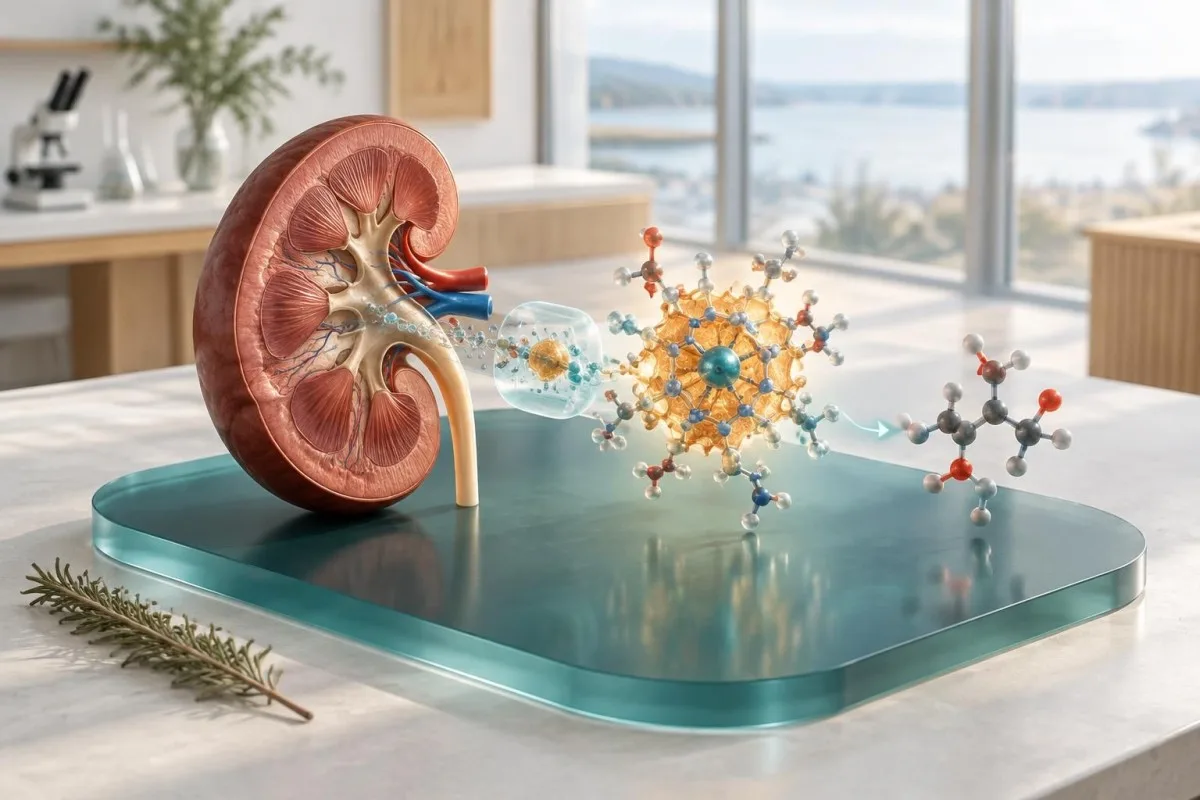
A normal serum B12 result does not always exclude a cellular B12 problem. Kidney function, supplements, timing, and confirmatory markers can change how methylmalonic acid results should be read.

Pangunang mga punto
- High MMA meaning: An elevated methylmalonic acid result can indicate cellular vitamin B12 deficiency even when serum B12 falls inside the laboratory range.
- Komon nga threshold: Many laboratories consider MMA above about 0.40 micromol/L, or 400 nmol/L, elevated, but the exact cutoff varies by assay and population.
- Paglihok sa mga kidney: Reduced eGFR can raise MMA because the kidneys clear it less efficiently; an elevated MMA is less specific when eGFR is below 60 mL/min/1.73 m2.
- Normal B12 limitation: Serum B12 commonly appears normal after supplements or injections and may not reflect how much vitamin is available inside cells.
- Useful confirmation: Clinicians may review creatinine, eGFR, homocysteine, complete blood count, mean corpuscular volume, folate, and active B12 or holotranscobalamin.
- Balik nga pagsulay: A repeat MMA is often considered after correcting reversible factors or beginning treatment, commonly after 8-12 weeks, although symptoms may require earlier action.
- Mga sintomas nga kinahanglan ug daliang pagtan-aw: New weakness, trouble walking, severe numbness, confusion, or vision changes need prompt medical assessment rather than waiting for a repeat laboratory test.
- Interpretation rule: The size and persistence of the MMA elevation matter, but the result must be interpreted alongside kidney function, symptoms, medication history, and the laboratory reference interval.
Why MMA Can Be High When B12 Is Normal
High MMA with normal B12 usually means one of three things: cellular B12 deficiency, reduced kidney clearance, or a result affected by recent supplementation or testing conditions. Serum B12 is a useful screening marker, but it does not measure intracellular vitamin activity directly; a B12 value of 350 pg/mL can coexist with an abnormal MMA, especially when neurological symptoms or risk factors are present.

Methylmalonic acid rises when vitamin B12-dependent conversion of methylmalonyl-CoA to succinyl-CoA is impaired. In adults, many laboratories use an MMA upper limit near 0.40 micromol/L, or 400 nmol/L, although the method-specific interval printed on your report should take priority.
A serum B12 result between approximately 200 and 300 pg/mL is often considered borderline, while values below 200 pg/mL commonly support deficiency; these are screening conventions rather than universal diagnostic rules. The American Academy of Family Physicians review by Langan and Goodbred recommends MMA testing to confirm deficiency when B12 is low-normal and clinical suspicion remains high (Langan and Goodbred, 2017).
For example, a 52-year-old vegan taking a B-complex supplement could have B12 at 468 pg/mL and MMA at 0.62 micromol/L. That combination does not prove deficiency, but it justifies checking kidney function, homocysteine, folate, blood-count patterns, supplement timing, and symptoms before dismissing the MMA.
The result needs a pattern, not a verdict
An isolated MMA value of 0.43 micromol/L has a different meaning from a persistent result of 1.8 micromol/L. The first may reflect biological or analytical variation, whereas the second deserves a structured review of renal function, malabsorption, medication exposure, and treatment history.
A normal B12 result can also be misleading after oral supplements or an injection received during the previous 1-2 months. For background on active B12 testing, see this guide to holotranscobalamin results.
What MMA Levels Are Considered Elevated?
MMA is commonly considered elevated above about 0.40 micromol/L, but no single cutoff applies to every laboratory, age group, or kidney function level. Some laboratories report MMA in nmol/L, where 400 nmol/L equals 0.40 micromol/L; others use a different upper reference limit based on their assay and local population.

The table below is an educational framework, not a replacement for the reference interval on your report. A value of 0.40 micromol/L may be flagged in one laboratory and accepted in another, so the number, unit, assay range, and eGFR must be read together.
MMA above 0.40 micromol/L is often used as a biochemical clue to B12 deficiency, while MMA above 1.00 micromol/L is more concerning for substantial elevation or a strong renal contribution. The cutoffs are not severity grades validated for every patient; clinicians disagree on how much weight to give a modest elevation when kidney function is reduced.
The 1994 study by Savage and colleagues found that serum MMA was highly useful for detecting cobalamin deficiency, particularly when ordinary serum B12 was not clearly low (Savage et al., 1994). That finding supports MMA as a confirmatory marker, but it does not make MMA specific for B12 deficiency in people with chronic kidney disease.
| Lebel | Range | Kahulogan |
|---|---|---|
| Usually within range | <0.40 micromol/L or <400 nmol/L | Often compatible with adequate B12 activity, although symptoms and recent treatment still matter. |
| Gamay nga taas | 0.40-0.70 micromol/L or 400-700 nmol/L | May reflect early or functional B12 deficiency, kidney effects, supplements, or biological variation. |
| Katamtamang taas | 0.71-1.00 micromol/L or 701-1000 nmol/L | Usually warrants confirmation with eGFR, homocysteine, CBC, symptoms, and treatment history. |
| Kaayo taas | >1.00 micromol/L or >1000 nmol/L | Needs clinician review; severe B12 dysfunction and reduced renal clearance should both be considered. |
Why laboratory intervals differ
MMA reference intervals vary because laboratories use different analytical platforms, calibration materials, age distributions, and units. An older adult may have a higher population-based MMA distribution than a younger adult, and reduced eGFR can shift the result upward even without a nutritional deficiency.
When the report gives only a flag such as high, request the actual value and unit. A result of 520 nmol/L is numerically identical to 0.52 micromol/L, but comparing it with a reference interval written in pg/mL would be a unit error; the giya sa mga biomarker sa laboratoryo explains why units and reference intervals matter.
How Kidney Function Changes MMA Results
Reduced kidney filtration can raise MMA independently of vitamin B12 deficiency because the kidneys help remove MMA from the circulation. An eGFR below 60 mL/min/1.73 m2 makes a high MMA less specific, particularly when the elevation is modest and the serum B12, blood count, and symptoms do not support deficiency.

Creatinine and eGFR should be reviewed alongside every unexpectedly high MMA result. A creatinine of 1.4 mg/dL may be normal for one muscular adult and abnormal for another, while eGFR incorporates age, sex, and the laboratory equation; this is why a single creatinine number cannot fully explain MMA.
People with eGFR between 45 and 59 mL/min/1.73 m2 can have modest MMA elevations without true intracellular B12 deficiency. The signal becomes harder to interpret as eGFR falls below 30, especially when urea, creatinine, and other retained metabolites are also abnormal.
The direction of change can help. If MMA falls from 0.90 to 0.48 micromol/L after renal function improves from eGFR 38 to 55, kidney clearance may have contributed; if MMA remains above 1.00 micromol/L despite stable renal results, B12-related dysfunction deserves closer attention. A BUN at creatinine guide can help explain the surrounding renal results.
Creatinine is not the only renal clue
Dehydration can temporarily increase creatinine and lower a calculated eGFR, which may make MMA appear more concerning than it is. A repeat renal panel after recovery from vomiting, fever, intense exercise, or poor fluid intake can clarify whether the kidney contribution is persistent.
A low eGFR is not itself proof of chronic kidney disease; chronicity generally requires persistence for at least 3 months or other evidence of kidney damage. For a broader explanation of a borderline result, see what borderline eGFR can mean.
What Functional B12 Deficiency Means
Functional vitamin B12 deficiency means that the measured vitamin is present in serum but is not providing enough usable cofactor activity inside cells. This can occur with a low-normal B12, recent supplementation, altered transport proteins, impaired absorption, or an early deficiency that has not yet changed the complete blood count.

Vitamin B12 is required for methylmalonyl-CoA mutase, the enzyme that limits MMA accumulation. When that reaction slows, MMA rises; the biochemical change can precede anemia, macrocytosis, or visible changes in mean corpuscular volume by weeks or months.
Serum B12 measures circulating cobalamin, not the rate at which tissues use it. Binding-protein differences, assay interference, liver disease, and recent vitamin use can produce a B12 result that looks reassuring even when MMA or homocysteine remains abnormal.
The evidence is strongest when multiple clues align: MMA above 0.40 micromol/L, homocysteine above about 15 micromol/L, neurological symptoms, a high MCV, or a risk factor such as metformin use or gastric surgery. The NEJM clinical review by Stabler describes this distinction between serum concentration and functional deficiency and supports using metabolic markers when the clinical picture is unclear (Stabler, 2013).
A normal CBC does not settle the question
A normal hemoglobin of 13.8 g/dL and MCV of 92 fL do not exclude early B12 deficiency. Neuropathy can occur without anemia, and correcting the blood count does not necessarily reverse nerve injury if treatment is delayed.
Conversely, a high MCV of 103 fL is not specific for B12 deficiency because alcohol exposure, liver disease, hypothyroidism, reticulocytosis, and some medicines can produce macrocytosis. The high MCV explanation shows why the CBC must be interpreted as a pattern rather than a single flag.
Which Tests Confirm the Cause of High MMA?
The most useful confirmation usually combines repeat MMA, kidney function, homocysteine, complete blood count, folate, and a careful review of B12 exposure. Active B12 or holotranscobalamin may add information, but no single follow-up test can distinguish nutritional deficiency from renal elevation in every patient.

A clinician may repeat serum B12 and MMA together, add total homocysteine, and measure creatinine with eGFR. MMA is more closely linked to B12-dependent metabolism, while homocysteine can also rise with folate deficiency, vitamin B6 deficiency, hypothyroidism, renal impairment, and certain medicines.
Folate should be checked because folate deficiency can raise homocysteine while leaving MMA normal. A pattern of high MMA plus high homocysteine points more strongly toward B12-related dysfunction than isolated homocysteine elevation, although kidney disease can raise both markers.
Active B12 is sometimes useful when serum B12 is between 200 and 400 pg/mL. A low holotranscobalamin supports limited delivery of B12 to cells, but reference intervals vary and an apparently normal active B12 does not overrule symptoms, MMA, or renal results.
Testing questions to take to an appointment
Ask whether the MMA result was serum or urine, whether the laboratory uses nmol/L or micromol/L, and whether the sample was collected before or after supplements. Also ask for the eGFR value, not only a statement that kidney tests were normal.
If you have used an injection, high-dose tablet, energy drink, or multivitamin in the previous 4-8 weeks, record the product and dose. Information about B12 tablets versus injections helps explain why serum B12 can change before MMA fully normalizes.
How Symptoms and CBC Results Change the Meaning
Neurological symptoms make an elevated MMA more clinically significant, even when hemoglobin and serum B12 are normal. Numbness, tingling, reduced vibration sense, imbalance, burning feet, weakness, memory change, or a sore tongue should be interpreted with MMA and risk factors rather than dismissed because the B12 line is in range.

A high MMA with MCV 101 fL and hemoglobin 10.9 g/dL supports a broader deficiency pattern, but a normal MCV of 88 fL does not rule it out. Iron deficiency can also mask macrocytosis, producing an apparently ordinary MCV even when B12-related cell changes are present.
For example, a 67-year-old taking metformin for 8 years might have B12 at 280 pg/mL, MMA at 0.76 micromol/L, MCV at 94 fL, and new toe numbness. That pattern merits prompt clinical review because metformin-associated B12 depletion, early neuropathy, and renal function should be considered together.
Red-cell distribution width may rise before MCV changes, but RDW is not specific for B12 deficiency. A detailed RDW and MCV guide can help explain why mixed deficiencies create confusing CBC patterns.
Symptoms can outweigh a reassuring number
Progressive balance problems or weakness require assessment sooner than a routine retest, particularly when MMA is above 0.70 micromol/L. Nerve symptoms may become less reversible with prolonged deficiency, so clinicians may begin treatment while confirmation is still being completed.
Mild fatigue alone is less specific because sleep loss, thyroid disease, iron deficiency, medication effects, and mood disorders can produce the same symptom. A blood-test approach to low mood and fatigue can help keep the differential diagnosis broad.
Diet, Medicines, and Absorption Problems
High MMA with normal B12 can result from inadequate intake, impaired absorption, or medication effects even when serum B12 has not fallen below range. Metformin, acid-suppressing medicines, gastric surgery, autoimmune gastritis, inflammatory bowel disease, and a strict vegan diet can all change the probability of true deficiency.

Metformin can interfere with B12 absorption over time, especially at higher doses and after several years of treatment. Proton-pump inhibitors and H2 blockers may reduce stomach acid needed to release food-bound B12; the effect varies, so medication history raises suspicion but does not diagnose deficiency.
A person who avoids animal products may obtain little dietary B12 unless fortified foods or supplements are used consistently. The guide to foods high in B12 explains why intake, fortification, and absorption are separate questions rather than interchangeable measures.
Autoimmune gastritis and previous gastric bypass can impair intrinsic-factor-dependent absorption, allowing serum B12 to fluctuate while tissue stores remain inadequate. Chronic diarrhea, weight loss, recurrent mouth soreness, or a history of intestinal surgery should be shared with the clinician even if the B12 number is 420 pg/mL.
Do not self-treat without explaining the result
A standard multivitamin may contain 2.4 micrograms of B12, while treatment regimens often use 1,000-2,000 micrograms orally or scheduled injections; the appropriate dose depends on cause and clinical findings. Taking a high-dose supplement before repeat testing can normalize serum B12 and make the original problem harder to interpret.
Folate should not be used alone to cover unexplained macrocytosis or neurological symptoms because it can improve anemia while neurological B12 injury continues. A B-complex supplement safety guide discusses why more is not automatically better.
When Clinicians Repeat MMA Testing
Clinicians may repeat MMA after 8-12 weeks when the initial elevation is mild, kidney function is stable, and there are no urgent neurological symptoms. Earlier reassessment or immediate treatment is reasonable when MMA is substantially high, symptoms are progressive, or a clear risk factor makes deficiency likely.

Repeat testing is most informative when the same laboratory, unit, and specimen type are used. A change from 0.68 to 0.39 micromol/L is more meaningful when creatinine, eGFR, supplements, and treatment have been recorded at both time points.
After effective B12 replacement, MMA may begin falling within days to weeks, but many clinicians wait about 2-3 months to assess biochemical response and adherence. The timing is not absolute; a person with severe neuropathy should not wait 12 weeks for care simply to obtain a cleaner laboratory comparison.
If MMA remains high after B12 treatment, clinicians may reconsider the diagnosis, check adherence and dose, review renal function, test for malabsorption, or investigate another metabolic cause. A stable serum B12 above 500 pg/mL does not prove that treatment corrected the underlying problem if MMA remains above 0.40 micromol/L.
Track what changed between tests
Write down the dates of supplements, injections, antibiotics, stomach medicines, illness, exercise, and fluid loss before repeating MMA. A trend is easier to interpret when the test conditions are comparable and the clinician can see whether eGFR changed by more than 10 mL/min/1.73 m2.
Keeping several laboratory dates side by side can reveal whether MMA follows B12 treatment, kidney function, or neither. The giya sa pag-andam alang sa baseline blood test covers practical ways to make serial results more comparable.
When an Elevated MMA Needs Prompt Medical Care
An elevated MMA needs prompt medical review when it is accompanied by new neurological symptoms, severe anemia, rapidly worsening weakness, confusion, or significant kidney impairment. The laboratory number alone rarely defines an emergency, but the combination of symptoms, degree of elevation, and underlying disease determines how quickly assessment is needed.

Seek urgent assessment for sudden one-sided weakness, new difficulty speaking, severe confusion, fainting, or sudden vision loss because these symptoms can signal conditions unrelated to B12 and should not be attributed to MMA. Gradually progressive numbness, gait difficulty, or weakness also deserves timely review rather than indefinite observation.
An MMA above 1.00 micromol/L with eGFR below 30 mL/min/1.73 m2 requires careful interpretation by a clinician familiar with kidney disease. The result may reflect reduced clearance, B12 deficiency, or both, and treatment decisions should consider potassium, bicarbonate, urea, creatinine, and the overall renal picture.
Pregnancy, advanced age, prior gastric surgery, strict vegan intake, long-term metformin use, and neurological disease can lower the threshold for follow-up. The giya sa mga simtomas sa ubos nga eGFR explains why kidney-related symptoms should be considered separately from a B12 interpretation.
A sensible appointment checklist
Bring the complete report, including units and reference intervals, plus a list of every supplement and medicine with dose and start date. Include prior B12, MMA, homocysteine, creatinine, eGFR, folate, hemoglobin, MCV, and RDW results if available.
Ask whether the result should be repeated before treatment, whether treatment should begin while testing continues, and what symptom change would require earlier contact. The medical content standards used for patient-facing explanations are described in clinical content standards.
A Practical Way to Read Your MMA Result
The safest interpretation of high MMA with normal B12 follows five steps: confirm the unit, compare with the laboratory range, check eGFR, review symptoms and risk factors, and decide whether repeat or treatment is appropriate. This sequence prevents both false reassurance from a normal B12 and unnecessary alarm from a modest kidney-related elevation.
First, identify whether MMA is 0.52 micromol/L or 520 nmol/L and confirm that the result is serum rather than urine. Second, compare it with the laboratory interval; a flag from one assay cannot be transferred automatically to another assay with a different upper limit.
Third, check eGFR and creatinine, then review B12 exposure during the previous 1-2 months. Fourth, look for supporting evidence such as homocysteine above 15 micromol/L, MCV above 100 fL, low folate, anemia, neuropathy, metformin use, acid suppression, or malabsorption risk.
Finally, decide with a clinician whether the result needs treatment, repeat testing, or a broader evaluation. Clinical validation and review methods should be transparent when health information tools are used; see the medikal nga pag-validate nga overview for the standards applied to interpretation workflows.
Bottom line for a normal B12 result
A normal B12 level does not automatically cancel an elevated MMA, but high MMA does not automatically prove B12 deficiency. The strongest interpretation comes from the combination of MMA magnitude, eGFR, homocysteine, CBC, symptoms, recent supplementation, diet, medicines, and absorption history.
For many adults with mild MMA elevation and stable kidney function, repeating the test after 8-12 weeks is reasonable. For anyone with progressive neurological symptoms, severe anemia, or advanced kidney disease, medical review should come before a routine retest; the impormasyon sa medical advisory board explains the role of clinical oversight in patient-facing health content.
Mga kanunayng gipangutana
What does high MMA mean if my vitamin B12 is normal?
High MMA with normal vitamin B12 usually means possible cellular B12 deficiency, reduced kidney clearance, or an effect from recent supplementation. Many laboratories flag MMA above about 0.40 micromol/L, or 400 nmol/L, but the cutoff varies by assay. Clinicians commonly review eGFR, creatinine, homocysteine, folate, CBC, MCV, symptoms, diet, and medicines before deciding whether treatment or repeat testing is appropriate.
Can kidney disease cause high methylmalonic acid?
Yes, reduced kidney filtration can raise methylmalonic acid because the kidneys help clear it from the body. An eGFR below 60 mL/min/1.73 m2 makes a mild MMA elevation less specific for vitamin B12 deficiency, and interpretation becomes more difficult below 30 mL/min/1.73 m2. A high MMA result should therefore be read with creatinine, eGFR, homocysteine, symptoms, and the laboratory reference range.
What MMA level indicates vitamin B12 deficiency?
Many laboratories consider MMA above 0.40 micromol/L, or 400 nmol/L, abnormal, but there is no universal diagnostic cutoff for every patient. Values between 0.40 and 0.70 micromol/L can reflect early B12 deficiency, kidney effects, recent supplements, or biological variation. MMA above 1.00 micromol/L is more concerning and usually warrants clinician review alongside eGFR, homocysteine, CBC, symptoms, and treatment history.
Should I repeat MMA if my B12 is normal?
A repeat MMA may be reasonable after 8-12 weeks when the elevation is mild, kidney function is stable, and there are no progressive neurological symptoms. Repeating B12, MMA, creatinine, eGFR, and sometimes homocysteine together makes the trend easier to interpret. Earlier assessment is appropriate when MMA is markedly high, symptoms are worsening, or there is a history of gastric surgery, malabsorption, metformin use, or strict vegan intake.
Can B12 supplements make the blood test look normal?
Yes, oral supplements or injections can raise serum B12 within weeks and make the result appear normal even when tissue-level deficiency was present before treatment. MMA may remain elevated for some time and can provide additional information, although kidney impairment also raises MMA. Record the dose and timing of every B12 product taken during the previous 1-2 months and tell the clinician before repeat testing.
Is high MMA dangerous?
High MMA is a biochemical finding rather than a diagnosis, so its significance depends on the cause and the rest of the results. An MMA above 1.00 micromol/L, progressive numbness, trouble walking, weakness, confusion, or severe anemia deserves prompt medical review, while a mild result near 0.40 micromol/L may be monitored after checking kidney function and treatment history. Sudden weakness, speech trouble, fainting, or vision loss requires urgent care regardless of the MMA value.
Paipatin-aw ang imong resulta sa blood test
I-upload ang report sa imong laboratoryo ug ipatin-aw sa AI sa Kantesti ang matag biomarker sa yano nga pinulongan sulod sa pipila ka segundo. Gigamit sa kapin sa 2 ka milyon ka tawo sa tibuok kalibotan.
Mga Reperensya
- Klein, T., Mitchell, S., & Weber, H. (2026). Giya sa Kahimsog sa Kababayen-an: Obulasyon, Menopos ug mga Sintomas sa Hormone. Panukiduki Medikal sa Kantesti AI. DOI
- Klein, T., Mitchell, S., & Weber, H. (2026). Multilingual nga Suportang Pangdesisyon sa Klinika nga Gitabangan sa AI alang sa Sayo nga Pagsusi sa Hantavirus: Disenyo, Pag-validate sa Inhenyeriya ug Pagpatuman sa Tinuod nga Kalibotan sa 50,000 ka mga Report sa Pagsabot sa Resulta sa Blood Test. Panukiduki Medikal sa Kantesti AI. DOI
- Langan RC, Goodbred AJ (2017). Vitamin B12 Deficiency: Recognition and Management. American Family Physician. PubMed
- Savage DG et al. (1994). Sensitivity of serum methylmalonic acid and total homocysteine determinations for diagnosing cobalamin and folate deficiencies. The American Journal of Medicine. DOI PubMed
- Stabler SP (2013). Vitamin B12 Deficiency. The New England Journal of Medicine. DOI PubMed
- 2M+Mga gisusi nga eksaminasyon
- 127+Mga nasud
- 100+Mga pinulongan
Mahitungod sa medikal nga team


Mga E-E-A-T Trust Signals
Kasinatian
Pagsusi sa klinika nga gipangulohan sa doktor sa mga workflow sa interpretasyon sa lab.
Kahanas
Pokus sa medisina sa laboratoryo kung giunsa paglihok ang mga biomarker sa konteksto sa klinika.
Pagka-awtorisado
Gisusi sa medisina ni Dr. Thomas Klein, uban sa mga kontribusyon ni Dr. Sarah Mitchell ug Prof. Dr. Hans Weber.
Kasaligan
Interpretasyon nga base sa ebidensya, nga adunay klaro nga mga agianan sa sunod nga buhat aron makunhuran ang kabalaka.






Disclaimer sa medisina
Kini nga artikulo para sa katuyoan sa edukasyon ra ug dili kini mosangpot sa medikal nga tambag. Kanunay mokonsulta sa usa ka kwalipikado nga healthcare provider alang sa mga desisyon sa diagnosis ug pagtambal.
Gibilin · Kontaka ang team sa editoryal
Gipatik sa Kantesti Ltd, narehistro sa England ug Wales, numero sa kompanya. 17090423, London, United Kingdom.
