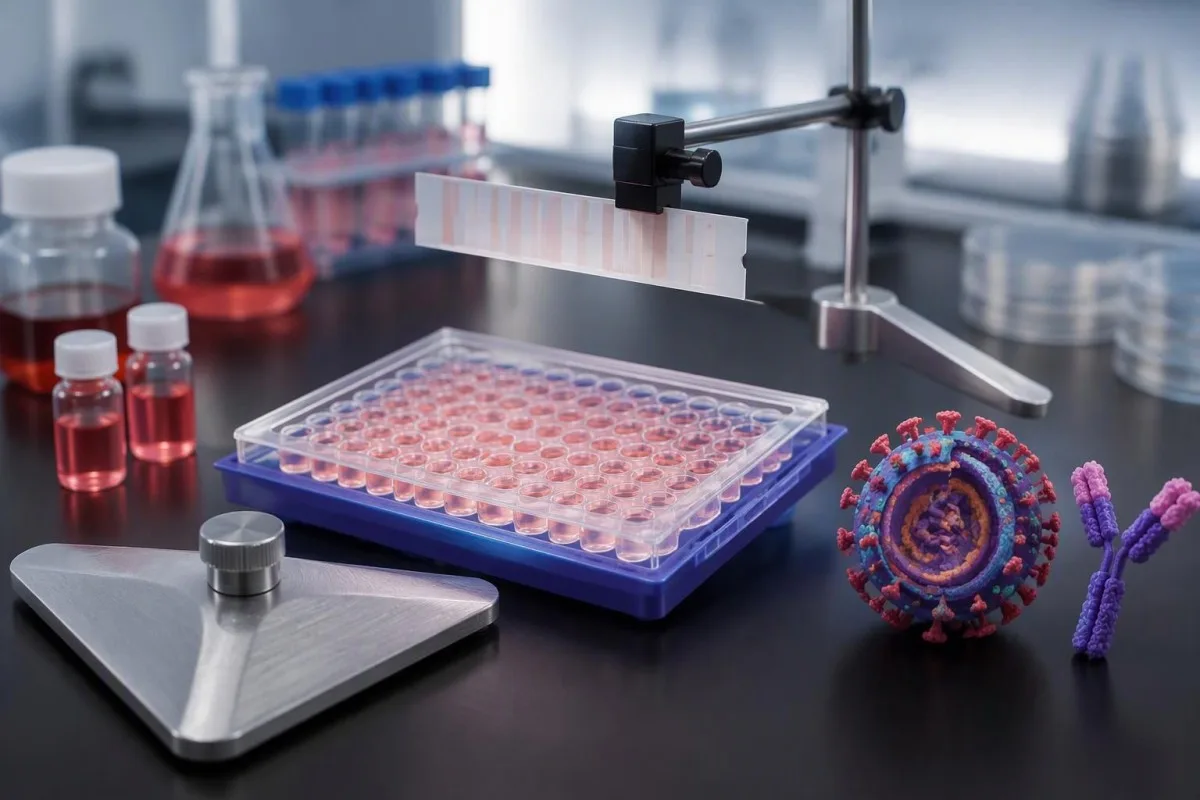
A positive antibody screen is not always a settled diagnosis. The assay, index value, exposure timeline and confirmation method determine what the result can actually tell you.


- HSV-2 IgG positive means a screening assay detected antibody reactivity; a low-positive result may need confirmation before diagnosing HSV-2 infection.
- Low-positive index values around 1.1–3.0 are a particular concern with the HSV-2 enzyme immunoassay discussed in CDC guidance, not a universal range for every assay.
- Index values are usually dimensionless assay signals, not viral loads, antibody concentrations in mg/dL or measures of outbreak severity.
- Kumpirmasyon should use a suitably different method, such as an HSV Western blot or Biokit, rather than simply repeating the same screening assay.
- Bag-ong pagkahipos can produce an early false-negative antibody test; CDC recommends repeat type-specific testing 12 weeks after suspected acquisition.
- HSV IgM is not recommended because it is not reliably type-specific and can become positive during recurrent episodes.
- Current symptoms are best investigated with an HSV PCR/NAAT swab from a fresh affected site; IgG cannot identify a current outbreak.
- Infection timing cannot be established from an index of 2.0, 8.0 or any other single antibody value.
- Screening without symptoms is not routinely recommended by the USPSTF, including during pregnancy; targeted testing may still be appropriate.
- Kinahanglan ug dali nga assessment is needed for new suspected herpes during pregnancy, eye symptoms, neurological symptoms or inability to urinate.
Does HSV-2 IgG positive establish genital herpes?
HSV-2 IgG positive does not always establish genital herpes, especially when a screening assay returns a low-positive index. A confirmed type-specific result generally supports HSV-2 infection, usually anogenital, but antibodies cannot identify an active outbreak or show when infection occurred; values around 1.1–3.0 on certain assays deserve particular scrutiny.
A laboratory's positive flag reports that its signal crossed a decision threshold, not that every diagnostic uncertainty disappeared. For example, an index of 1.6 in someone without symptoms should prompt questions about the assay and confirmation pathway before anyone labels the result a lifelong diagnosis.
A properly confirmed HSV-2 antibody result generally implies anogenital infection because HSV-2 is predominantly sexually acquired, although serology does not anatomically locate the virus. Neither a value of 1.6 nor 16 proves that a particular rash is herpes; testing the affected site answers that separate question.
My first 3 questions are straightforward: Which assay was used, what was the exact index, and how long after the possible exposure was the sample collected? I’m Thomas Klein, MD, Chief Medical Officer at Kantesti; the reasoning behind those questions is more useful than treating every positive flag identically.
Si Kantesti usa ka AI blood test analyzer that can help organize a reported HSV-2 index and the questions it raises, but it cannot perform biological confirmation. Our organisasyon ug clinical focus explain that distinction; a screen, a confirmatory test and a symptom assessment answer 3 different questions.
What does an HSV-2 IgG index value measure?
Usa ka HSV-2 IgG index value is usually a dimensionless comparison between the sample's assay signal and a laboratory cutoff. It is not a viral load, and a value of 4.0 does not mean twice the infection burden of 2.0; the manufacturer's interpretation rules control how the number is classified.
Many reports use negative, equivocal and positive categories, but their boundaries are not interchangeable. The example below uses 1.10 as the positive threshold; another assay may report a different cutoff, an arbitrary unit or only a qualitative result, so the printed reference interval takes priority.
Ang termino low positive describes a region where weak reactivity is less dependable on certain assays, not a mild form of herpes. CDC highlights indexes below 3.0 for a particular enzyme immunoassay, whereas some studies investigated low-positive results through 3.5; those are assay-specific evidence boundaries.
An index of 2.4 from one laboratory cannot safely be compared with 2.4 from another unless the test method, calibration and reporting scale match. Even matching assay names do not make small fluctuations clinically meaningful, because analytical variation can move a sample across a borderline threshold.
Ask for the exact assay name, index, reference interval and any reflex-confirmation comment—4 report details that often get lost in a portal notification. Our explanation of kalidad kumpara sa gidaghanon nga mga resulta helps distinguish a numerical screening signal from a genuinely measured concentration.
Why can a low positive HSV-2 result be false?
A low positive HSV-2 result can reflect nonspecific antibody binding, cross-reactivity or analytical variation rather than true HSV-2 infection. False positives also become proportionally more common when testing people with a low likelihood of infection, so an index of 1.5 needs both laboratory and clinical context.
The probability that a positive result is correct is called its positibo nga prediktibo nga bili, and it depends on the population being tested. For a deliberately hypothetical assay with 95% sensitivity, 95% nga specificity ug 5% prevalence, testing 1,000 people produces about 48 true positives and 48 false positives.
That hypothetical example gives a positive predictive value of roughly 50%, despite apparently reassuring sensitivity and specificity figures. It is not an estimate for your particular HSV-2 test; it explains why indiscriminate screening of low-risk populations can create substantial uncertainty and why personal probability cannot be read directly from an index.
Morrow et al. examined 782 samples and found that only about 35% of low-positive HerpeSelect results with indexes 1.1–3.5 were positive by both Biokit and Western blot, compared with about 92% above 3.5. The population and assays matter; these percentages are not a universal calculator for every positive result (Morrow et al., 2005).
A plausible exposure history raises the chance that a reactive screen is genuine, but anxiety does not change assay specificity. Our discussion of positibo nga kahulugan sa resulta sa antibody separates 3 commonly confused ideas: detected reactivity, past exposure and evidence of current disease.
Which HSV-2 assays need extra caution?
Ang HerpeSelect HSV-2 enzyme immunoassay has a recognized false-positive problem at low index values, particularly 1.1–3.0 in CDC guidance. Other enzyme and chemiluminescent assays have their own performance characteristics; the same numerical cutoff should not be applied automatically across different testing systems.
CDC cites one study reporting 57.4% overall specificity ug 39.8% specificity for samples with index values 1.1–2.9 on the assay under discussion. These are study-specific performance figures—not the probability that your positive test is false—and CDC consequently recommends confirmation with a second method before interpretation (Workowski et al., 2021).
A newer instrument or a more precise-looking decimal does not eliminate this problem. Reports showing 1.73 ug 1.7 may reflect the same weak signal; additional decimal places describe reporting precision, not stronger clinical proof, and different assays may share enough antigen design to share an error.
The best laboratory question is not simply, 'Is this test accurate?' Ask whether the laboratory validates low-positive results, which assay it uses and whether its reflex test is independent—3 details that determine whether a confirmation comment genuinely reduces uncertainty.
Assay-specific interpretation also matters in other settings, although their thresholds cannot be imported into herpes testing; our JCV antibody index explanation illustrates that principle. Our mga sumbanan sa medikal nga pag-validate distinguish technical performance from clinical claims; an AI interpretation is not a second laboratory method.
How should a positive HSV-2 screen be confirmed?
A questionable HSV-2 screen should be confirmed with a suitably different testing method, commonly an HSV Western blot or Biokit where available. Repeating the same enzyme immunoassay may reproduce the same error; 2 positive results are not automatically independent evidence if they share the same method.
HSV Western blot evaluates antibody patterns against multiple viral proteins and is used as a reference method, although access, ordering arrangements and cost vary. Biokit uses a different format and can improve the specificity of a 2-step algorithm; neither test turns a very early sample into a reliable final answer.
Some laboratories offer an HSV-2 inhibition assay as reflex confirmation, using competition or blocking to investigate type-specific reactivity. Ask how that particular laboratory defines positive, negative and indeterminate results, because an inhibition percentage such as 60% has meaning only within that test's validated decision rule.
CDC specifically warns against using the HerpeSelect HSV-2 immunoblot to confirm its enzyme immunoassay because the 2 tests use the same antigen. The word 'blot' therefore does not guarantee independence: a commercial immunoblot and a reference HSV Western blot are not interchangeable confirmation methods (Workowski et al., 2021).
When confirmation is unavailable, the clinician should explain the unresolved false-positive possibility rather than quietly treating the screen as definitive. The broader logic of pagkumpirma sa mga reaktibo nga screen sa impeksiyon is useful here, although Chagas and HSV require entirely different tests and timing rules.
When should HSV-2 testing be repeated after exposure?
After suspected recent HSV-2 acquisition, CDC recommends repeating type-specific antibody testing at 12 weeks because early tests can be falsely negative. A low-positive result during that interval can represent developing antibodies or nonspecific reactivity; exposure timing and confirmation must be considered together, not as competing explanations.
Twelve weeks means 84 days, counted from the relevant possible acquisition rather than from the day the report arrived. If the exposure occurred on October 19, 2026, the 12-week point is January 11, 2027; a new exposure during that interval creates a new timeline for that later event.
CDC reports sensitivity of approximately 80%–98% for glycoprotein-G-based type-specific HSV-2 tests, with false negatives more frequent early in infection. This range describes different tests and study populations; a negative result at 12 weeks is more informative than one at 2 weeks but is not mathematically infallible (Workowski et al., 2021).
A reference laboratory may request a longer interval or paired samples if its confirmatory result is indeterminate, so follow the instructions for the actual test ordered. Our guide to PCR and antibody timing explains why direct detection and immune-response tests can disagree, without suggesting their detection windows are identical.
Medication histories can complicate the chronology, but antibiotics do not treat HSV and cannot be assumed to explain away an HSV-2 IgG result. Record any antiviral use and the dates of all treatment; our discussion of STI testing after antibiotics helps separate medication effects across different infections.
What if screening and confirmation disagree?
A positive HSV-2 screen followed by negative or indeterminate confirmation is a discordant result, not automatic proof of either infection or laboratory error. If testing occurred within 12 ka semana of a possible acquisition, repeat testing may be appropriate; after an adequate interval, a false-positive screen becomes a stronger explanation.
Usa ka indeterminate Western blot means the observed pattern does not meet that laboratory's criteria for either a positive or a negative result. It can occur with early antibody development or nonspecific reactivity; the next step is usually a laboratory-directed repeat strategy, not an assumed diagnosis based on 1 ambiguous pattern.
A confirmed negative reference test collected sufficiently late after exposure often outweighs a weak positive screening signal, but the ordering clinician should reconcile the complete history. A documented HSV-2-positive lesion PCR answers a different question and can establish infection even when an antibody result is negative during the first 12 ka semana.
Si Kantesti usa ka AI pagsabot sa resulta sa blood test platform that can help place 2 conflicting reports side by side, provided the uploaded reports contain the assay details. It cannot decide which laboratory is wrong from index values alone; a result described as 'unconfirmed reactive screen' is often more accurate than a settled herpes label.
Ask the clinician to record the actual screening result, confirmation result and follow-up plan—3 separate elements that prevent uncertainty from disappearing inside a problem list. Our explanation of reactive screens and confirmation addresses this documentation issue in another infection without transferring its diagnostic algorithm to HSV.
Do HSV-1 antibodies or HSV IgM clarify HSV-2?
HSV-1 IgG does not confirm HSV-2 infection, and HSV IgM is not recommended for diagnosing either type. HSV-1 antibody cannot distinguish oral from genital infection, while IgM can recur during established herpes; neither test can reliably date an HSV-2 result obtained 2 weeks or 2 years after an exposure.
HSV-1 antibodies can contribute to cross-reactivity in some HSV-2 testing settings, but a positive HSV-1 result does not automatically make an HSV-2 index of 1.8 false. The appropriate response is assay-specific confirmation, not subtracting one index from the other or assuming that all reactivity came from childhood cold sores.
Type-common HSV antibody testing does not reliably separate HSV-1 from HSV-2 and therefore cannot settle an HSV-2-specific question. A report listing only 'HSV IgG positive' lacks 1 crucial detail—the type—and should be clarified with the laboratory before it is interpreted as evidence of genital HSV-2.
HSV IgM is not reliably type-specific and may become positive during recurrent oral or genital episodes, so CDC recommends against using it. Ordering an IgM test after an HSV-2 index of 2.0 does not supply the missing confirmation or prove a recent acquisition (Workowski et al., 2021).
Total IgG concentration is another separate measurement: a result in g/L does not confirm type-specific HSV antibodies. Our serum proteins interpretation guide explains that distinction, while CMV antibody pattern interpretation shows why IgG and IgM rules must remain infection-specific.
Can HSV-2 IgG identify a current outbreak?
HSV-2 IgG cannot identify a current outbreak because antibodies commonly persist between symptomatic episodes. For a fresh blister, ulcer or other suspicious affected site, an HSV PCR/NAAT swab is preferred; CDC reports sensitivities of 90.9%–100% for available HSV NAATs, with high specificity.
A swab should be collected promptly while an affected site is still present, rather than waiting for an antibody appointment in 12 ka semana. A first clinical episode may need treatment before the laboratory result returns; delaying care to settle the IgG index can miss the useful direct-testing window.
Viral culture becomes less sensitive as affected sites heal, and a negative swab does not always exclude herpes because shedding is intermittent. Even with highly sensitive NAATs in the 90.9%–100% range, collection quality and the presence of a suitable affected site determine how useful the individual result is (Workowski et al., 2021).
A random genital swab without an affected site has low diagnostic usefulness for ruling out herpes, and a blood HSV PCR is not the routine test for localized genital symptoms. Our discussion of antibodies versus active infection explains the distinction between an immune memory marker and direct organism detection.
Discharge, itching and painful urination can have causes other than herpes, so a positive IgG should not stop investigation of another treatable condition. Depending on the history, clinicians may order separate tests for 2 o mas daghan infections; our trichomoniasis testing explanation describes one relevant alternative diagnostic pathway.
Can the index reveal when HSV-2 infection occurred?
Dili HSV-2 IgG index value can reliably establish the date of infection, identify the transmitting partner or prove infidelity. An index of 8.0 may occur in established or relatively recent infection, and a first recognized outbreak can appear long after acquisition; antibody magnitude is not a biological timestamp.
A documented change from negative to confirmed positive can support acquisition between 2 appropriately timed samples, but even that interval may not be exact. The earlier negative could have been collected before seroconversion, so the dates, assay sensitivity and intervening exposures still need to be reviewed.
Serial indexes of 1.7, 2.8 and 5.2 do not function like a clock, even if they rise on the same assay. Laboratory variation and individual immune responses limit that interpretation; confirmation or a documented type-specific seroconversion is more meaningful than the slope of an index trend.
Hunahunaa ang usa ka hypothetical 29-anyos nga whose first HSV-2 test is positive after years with the same partner: that single result cannot establish recent acquisition. My clinical rule as Thomas Klein, MD, is to separate what the test supports from what someone fears it implies—especially before relationship conclusions become irreversible.
Antibody timing is not interchangeable between pathogens, and specialist tools used in another infection cannot simply be applied to HSV-2. Our discussion of IgG results during pregnancy illustrates why dating exposure requires infection-specific evidence rather than a generic 'higher means newer' assumption.
Which symptoms need care before confirmation?
New suspected herpes symptoms should be assessed promptly rather than waiting for IgG confirmation, especially during pregnancy or with eye symptoms, neurological symptoms or inability to urinate. CDC recommends 7–10 ka adlaw of antiviral treatment for a first genital episode; the clinician can begin appropriate care while obtaining a swab.
One CDC-recommended first-episode regimen is valacyclovir 1 g orally twice daily for 7–10 days, prescribed after clinical assessment. Kidney impairment can require dose adjustment, and treatment may be extended when healing is incomplete; the appropriate regimen depends on the episode and patient, not the IgG index.
Pregnancy changes the urgency because neonatal transmission risk is approximately 30%–50% when genital herpes is acquired near delivery, compared with less than 1% with recurrent infection or acquisition in the first half of pregnancy. These CDC figures concern actual maternal infection and timing—not an isolated unconfirmed low-positive antibody screen (Workowski et al., 2021).
A painful one-sided rash may suggest shingles rather than genital HSV, but distribution alone cannot replace examination or testing when the presentation is unclear. Our early shingles symptom guide explains that alternative; symptoms involving an eye warrant urgent assessment because vision can be affected.
A possible sexual exposure may also require assessment for other infections independently of the HSV result. If a potentially significant HIV exposure occurred within 72 ka oras, seek urgent advice about post-exposure prophylaxis; our HIV testing human sa PEP explains why its follow-up schedule differs from HSV antibody testing.
Who benefits from HSV-2 antibody testing?
HSV-2 antibody testing is most useful when a specific clinical question justifies it, rather than as routine screening for everyone without symptoms. The 2023 USPSTF recommendation advises against routine serologic screening in asymptomatic adolescents and adults, including pregnant people, because false-positive diagnoses and downstream harms can outweigh expected benefit.
CDC identifies targeted uses including recurrent or atypical genital symptoms with negative direct testing, a clinical diagnosis without laboratory confirmation, or a partner with genital herpes. These are 3 different indications; the USPSTF recommendation against population screening does not mean every diagnostic antibody test is inappropriate (Workowski et al., 2021).
Confirmed HSV-2 can be transmitted without visible symptoms, but an IgG index cannot calculate an individual's daily shedding or per-contact transmission risk. Condoms reduce rather than eliminate risk, and avoiding sexual contact during symptoms is sensible; a value of 10.0 does not justify a numerical infectiousness estimate.
For symptomatic HSV-2 in a discordant heterosexual couple, CDC notes that valacyclovir 500 mg daily reduces transmission risk as part of a broader prevention strategy. That evidence should not be assumed to apply identically to an asymptomatic person identified only by serology; suppressive treatment decisions belong in a clinician-led discussion.
The USPSTF's Grade D recommendation reflects the balance of benefit and harm in asymptomatic screening, not a judgment about people living with herpes (US Preventive Services Task Force, 2023). Our explanation of tinuig nga mga pagsulay sa dugo nga gibase sa risgo shows why adding more tests does not automatically create better preventive care.
What should you bring to the follow-up appointment?
Bring the complete laboratory report, the exposure timeline and any symptom or swab results to your HSV-2 follow-up appointment. The most useful report details are the assay name, exact index, reference interval and confirmation status—4 fields that determine whether a positive flag needs further laboratory investigation.
Si Kantesti usa ka AI-powered blood test analysis tool that can help organize an HSV-2 report for discussion, but it cannot supply a confirmatory assay or date an infection. When a report shows an index of 1.9, the useful output is a clear account of missing information and next questions—not a confidence score presented as a diagnosis.
Ask your clinician 3 practical questions: 'Does this assay's low-positive range apply to me?', 'Which confirmation method is available?' and 'Was the sample collected late enough after exposure?' If answers are uncertain, a laboratory consultation or sexual-health specialist may be more useful than ordering another broad panel.
Sexual-health reports can contain unusually sensitive information, including partner details and identifying data. Review consent and remove unnecessary identifiers before sharing; our mga pamaagi sa pribasiya ug datos explain data handling, while 2-person consent matters when one person's report includes information about someone else.
I would also verify that the AI explanation matches the original report's 4 key fields rather than a cropped screenshot. Our AI report safety checklist describes source checking; Thomas Klein, MD, is the physician voice of this article, but an article or automated interpretation does not replace your own clinician's assessment.
Research publications and limits of AI interpretation
Ang 2 research records listed below describe AI engineering and technical evaluation, not HSV-2 assay validation or proof that AI can confirm herpes. As of Oktubre 19, 2026, this article's clinical interpretation draws on CDC 2021 guidance, the 2023 USPSTF recommendation and the directly relevant assay study cited above.
A benchmark using 100,000 sintetikong mga kaso can evaluate performance against its chosen rubric, but its title and sample count do not establish real-world diagnostic accuracy for low-positive HSV-2 results. Our technical benchmark documentation should be read with attention to case selection, scoring rules and clinical applicability.
The second research record concerns early hantavirus triage and describes 50,000 ka gihubad nga taho in its title, a different clinical problem from HSV serology. Its presence here provides research transparency, not evidence that a hantavirus workflow or multilingual interpretation method can resolve HSV-2 cross-reactivity.
A DOI identifies a research object, but it does not by itself demonstrate peer review, clinical effectiveness or independent replication; those are 3 separate questions. The citations below retain the supplied titles and use 'n.d.' because verified publication dates and complete author lists were not provided.
Kantesti's clinical communication should preserve uncertainty when 2 laboratory methods disagree, rather than convert an unresolved screen into a definitive label. Our impormasyon sa medical advisory board describes clinical oversight; a completed, appropriately timed confirmation test remains the relevant evidence for an individual HSV-2 diagnosis.
Kanunay nga Gipangutana nga mga Pangutana
Nagpasabot ba gyud nga naa koy genital herpes kon positibo ang HSV-2 IgG?
Ang positibong resulta sa screening sa HSV-2 IgG dili kanunay nagpamatuod sa genital herpes, ilabi na kon ubos ang index sa usa ka assay nga nahibaloang adunay mga limitasyon sa false-positive nga resulta. Gipasiugda sa CDC nga ang mga bili sa index nga mga 1.1–3.0 sa HerpeSelect HSV-2 enzyme immunoassay maoy sakop diin labi ka importante ang pagkumpirma. Ang nakumpirmang resulta nga espesipiko sa tipo kasagarang mosuporta sa impeksiyon sa HSV-2, nga kasagarang anogenital. Dili gihapon mapamatud-an sa mga antibody nga herpes outbreak ang kasamtangang mga simtomas o mahibal-an kon kanus-a nahitabo ang impeksiyon.
What does an HSV-2 IgG index of 1.5 or 2.0 mean?
An HSV-2 IgG index of 1.5 or 2.0 is a low-positive screening signal on many commonly used reporting scales, but the laboratory's own reference interval determines its classification. The index is usually dimensionless and does not measure viral load or outbreak severity. If the assay has recognized low-positive limitations, a suitably different confirmatory method should be discussed. The same index on another assay may have a different predictive value.
Can an HSV-2 IgG result above 3.5 still be false positive?
An HSV-2 IgG result above 3.5 can still be false positive; no single index guarantees infection across all assays. In Morrow et al.'s 2005 study, approximately 92% of HerpeSelect results above 3.5 were positive by both Biokit and Western blot. That finding applies to the studied samples and methods, not every laboratory or patient. Confirmation can still be reasonable when the result conflicts with clinical history or has major consequences.
How long after exposure should I repeat an HSV-2 IgG test?
CDC recommends repeating type-specific HSV-2 antibody testing 12 weeks after suspected recent acquisition because early testing can miss developing antibodies. Twelve weeks equals 84 days from the relevant exposure, not from the date the report arrived. A confirmatory laboratory may give additional timing instructions for an indeterminate result. New suspicious symptoms should be assessed promptly with an affected-site swab rather than waiting for the antibody retest.
Can HSV-2 IgG show a current outbreak or when I caught herpes?
HSV-2 IgG cannot identify a current outbreak or reliably date infection. An index of 2.0 or 8.0 is not a timestamp, because antibody responses vary and antibodies persist between episodes. A fresh affected-site HSV PCR/NAAT is preferred when investigating current symptoms. A documented change between 2 appropriately timed tests may narrow an acquisition interval, but it cannot reliably identify the transmitting partner.
Is repeating the same HSV-2 test enough to confirm it?
Repeating the same HSV-2 screening assay is not necessarily sufficient confirmation because the same nonspecific reactivity can recur. CDC recommends a second method such as Biokit or HSV Western blot for low-positive results on the enzyme immunoassay it discusses. CDC also warns that the HerpeSelect immunoblot should not confirm the HerpeSelect enzyme immunoassay because the 2 use the same antigen. A laboratory-specific inhibition assay may offer additional evidence, but its validation and interpretation rules should be clarified.
Karon na ang AI-Powered Blood Test Analysis
Apil sa kapin sa 2 milyon nga mga user sa tibuok kalibutan nga nagsalig sa Kantesti para sa dayon ug tukma nga pag-analisa sa lab test. I-upload ang imong resulta sa blood test ug makadawat og komprehensibong pagsabot sa 15,000+ nga mga biomarker sulod sa mga segundo.
📚 Mga Napangalan nga Research Publications
Klein, T., Mitchell, S., & Weber, H. (2026). Multilingual AI Assisted Clinical Decision Support para sa Sayong Hantavirus Triage: Disenyo, Engineering Validation, ug Real-World Deployment sa 50,000 ka Gi-interpretang Report sa Blood Test. Kantesti AI Medical Research.
Klein, T., Mitchell, S., & Weber, H. (2026). Usa ka Pre-Registered, Rubric-Based Automated Technical Benchmark sa Kantesti Blood-Test Interpretation Engine sa 100,000 Synthetic Test Cases. Kantesti AI Medical Research.
📖 Mga Panlabas nga Sanggunian sa Medisina
Morrow RA et al. (2005). Use of "biokit HSV-2 Rapid Assay" to improve the positive predictive value of Focus HerpeSelect HSV-2 ELISA. BMC Infectious Diseases, 5, 84.
US Preventive Services Task Force (2023). Serologic Screening for Genital Herpes Infection: US Preventive Services Task Force Reaffirmation Recommendation Statement. JAMA, 329(6), 502–507.
⚕️ Pagpasabot sa Medikal
Kini nga artikulo para sa katuyoan sa edukasyon ra ug dili kini mosangpot sa medikal nga tambag. Kanunay mokonsulta sa usa ka kwalipikado nga healthcare provider alang sa mga desisyon sa diagnosis ug pagtambal.
Mga E-E-A-T Trust Signals
Kasinatian
Pagsusi sa klinika nga gipangulohan sa doktor sa mga workflow sa interpretasyon sa lab.
Kahanas
Pokus sa medisina sa laboratoryo kung giunsa paglihok ang mga biomarker sa konteksto sa klinika.
Pagka-awtorisado
Gisulat ni Dr. Thomas Klein ug gisusi ni Dr. Sarah Mitchell ug Prof. Dr. Hans Weber.
Kasaligan
Interpretasyon nga base sa ebidensya, nga adunay klaro nga mga agianan sa sunod nga buhat aron makunhuran ang kabalaka.