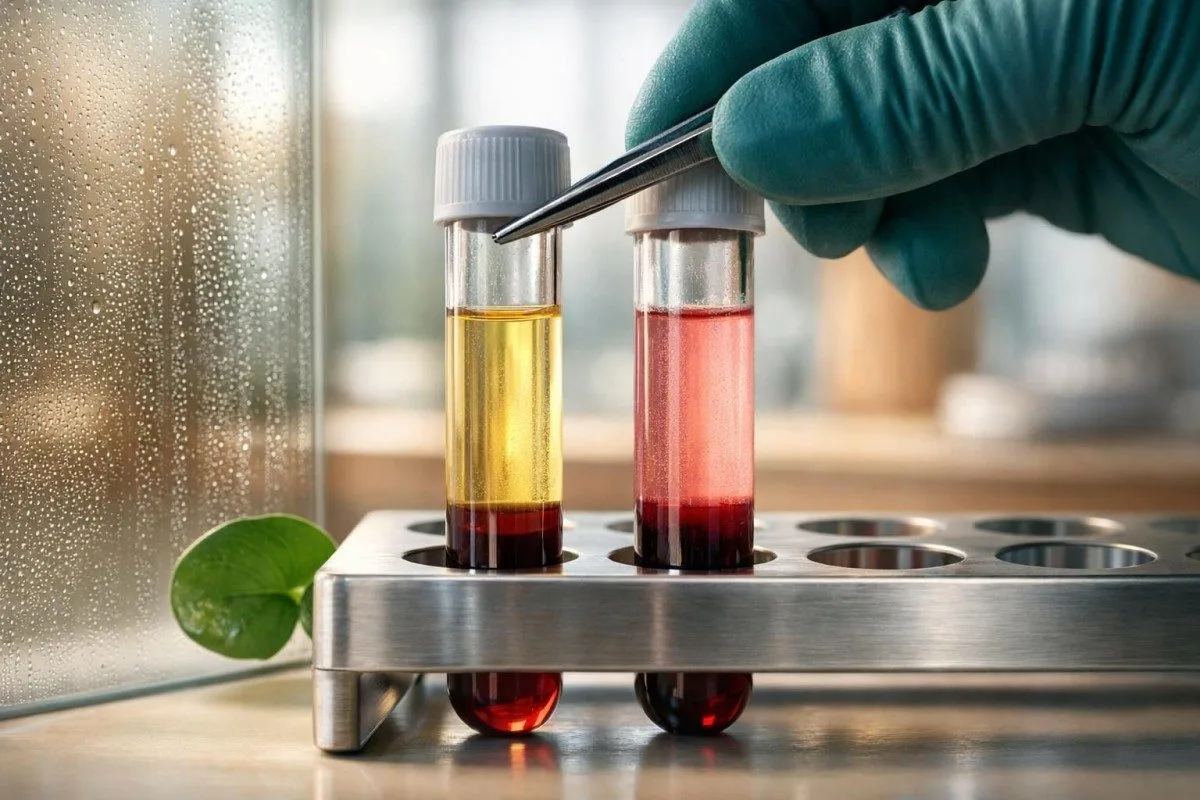
The closest lab is not always the safest one. For a routine blood test or annual blood test, sample handling, accreditation, turnaround, and honest pricing matter more than postcode.


- CLIA/CAP beats convenience; CLIA is the legal minimum in most US labs, while CAP or ISO 15189 usually signals tighter quality oversight.
- Potassium can read falsely high by roughly 0.3-1.0 mmol/L after hemolysis, so collection quality changes the answer before the analyzer starts.
- Glucose can fall about 5-7% per hour if whole blood is left unprocessed at room temperature.
- Citrate tubes for PT/INR should be filled to at least 90% of stated volume or clotting times may look falsely prolonged.
- CBC timing matters; EDTA samples are best analyzed within 24 hours because delay can distort MCV and platelet indices.
- Ferritin below 30 ng/mL often suggests depleted iron stores in adults even when a lab's lower reference limit is 12-15 ng/mL.
- HbA1c of 5.7-6.4% fits prediabetes, and 6.5% or higher supports diabetes when confirmed in the right clinical setting.
- Routine pricing for a self-pay CBC, CMP, and lipid panel often lands around $60-$200 total, but hospital facility fees can push it much higher.
- Best setting is usually walk-in for low-complexity routine panels, hospital labs for urgent or specialist-linked testing, urgent care when you also need an exam, and at-home collection only for selected tests.
What actually makes a local blood lab reliable?
A reliable blood test near me is the lab that gets the specimen right, not the one five minutes away. The safest choice has current accreditation, trained collectors, clear pricing, realistic turnaround times, and a plan for urgent abnormalities.
If you search blood test near me, compare the setting before the address: walk-in labs are usually best for low-cost routine testing, hospital labs for urgent or complex work, urgent care when symptoms need same-day review, and at-home kits for convenience with selected markers only. On Kantesti AI, we repeatedly see confusing results after preventable collection errors rather than rare disease. One common example is dehydration, which can falsely concentrate several values; we break that down in our article on dehydration-related false highs.
Pre-analytical errors dominate real-world lab mistakes. Plebani's work in Clin Chem Lab Med has long shown that the collection, labeling, transport, and processing phase accounts for the largest share of lab error, often cited around 46% to 68%, and that fits what I see when our team reviews uploaded reports.
A serum glucose sample can drop by about 5% to 7% per hour if whole blood sits unseparated at room temperature. Potassium can look falsely high after hemolysis—often by 0.3 to 1.0 mmol/L—so the best local lab is the one that prevents avoidable artifact, not the one with the prettiest waiting room.
As Thomas Klein, MD, I tell patients to ask one blunt question before booking: who contacts me if a critical result posts at 7 pm? If the front desk cannot explain how they handle a potassium above 6.0 mmol/L, a sodium below 125 mmol/L, or a hemoglobin near 7 g/dL, I move on.
Which safety and accreditation checks matter most?
The quickest quality screen is accreditation plus visible collection discipline. In most US settings, CLIA certification is the floor; CAP accreditation or ISO 15189 usually tells me the lab takes quality systems more seriously.
Accreditation matters because it predicts how a lab behaves on boring days, not just crisis days. When we discuss analytical reliability on our Medical Validation page, the point is simple: the result is only as trustworthy as the process that produced it.
CLIA certification is the legal minimum for most diagnostic testing in the United States, but it does not mean every lab is equally good. CAP-accredited labs undergo external proficiency testing and on-site inspection, while ISO 15189 remains the key international standard for medical laboratory competence; our physicians review methodology with that mindset through the Medical Advisory Board.
Watch the collector for 30 seconds and you learn a lot. A careful phlebotomist verifies two identifiers, labels tubes in your presence, releases tourniquet pressure within about 1 minute, and knows when a blue-top citrate tube or chilled transport is needed. Tourniquet time beyond 1 minute can falsely increase total protein, calcium, and hematocrit.
The best labs also have a redraw policy that does not punish you for their error. If a specimen is rejected for clotting, underfilling, or labeling failure, a reliable site can explain what happened and usually repeats the collection without charging twice.
How do walk-in labs, hospital labs, urgent care, and at-home kits compare?
Walk-in labs are usually best for simple self-pay testing, hospital labs are best for urgent or specialist-linked work, urgent care is best when you also need a clinician today, and at-home testing is best for convenience—not complexity.
Walk-in labs usually win on price and speed for a routine blood test such as a CBC, CMP, lipid panel, HbA1c, or TSH. They make sense when you are stable, know what was ordered, and do not need a physical exam; for the limits of home collection versus in-person collection, our review of at-home testing accuracy is worth reading.
Hospital outpatient labs cost more, but they handle urgency and complexity better. If you need same-day electrolytes before chemotherapy, difficult draws, pediatric collection, timed medication levels, or fast escalation to a doctor, hospitals are hard to beat; our timeline guide on how long blood test results take shows why on-site analyzers change the clock.
Urgent care sits in the middle. A 52-year-old marathon runner with AST 89 U/L after a race may only have muscle stress, especially if CK is 1200 U/L, but he still benefits from an exam and repeat planning that a bare-bones draw station cannot provide.
At-home kits are getting better for selected markers, but I still avoid them for troponin, PT/INR, blood cultures, difficult hormone timing, or anything where sample stability is tight. Finger-prick collections can work for HbA1c or some lipid testing, yet a borderline result often ends with a standard venous redraw anyway.
How can you compare blood test cost without getting surprised later?
Transparent pricing means the lab can quote the all-in cash price before your sample is collected. That quote should include the test itself, the collection fee, any facility fee, and whether a redraw costs extra.
For self-pay patients, blood test cost varies more by setting than by geography. A CBC often runs $20-$50, a CMP $25-$70, a lipid panel $20-$60, TSH $25-$80, and HbA1c $20-$50 at many outpatient sites; our price breakdown for blood test cost without insurance shows how quickly bundled pricing can drift.
Hospital outpatient departments often add a facility fee of roughly $50-$250 on top of the lab charge. Patients hate that surprise, and honestly I do too, because the menu may look similar to a walk-in lab until the bill arrives.
Hidden fees tend to come from four places: the venipuncture charge, the clinician visit, urgent processing, and pathology review if a smear or manual differential is triggered. If staff can only quote a vague wellness panel price and cannot tell you whether the draw fee is separate, that is a warning sign.
As of April 10, 2026, the smartest way to shop locally is still old-fashioned: ask for the written cash price of the exact tests you need, not a mystery package. If you already have the report and want a second layer of context, our AI blood test platform can interpret trends after the fact—but price transparency should come first.
What should a routine blood test or annual blood test usually include?
A routine blood test usually means a CBC, a BMP or CMP, and often a lipid panel. An annual blood test should be tailored to age, medications, symptoms, and family history rather than expanded into a giant shopping list.
A standard outpatient panel often includes CBC, CMP or BMP, and lipids, with HbA1c added when metabolic risk is present. Our guide to the standard blood test and what it misses explains why ferritin, B12, vitamin D, thyroid tests, or inflammation markers should be added for a reason—not just because a package sounds thorough.
An annual blood test is not one size fits all. In women with heavy periods, fatigue, vegetarian diets, or postpartum symptoms, I add ferritin early because ferritin below 30 ng/mL often reflects depleted iron stores even when a lab marks 12-15 ng/mL as technically normal; our checklist for women in their 30s goes deeper on that nuance.
Age changes the menu. In men over 50, kidney function, glucose status, lipids, liver enzymes, and medication-specific monitoring usually matter more than fashionable hormone bundles; our review of blood tests every man over 50 is the version I would hand to a patient in clinic.
Timing matters for certain add-ons. HbA1c 5.7%-6.4% indicates prediabetes, 6.5% or higher supports diabetes when confirmed, testosterone is best checked around 7-10 am, cortisol around 8-9 am, and prolactin is cleaner after 15-30 minutes of quiet rest because stress can transiently double or triple it.
Why do fasting, timing, supplements, and tube handling change lab reliability?
Collection conditions can change results enough to create a false diagnosis. Fasting status, hydration, exercise, supplements, tube fill, and transport temperature all affect whether a result reflects physiology or artifact.
Fasting is only necessary for selected tests, but timing still matters. Our review of fasting before a blood test explains why water is usually fine, while coffee, nicotine, intense exercise, and prolonged fasting can move glucose, triglycerides, cortisol, and even white cell counts in the wrong direction.
Biotin supplements matter more than many patients realize. Doses of 5-10 mg daily—common in hair and nail products—can interfere with some immunoassays, including certain thyroid and cardiac tests, and I still see patients forget to mention them; if you are comparing cell-based markers, our CBC differential guide shows how easily context changes interpretation.
Tube type and fill volume are not trivia. Blue-top citrate tubes used for PT/INR should be filled to at least 90% of target volume, and EDTA CBC samples are ideally analyzed within 24 hours because delay can alter MCV, MPV, and smear appearance; if you are unsure what chemistry panel was ordered, see the practical split between CMP and BMP.
Exercise and hydration can fool routine screening. I—Thomas Klein, MD—have seen runners sent into liver workups because AST was elevated from muscle strain, while dehydration temporarily pushed up hematocrit, albumin, and creatinine enough to make a healthy person look sick.
How fast should results come back, and when does speed matter?
Routine outpatient CBC and chemistry results should usually return within 24-72 hours. Same-day turnaround mainly matters when the result changes today's treatment, triage, or medication decision.
Same-day testing is useful for potassium, creatinine, sodium, pregnancy hCG, PT/INR, and emergency cardiac markers—not for everything. If kidney function is the question, the difference between a basic chemistry panel and a renal-focused order matters more than many patients realize; our comparison of renal panel versus CMP helps sort that out.
Speed matters when delay changes care. A creatinine rise of 0.3 mg/dL within 48 hours meets one accepted criterion for acute kidney injury, and a potassium above 6.0 mmol/L or sodium below 125 mmol/L often triggers urgent clinician contact, whereas most lipid results can safely wait a day or two; if lipids are your main question, our lipid panel guide is more useful than chasing a same-day promise.
Send-out assays are different. Many autoimmune panels, advanced hormones, and specialty immunology tests take 3-10 days, and any lab promising every test by tomorrow makes me cautious unless I know they truly run it onsite; our full biomarkers guide shows which markers are simple chemistry and which usually travel.
Most patients find one honest estimate better than three optimistic ones. If the front desk says, 'CBC tomorrow, ANA next week, and critical results are phoned the same day,' that is usually a better sign than glossy vague reassurance.
What should a trustworthy lab report include?
A trustworthy lab gives you the actual report, not just a green or red flag in a portal. You need the number, the unit, the reference interval, the collection time, and any specimen comment that explains a possible artifact.
A useful report shows units, reference ranges, collection time, and comments such as hemolyzed, lipemic, or insufficient sample. If you upload complete files through our guide to PDF blood test upload, the interpretation is usually better because page 2 often holds the context patients accidentally crop away.
Reference ranges are not universal. A creatinine of 1.2 mg/dL is about 106 µmol/L, some European labs still flag ferritin differently from US labs, and an eGFR result may shift when a lab updates equations, so a photo of the whole document matters; if you are scanning paper results, our note on photo-based lab reading explains where errors creep in.
Kantesti AI interprets patterns, not isolated flags. In our analysis of more than 2 million uploaded panels from 127+ countries, the most common patient mistake is treating one mildly abnormal number as a diagnosis, when the real clue lives in the combination—AST with CK, MCV with ferritin, or BUN with creatinine; the technical side is outlined in our AI blood test analyzer technology guide.
Context changes almost everything. An AST of 89 U/L after weightlifting, a WBC of 11.5 x10^9/L during a viral recovery, or a TSH swing of 0.5-1.0 mIU/L across the day may mean far less than patients fear, which is why our platform focuses on trends, symptom context, and related markers rather than a simple red-box alert.
How do privacy, chain of custody, and follow-up affect lab choice?
Reliable labs protect identity, control who sees results, and explain who acts on critical values. Privacy is part of quality now, especially if your results move between a local lab, a patient portal, and an interpretation tool.
Ask how your results are delivered before the sample is taken. A solid workflow uses a secure portal, identity verification, and a defined callback plan for critical abnormalities rather than plain email sent to whoever typed the address fastest.
Chain of custody matters most when the sample leaves your sight. Home collection can be reasonable for selected tests, but delays in mailing, weekend storage, or temperature swings can make some hormone, coagulation, and cellular measurements much less reliable than a standard venous sample.
When patients use Kantesti, we want the data handled as carefully as the specimen. Our platform operates under CE Mark, HIPAA, GDPR, and ISO 27001 controls, and the details sit in our Terms of Use and software license agreement; that digital discipline is one reason clinicians trust our AI with full PDF interpretation in about 60 seconds.
Follow-up matters as much as privacy. If you have chest pain, shortness of breath, black stools, fainting, or a doctor specifically worries about troponin, sepsis, or severe anemia, skip the search for a convenient local lab and go where treatment can happen immediately; if you need help using our workflow safely, our contact team can point you in the right direction.
A simple checklist for choosing the right local lab
If two labs are equally close, choose the one that can answer five questions in under 60 seconds: What accreditation do you hold, who collects the sample, what is the all-in price, when will results post, and who contacts me for critical values?
My quick scoring system is simple: give 0-2 points each for accreditation, collector skill, transparent pricing, realistic turnaround, and critical-result follow-up. Any lab scoring 8/10 or above is usually a safe bet for a routine blood test or annual blood test in a stable adult.
Boring competence beats glossy marketing. In my experience, the labs that answer clearly about redraw policy, timed collections, fasting rules, and send-out delays are the ones least likely to create confusing noise in your results.
If you already have results, use that information instead of guessing. You can try our free blood test analysis demo for a structured interpretation, and if you want to know who we are as a medical organization, our About Us page lays out the team, standards, and mission behind Kantesti AI.
Bottom line: for a simple wellness screen, a well-run walk-in lab usually wins; for symptoms, difficult collections, timed tests, or urgent chemistry, hospital labs or urgent care are safer. The right lab is the one whose process fits the test.
A 30-second phone script I would actually use
Ask these questions in order: Do you have CLIA, CAP, or ISO 15189 oversight; do you collect onsite; what is the full cash price for CBC, CMP, lipids, or the exact tests I need; when do results post; and who calls if something is critical? If staff can answer cleanly without putting you on hold three times, that is usually a good sign.
When I steer patients elsewhere
I look elsewhere when the lab cannot explain sample timing, quotes only a vague package price, emails results insecurely, or treats a rejected sample as your financial problem. Those are process failures, and process failures are how healthy people get mislabeled.
Research publications and deeper methodology
Two recent publications from our group are especially useful when you are comparing local labs because they show how much interpretation can change when indices, specimen handling, and paired markers are overlooked.
Klein, T. (2025). RDW Blood Test: Complete Guide to RDW-CV, MCV & MCHC. Zenodo. https://doi.org/10.5281/zenodo.18202598. ResearchGate: search record. Academia.edu: search record. If your local lab reports RDW with no explanation, our patient-facing RDW guide shows why RDW-CV, MCV, and MCHC should be interpreted together.
Klein, T. (2025). BUN/Creatinine Ratio Explained: Kidney Function Test Guide. Zenodo. https://doi.org/10.5281/zenodo.18207872. ResearchGate: search record. Academia.edu: search record. For day-to-day use, our BUN/creatinine ratio guide explains why dehydration, GI bleeding, catabolism, and low muscle mass can all reshape the same number.
If you like this kind of methodology-first approach, the Kantesti blog is where we publish the deeper lab reasoning behind our clinical summaries. That is also where I tend to send colleagues when they want the 'why,' not just the flag.
Frequently Asked Questions
How do I know if a blood test near me is accredited?
A reliable local lab should be able to tell you its accreditation status before you book. In the United States, CLIA certification is the minimum legal requirement for most diagnostic labs, while CAP accreditation adds external proficiency testing and on-site inspection; outside the US, ISO 15189 is the main international benchmark. Ask who oversees the lab, whether testing is done onsite or sent out, and how critical results are communicated. If staff cannot answer those basics, I would be cautious.
Is a hospital lab more accurate than a walk-in lab?
Hospital labs are not automatically more accurate, but they are usually better set up for urgent, complex, or specialist-linked testing. A good walk-in lab can be perfectly reliable for a routine blood test such as CBC, CMP, lipids, HbA1c, or TSH, especially when pricing matters. Hospital labs tend to have faster escalation pathways, difficult-draw support, same-day chemistry capacity, and closer links to clinicians when potassium is above 6.0 mmol/L or creatinine is rising quickly. The best choice depends on the test and whether you also need an exam or urgent treatment.
What does a routine blood test usually include?
A routine blood test usually includes a CBC, a BMP or CMP, and often a lipid panel. HbA1c is commonly added when diabetes risk is present, and TSH, ferritin, B12, or vitamin D are added selectively based on symptoms, medications, or history rather than automatically. HbA1c of 5.7% to 6.4% fits prediabetes, and ferritin below 30 ng/mL often suggests low iron stores even if a lab's lower reference range is lower. A good annual blood test should answer a clinical question, not just produce more numbers.
What is a typical blood test cost without insurance?
For cash-pay testing, a CBC often costs about $20 to $50, a CMP about $25 to $70, a lipid panel about $20 to $60, TSH about $25 to $80, and HbA1c about $20 to $50 at many outpatient labs. The total price for a simple annual blood test package often lands between $60 and $200, but hospital outpatient departments may add facility fees of roughly $50 to $250. The practical move is to ask for the all-in price before the draw, including collection and any clinician visit. If the quote is vague, I assume the bill may not stay low.
Are at-home blood tests accurate enough for annual screening?
At-home blood tests can be reasonable for selected low-complexity markers, but they are not ideal for every annual blood test. Shipping delays, temperature changes, small sample volume, and collection technique can affect cellular tests, coagulation studies, some hormone measurements, and any result that depends on tight timing. In my experience, HbA1c and some lipid checks are more forgiving than PT/INR, troponin, or specialist autoimmune panels. If the result is borderline or unexpected, a standard venous redraw is often the next step anyway.
How long should routine blood test results take?
Most routine outpatient CBC and chemistry results should come back within 24 to 72 hours. Same-day turnaround is mainly relevant for urgent electrolytes, kidney injury concerns, pregnancy testing, PT/INR, and hospital-based emergency pathways, while many specialty send-out tests take 3 to 10 days. A creatinine rise of 0.3 mg/dL within 48 hours can matter clinically, so waiting a week for that kind of result is not ideal. Honest turnaround estimates are usually a sign of a well-run lab.
Get AI-Powered Blood Test Analysis Today
Join over 2 million users worldwide who trust Kantesti for instant, accurate lab test analysis. Upload your blood test results and receive comprehensive interpretation of 15,000+ biomarkers in seconds.
📚 Referenced Research Publications
Klein, T., Mitchell, S., & Weber, H. (2026). RDW Blood Test: Complete Guide to RDW-CV, MCV & MCHC. Kantesti AI Medical Research.
Klein, T., Mitchell, S., & Weber, H. (2026). BUN/Creatinine Ratio Explained: Kidney Function Test Guide. Kantesti AI Medical Research.
⚕️ Medical Disclaimer
This article is for educational purposes only and does not constitute medical advice. Always consult a qualified healthcare provider for diagnosis and treatment decisions.
E-E-A-T Trust Signals
Experience
Physician-led clinical review of lab interpretation workflows.
Expertise
Laboratory medicine focus on how biomarkers behave in clinical context.
Authoritativeness
Written by Dr. Thomas Klein with review by Dr. Sarah Mitchell and Prof. Dr. Hans Weber.
Trustworthiness
Evidence-based interpretation with clear follow-up pathways to reduce alarm.