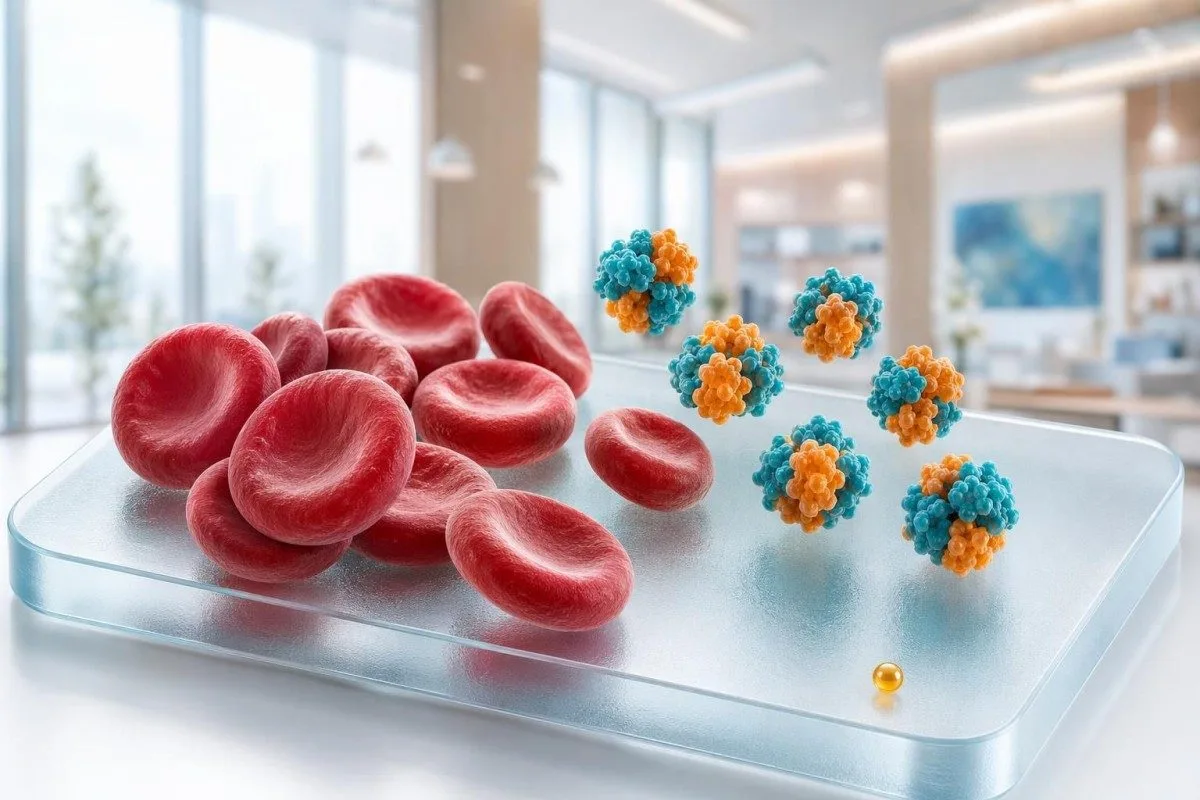
A high RBC flag can look alarming when hemoglobin and hematocrit are normal. In clinic, this pattern is usually about cell size, plasma volume, reference ranges, or mild oxygen stress—not automatically a dangerous excess of red cells.


- Red blood cell count can be high while hemoglobin stays normal when the cells are small, especially with thalassemia trait or early iron-related changes.
- RBC normal range is usually about 4.5–5.9 million/µL in adult men and 4.1–5.1 million/µL in adult women, but labs vary.
- Hemoglobin levels matter more than RBC count alone for oxygen-carrying capacity; normal adult hemoglobin is roughly 13.5–17.5 g/dL in men and 12.0–15.5 g/dL in women.
- MCV below 80 fL with a high RBC count often points toward thalassemia trait, especially if RDW is normal and hemoglobin is only mildly low or normal.
- Ferritin below 30 ng/mL commonly supports iron deficiency even when hemoglobin has not fallen yet.
- Smoking, altitude, and sleep apnea can push RBC production upward through low-oxygen signaling, sometimes before hemoglobin crosses the lab’s high cutoff.
- Repeat testing is often done in 2–8 weeks when the patient is well hydrated, not acutely ill, and ideally at the same lab.
- Polycythemia vera workup is usually considered when hemoglobin or hematocrit is high, not when RBC count alone is slightly flagged.
Why RBC can be high when hemoglobin looks normal
A high red blood cell count with normal hemoglobin usually means one of four things: smaller-than-average red cells, mild dehydration or plasma-volume shift, smoking or altitude-related oxygen stress, or a lab reference-range mismatch. It does not automatically mean polycythemia. I’m Thomas Klein, MD, and when I review this pattern, I read RBC beside MCV, MCH, RDW, ferritin, hematocrit, and the patient’s baseline—never as a single isolated number.
The confusing part is arithmetic. RBC count measures how many red cells are present per microliter, while hemoglobin measures how much oxygen-carrying protein those cells contain. A person can have 5.6 million/µL red cells but a hemoglobin of 13.8 g/dL if each cell is small and carries less hemoglobin than average.
Kantesti AI reads this pattern by comparing CBC indices rather than reacting to the red flag alone. If you upload a CBC to Kantesti AI, our system checks whether the high RBC flag travels with low MCV, low MCH, high RDW, normal hematocrit, or previous similar results.
The first practical step is to compare your result with a reliable baseline. Our deeper guide to RBC normal range explains why a count that is “high” at one lab can be normal at another, especially near the upper limit.
RBC count, hemoglobin, and hematocrit measure different things
RBC count measures cell number, hemoglobin measures oxygen-carrying protein, and hematocrit estimates the percentage of blood volume occupied by red cells. Normal hemoglobin and hematocrit usually mean total red-cell mass is not clearly excessive, even if the RBC count is mildly flagged.
A typical adult RBC normal range is 4.5–5.9 million/µL for men and 4.1–5.1 million/µL for women, though some European laboratories use slightly narrower intervals. Normal hemoglobin levels are often 13.5–17.5 g/dL in men and 12.0–15.5 g/dL in women.
Hematocrit usually sits around 41–53% in adult men and 36–46% in adult women. If hematocrit is normal, the blood is usually not unusually thick, which is why clinicians rarely panic over a borderline RBC flag by itself.
For sex-, age-, and pregnancy-specific hemoglobin ranges, our hemoglobin normal range guide is more useful than a single universal cutoff. Pregnancy, testosterone therapy, high altitude, and heavy endurance training can all shift the expected range.
Dehydration can flag RBC, but the pattern has clues
Dehydration can make a red blood cell count look higher because there is less plasma around the cells. In true hemoconcentration, hemoglobin, hematocrit, albumin, BUN, and sometimes sodium often drift upward together rather than RBC rising alone.
I see this after gastroenteritis, long flights, sauna use, and hard training days. A marathon runner may show RBC 5.9 million/µL, hemoglobin 15.8 g/dL, hematocrit 46%, and BUN 27 mg/dL after a hot race; the same person can normalize 72 hours later.
The thing is, dehydration usually pushes hematocrit more visibly than RBC count. If your hematocrit is 40% and hemoglobin is 13.2 g/dL, dehydration alone is less convincing unless other chemistry results also look concentrated.
Our article on dehydration false highs walks through the albumin, calcium, BUN, creatinine, and sodium clues that help separate a real abnormality from a dry-day artifact.
Thalassemia trait is the classic small-cell explanation
Thalassemia trait commonly causes a high or high-normal RBC count with normal or mildly low hemoglobin because the body makes many small red cells. The telltale CBC pattern is low MCV, low MCH, relatively preserved hemoglobin, and often a normal RDW.
A very typical beta-thalassemia trait result is RBC 5.8 million/µL, hemoglobin 13.1 g/dL, MCV 66 fL, MCH 21 pg, and RDW 13%. That combination is very different from classic iron deficiency, where RBC count often falls or stays normal while RDW rises.
The British Society for Haematology guideline by Ryan et al. describes hemoglobinopathy screening with CBC indices followed by hemoglobin analysis when indicated (Ryan et al., 2010). In practice, beta-thalassemia trait often shows HbA2 above 3.5%, while alpha-thalassemia trait can have a normal electrophoresis and may need genetic testing if the answer matters for family planning.
MCV is the first number I check after RBC in this pattern. Our MCV blood test guide explains why a cell size below 80 fL changes the whole interpretation of a high RBC flag.
Iron deficiency can mimic thalassemia, but not perfectly
Iron deficiency can cause normal hemoglobin with subtle CBC changes, but it usually does not raise RBC count as strongly as thalassemia trait. Ferritin, transferrin saturation, RDW, MCH, and the Mentzer index help doctors separate the two.
Ferritin below 15 ng/mL is highly suggestive of depleted iron stores, and many clinicians treat ferritin below 30 ng/mL as iron deficiency when symptoms fit. In inflammatory states, ferritin can look falsely normal, so transferrin saturation below 20% can be a useful second clue.
The Mentzer index is MCV divided by RBC count. A value below 13 leans toward thalassemia trait, while a value above 13 leans toward iron deficiency; it is a screening clue, not a diagnosis, and it fails in mixed cases.
MCH often falls before hemoglobin does. If your report shows low MCH with normal hemoglobin, our MCH blood test guide and iron deficiency anemia labs article show which markers usually change first.
Smoking, altitude, and sleep apnea can nudge RBC upward
Smoking, high altitude, and sleep apnea can raise red blood cell count by exposing the body to lower oxygen availability. Hemoglobin may remain within the reference range at first, especially if the person’s baseline hemoglobin was previously low-normal.
Cigarette smoke contains carbon monoxide, which binds hemoglobin and reduces effective oxygen delivery. Nordenberg et al. found that smoking raises hemoglobin enough to interfere with anemia screening, meaning a “normal” hemoglobin can sometimes be artificially propped up in smokers (Nordenberg et al., 1990).
Altitude effects are strongest above about 1,500–2,000 meters, and they are not immediate in everyone. A person living at 2,400 meters may have a higher expected RBC and hemoglobin than someone at sea level, while a one-week ski trip usually causes a smaller shift.
Sleep apnea is the sneaky one. If a patient has RBC 5.7 million/µL, hematocrit 47%, morning headaches, loud snoring, and oxygen dips on a wearable, I pay more attention than I would to the RBC flag alone; our hematocrit levels guide explains why thickness markers matter here.
Reference ranges can make a normal personal baseline look high
A red blood cell count can be flagged high simply because your lab uses a narrower reference interval than another lab. RBC units also vary: 5.4 million/µL is the same as 5.4 × 10¹²/L, just written differently.
Some laboratories define the upper female RBC limit near 5.0 million/µL, while others use 5.2 or 5.4 million/µL. That small difference can turn the same biological result into either “normal” or “high.”
This is why I ask for the full PDF rather than a screenshot of one flagged line. A 47-year-old woman with RBC 5.18 million/µL, hemoglobin 14.1 g/dL, hematocrit 42%, MCV 81 fL, and identical results for 6 years is usually showing a stable personal baseline.
If your results look changed after switching labs or countries, read our guide to lab values in different units. Unit conversion errors are more common than most patients think, especially in international records.
When doctors recheck the CBC instead of ordering everything
Doctors often repeat a CBC in 2–8 weeks when the red blood cell count is mildly high but hemoglobin and hematocrit are normal. Rechecking is especially reasonable when the patient was dehydrated, acutely ill, traveling, exercising heavily, or tested at a new lab.
A repeat test is not medical dismissal; it is pattern confirmation. Many borderline CBC flags disappear when the patient is well hydrated, rested, and retested under similar conditions.
Clinicians disagree on the exact timing. In primary care, I often see 4–6 weeks used for a stable adult with no symptoms, while a repeat within days may be chosen if hematocrit is high, oxygen saturation is low, or platelets and WBC are also abnormal.
Kantesti’s neural network weighs test-to-test variation rather than treating every flag as a new disease. Our guide on repeat abnormal blood tests explains which lab changes deserve immediate action and which ones deserve confirmation.
The usual next tests: iron studies, smear, and hemoglobin analysis
When RBC count is high with normal hemoglobin, doctors commonly order ferritin, iron, TIBC, transferrin saturation, a peripheral cell sample review, and sometimes hemoglobin electrophoresis. The choice depends mostly on MCV, MCH, RDW, ethnicity, family history, and pregnancy plans.
Ferritin estimates stored iron; transferrin saturation estimates circulating iron availability. A ferritin of 8 ng/mL with transferrin saturation 12% tells a very different story from ferritin 85 ng/mL with HbA2 4.2%.
A manual cell sample review can identify target cells, marked microcytosis, or mixed cell populations that the automated analyzer compresses into averages. Reticulocyte count is helpful if bleeding, hemolysis, or recent iron treatment is part of the story.
Before starting iron, it is worth confirming deficiency. Our iron studies guide and article on low ferritin with normal hemoglobin explain why ferritin can become abnormal months before anemia appears.
When a high RBC count becomes more concerning
A high red blood cell count becomes concerning when hemoglobin, hematocrit, platelets, WBC, oxygen saturation, or symptoms are also abnormal. Polycythemia vera is unlikely with normal hemoglobin and hematocrit, but it should not be ignored if the broader pattern fits.
The 2016 WHO criteria lowered polycythemia vera thresholds to hemoglobin above 16.5 g/dL in men, above 16.0 g/dL in women, or hematocrit above 49% in men and 48% in women (Arber et al., 2016). Those cutoffs exist because thrombotic risk tracks more closely with red-cell mass and hematocrit than with RBC count alone.
Symptoms that change the urgency include new severe headache, visual disturbance, chest pain, one-sided leg swelling, unexplained itching after hot showers, or a history of clotting. A CBC showing high RBC plus high platelets is a different animal from isolated RBC 5.3 million/µL with normal indices.
If platelets are also high, our guide to high platelet count is worth reading before assuming the RBC flag is the whole story. Doctors may then check EPO level, JAK2 mutation, oxygen saturation, and sometimes sleep studies.
Athletes, pregnancy, and children need different interpretation
RBC count interpretation changes in athletes, pregnancy, and childhood because plasma volume, iron demand, and reference ranges shift. A number that is high for one adult lab may be expected in a teenager, an endurance athlete, or someone living at altitude.
Endurance athletes often expand plasma volume, which can make hemoglobin look lower even when red-cell mass is healthy. After heavy training blocks, I look for ferritin under 30 ng/mL, rising RDW, or falling MCH rather than relying on RBC alone.
Pregnancy usually lowers hemoglobin concentration because plasma volume expands faster than red-cell mass. A pregnant patient with normal hemoglobin but microcytosis still deserves iron and hemoglobinopathy assessment, because thalassemia trait affects reproductive counseling.
Children have age-specific RBC and hemoglobin ranges, especially in infancy. For adult athletes, our performance blood tests guide explains why ferritin, B12, vitamin D, CK, and thyroid markers often matter more than one isolated CBC flag.
Medications and supplements can change the pattern
Testosterone, erythropoietin medicines, diuretics, SGLT2 inhibitors, and sometimes over-aggressive supplementation can alter red blood cell count or hematocrit. Medication context matters because a drug-related rise may need dose adjustment even before symptoms appear.
Testosterone therapy is a common one. Many clinicians monitor hematocrit because values above about 54% often trigger holding or reducing therapy, although exact protocols vary by guideline and country.
SGLT2 inhibitors can raise hematocrit modestly, partly through plasma-volume effects and possibly erythropoietin signaling. Diuretics can concentrate the CBC by reducing plasma volume, especially if the patient is also restricting fluids.
Do not take iron “just because RBC is high.” If iron stores are normal and the real issue is thalassemia trait, extra iron may cause constipation, nausea, and unnecessary ferritin accumulation; our medication monitoring timeline shows why timing matters when retesting after therapy changes.
Trends beat one flagged result
A single high red blood cell count is less useful than a 2–5 year trend of RBC, hemoglobin, hematocrit, MCV, MCH, RDW, ferritin, and symptoms. Stable lifelong microcytosis behaves differently from a new rise over 6 months.
If RBC has been 5.6 million/µL since age 20 with MCV 68 fL, inherited small-cell traits become likely. If RBC rose from 4.7 to 5.9 million/µL in one year while hematocrit rose from 42% to 50%, that deserves a different workup.
The most missed clue is direction. A normal hemoglobin of 13.2 g/dL can be reassuring in one patient and a fall of 2 g/dL in another, which is why I prefer old reports whenever possible.
Our guide to blood test comparison explains how to spot real shifts rather than normal biological noise. Most CBC analytes have small day-to-day variation, but a persistent directional change carries more weight.
How Kantesti AI interprets this CBC pattern
Kantesti AI interprets a high red blood cell count with normal hemoglobin by analyzing the full CBC pattern, iron markers, prior results, demographics, units, and clinical context. Our platform does not label isolated RBC elevation as one diagnosis.
Kantesti’s neural network reads more than 15,000 biomarkers and converts PDFs or photos into structured results in about 60 seconds. For CBCs, it checks RBC against MCV, MCH, RDW, hemoglobin, hematocrit, WBC, platelets, ferritin if present, and historical trend lines.
As Thomas Klein, MD at Kantesti LTD, I care about false reassurance as much as false alarm. A normal hemoglobin can still hide early iron deficiency, thalassemia trait, or smoking-related compensation, which is why our AI highlights plausible explanations rather than a single scary label.
You can see how uploads are handled in our blood test PDF upload guide, and our biomarkers guide explains how related markers are grouped clinically. Kantesti’s clinical validation work is publicly indexed, including our validation framework.
Practical next steps if your RBC is high but hemoglobin is normal
If your red blood cell count is high but hemoglobin and hematocrit are normal, review MCV, MCH, RDW, ferritin, hydration status, smoking or altitude exposure, medications, and old CBCs. Then decide with a clinician whether to repeat the CBC or order iron studies and hemoglobin analysis.
Bring the complete report, not just the abnormal line. The minimum useful set is RBC, hemoglobin, hematocrit, MCV, MCH, MCHC, RDW, WBC, platelets, and any ferritin or transferrin saturation result within the last 12 months.
Ask three focused questions: Is MCV below 80 fL? Is ferritin below 30 ng/mL or transferrin saturation below 20%? Has hematocrit crossed 48–49% or risen steadily? Those answers usually decide whether the next step is reassurance, iron studies, hemoglobin electrophoresis, or oxygen-related evaluation.
If you want help making sense of the pattern, upload your CBC to try free AI blood test analysis. Kantesti AI is supported by our Medical Advisory Board and published medical validation standards; you can also learn more about Kantesti as an organization.
Frequently Asked Questions
Why is my red blood cell count high but hemoglobin normal?
A high red blood cell count with normal hemoglobin usually happens when the red cells are smaller than average, when plasma volume is temporarily reduced, or when the lab’s reference range is narrow. Thalassemia trait is a classic cause because it can produce RBC counts above 5.0–5.5 million/µL with MCV below 80 fL and hemoglobin still near normal. Doctors interpret this pattern with MCV, MCH, RDW, ferritin, hematocrit, and prior CBCs rather than RBC alone.
Can dehydration cause high RBC with normal hemoglobin?
Dehydration can make RBC count look higher by reducing plasma volume, but it usually raises hematocrit and sometimes hemoglobin too. If hemoglobin is 13–15 g/dL, hematocrit is normal, and albumin or BUN are not elevated, dehydration is less convincing as the only explanation. A repeat CBC after 24–72 hours of normal hydration can clarify mild borderline results.
Does thalassemia trait cause high RBC count?
Yes, thalassemia trait often causes a high or high-normal RBC count because the body makes many small red cells. A common pattern is RBC above 5.0 million/µL, MCV below 80 fL, MCH below 27 pg, and hemoglobin that is normal or only mildly low. Beta-thalassemia trait often shows HbA2 above 3.5%, while alpha-thalassemia trait may need genetic testing because electrophoresis can be normal.
Should I take iron if RBC is high and hemoglobin is normal?
You should not take iron solely because RBC is high; iron treatment depends on iron studies, not the RBC count alone. Ferritin below 15–30 ng/mL or transferrin saturation below 20% often supports iron deficiency, especially with symptoms or low MCH. If the real cause is thalassemia trait and ferritin is normal, unnecessary iron can cause side effects and may raise ferritin over time.
When should I worry about polycythemia vera?
Polycythemia vera becomes more likely when hemoglobin or hematocrit is high, not when RBC count alone is slightly flagged. WHO 2016 thresholds include hemoglobin above 16.5 g/dL in men, above 16.0 g/dL in women, or hematocrit above 49% in men and 48% in women. Concern rises further if platelets or WBC are high, EPO is low, JAK2 is positive, or symptoms such as clotting, severe itching after hot showers, or splenomegaly are present.
How soon should I repeat a CBC after a high RBC flag?
For a mild isolated RBC elevation with normal hemoglobin and hematocrit, many clinicians repeat the CBC in 2–8 weeks. A sooner repeat may be chosen if hematocrit is near 48–49%, symptoms are present, oxygen saturation is low, or other CBC lines are abnormal. Retesting under similar conditions—same lab, normal hydration, no acute illness, and no heavy exercise the day before—makes the comparison more reliable.
What is the normal range for RBC count and hemoglobin?
A typical adult RBC normal range is about 4.5–5.9 million/µL in men and 4.1–5.1 million/µL in women, although laboratories vary. A common adult hemoglobin normal range is 13.5–17.5 g/dL in men and 12.0–15.5 g/dL in women. Pregnancy, age, altitude, smoking, testosterone therapy, and lab method can shift these ranges, so the full CBC pattern matters more than one cutoff.
Get AI-Powered Blood Test Analysis Today
Join over 2 million users worldwide who trust Kantesti for instant, accurate lab test analysis. Upload your blood test results and receive comprehensive interpretation of 15,000+ biomarkers in seconds.
📚 Referenced Research Publications
Klein, T., Mitchell, S., & Weber, H. (2026). Clinical Validation Framework v2.0 (Medical Validation Page). Kantesti AI Medical Research.
Klein, T., Mitchell, S., & Weber, H. (2026). AI Blood Test Analyzer: 2.5M Tests Analyzed | Global Health Report 2026. Kantesti AI Medical Research.
📖 External Medical References
⚕️ Medical Disclaimer
This article is for educational purposes only and does not constitute medical advice. Always consult a qualified healthcare provider for diagnosis and treatment decisions.
E-E-A-T Trust Signals
Experience
Physician-led clinical review of lab interpretation workflows.
Expertise
Laboratory medicine focus on how biomarkers behave in clinical context.
Authoritativeness
Written by Dr. Thomas Klein with review by Dr. Sarah Mitchell and Prof. Dr. Hans Weber.
Trustworthiness
Evidence-based interpretation with clear follow-up pathways to reduce alarm.