
A result outside one reference range does not necessarily mean your thyroid is underactive or overactive. The pattern, test method, medicines and recent health all matter.

Ključne ugotovitve
- Free T3 vs total T3: Total T3 includes protein-bound and unbound hormone; free T3 estimates the small unbound fraction.
- Protein binding: More than 99% of circulating T3 is protein-bound, so changes in binding proteins can shift total T3 without an equivalent change in free T3.
- Low total, normal free: Reduced binding proteins, illness or differences between assays can produce this pattern; it does not diagnose hypothyroidism by itself.
- High total, normal free: Pregnancy or oral estrogen can raise thyroid-binding globulin and total T3 without necessarily causing hyperthyroidism.
- TSH and free T4: Clinicians usually interpret T3 alongside both tests, symptoms, medication and the reason testing was ordered.
- Suppressed TSH: A low TSH with normal free T4 and elevated T3 can suggest T3-predominant hyperthyroidism and needs clinical assessment.
- Biotin: Some thyroid immunoassays are affected by biotin supplements; tell the laboratory the dose and follow its instructions before repeat testing.
- Nujni simptomi: Chest pain, severe breathlessness, fainting or a very fast heartbeat with marked illness warrant urgent medical care rather than a routine retest.
What is the difference between free T3 and total T3?
Skupni T3 measures the T3 carried by proteins plus the small amount circulating unbound; prosti T3 estimates the unbound fraction. The results may disagree when protein binding changes, when illness affects hormone levels, or when the testing method produces an unreliable estimate.
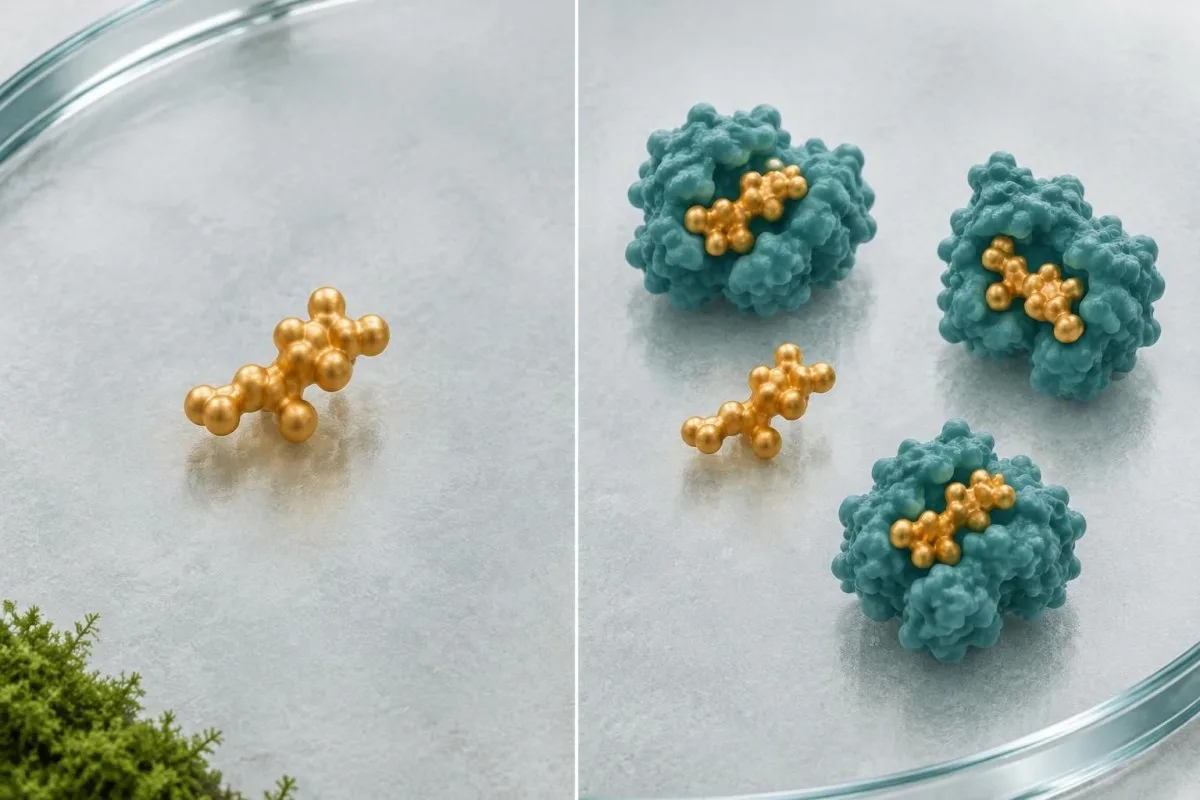
T3, or triiodothyronine, is an active thyroid hormone. More than 99% of circulating T3 is bound to proteins, principally thyroid-binding globulin, as well as transthyretin and albumin; the remainder is free.
A useful distinction is that a total T3 test measures a larger pool, while a free T3 test attempts to estimate a much smaller one. The vodnik za testiranje skupnega T3 explains why an abnormal total result is not automatically evidence of thyroid disease.
Free T3 is not a direct reading of hormone action inside every tissue. Nor is it inherently the better test: free-hormone immunoassays can be affected by abnormal binding conditions, and laboratories may choose total T3 when investigating suspected hyperthyroidism.
Most T3 in blood is produced by conversion of T4 in tissues outside the thyroid gland. A smaller portion is released directly by the thyroid, so illness, medicines and thyroid disease can alter the relationship between the two hormones.
How do binding proteins change total T3?
Changes in thyroid-binding globulin can raise or lower total T3 even when free hormone and thyroid function remain appropriate. Pregnancy and oral estrogen commonly increase this binding protein; inherited binding-protein differences and some illnesses can reduce it.

Thyroid-binding globulin is a transport protein, not the same test as thyroid-stimulating hormone, or TSH. When more binding sites are available, the total pool of circulating T3 can rise after the system reaches a new balance, while free T3 and TSH may remain within their appropriate ranges.
For example, a person taking an estrogen-containing oral contraceptive may have high total T3 with normal free T3 and TSH. That pattern can reflect increased binding rather than excess hormone production, but the prescribing clinician should still review symptoms and the full report.
Low binding-protein concentrations can have the opposite effect. Significant protein loss, some severe illnesses and uncommon inherited thyroid-binding globulin deficiency can reduce total T3 without proving that the thyroid is underactive; the vodniku za serumske beljakovine describes related protein measurements.
A normal albumin result does not establish that thyroid-binding globulin is normal. If a persistent total-versus-free discrepancy remains unexplained, a clinician may discuss targeted binding-protein testing with the laboratory rather than ordering it automatically.
What does low total T3 with normal free T3 mean?
Low total T3 with normal free T3 can occur with reduced binding proteins, recent illness or measurement differences. It cannot establish hypothyroidism on its own, and the next question is whether TSH and free T4 agree with the clinical picture.

Consider a hypothetical adult whose total T3 is 70 ng/dL against that laboratory's illustrative interval of 80–200 ng/dL, with free T3, free T4 and TSH all inside their own intervals. A clinician might first review illness, medicines and binding-protein changes rather than diagnose hypothyroidism from the total T3 result alone.
That example uses a made-up laboratory interval, not a universal cutoff. A result of 70 ng/dL converts to approximately 1.08 nmol/L, but conversion does not make reference intervals from different methods interchangeable.
Acute or chronic non-thyroidal illness can lower T3, often before free T4 changes. Koulouri et al. (2013) describe how illness and analytical interference complicate thyroid test interpretation; a normal free T3 does not exclude every illness-related effect.
Symptoms still deserve attention. The low free T3 symptoms guide discusses why fatigue, feeling cold and muscle symptoms are not specific enough to identify the cause without other clinical information.
What does high total T3 with normal free T3 mean?
High total T3 with normal free T3 may reflect increased thyroid-binding globulin, especially during pregnancy or oral estrogen use. A normal free T3 does not settle the question by itself: TSH, free T4, symptoms and the reliability of the free T3 assay also matter.

In a hypothetical report, total T3 is 225 ng/dL against an illustrative adult interval of 80–200 ng/dL, while free T3 and TSH are within the laboratory's ranges. If the person recently started oral estrogen, increased binding is one possible explanation; the result alone does not prove that estrogen caused it.
Pregnancy changes thyroid physiology and interpretation, so a non-pregnant adult interval should not automatically be applied. A pregnant patient with a flagged thyroid result should contact their maternity or thyroid care team for pregnancy-appropriate interpretation rather than change medication independently.
If TSH is suppressed, however, a high total T3 deserves closer attention even when free T3 is reported as normal. True T3 excess, assay disagreement and early disease are possible explanations, and confirmation may require another method or repeat sampling.
A thyroid nodule can occasionally produce hormone independently, but a high total T3 alone cannot identify the cause. The thyroid nodule testing guide explains why the TSH result helps guide further assessment.
Can free or total T3 tests be inaccurate?
Both free and total T3 tests can be misleading because of assay interference, abnormal binding or differences between laboratory methods. Free T3 immunoassays are especially challenging because they estimate a very small unbound fraction while preserving its equilibrium with bound hormone.
Many laboratories use immunoassays, which rely on antibody-based reactions. Biotin supplements can interfere with assays that use biotin–streptavidin technology; depending on assay design, interference can produce a falsely low TSH or falsely high thyroid hormone result, although not every method is affected.
Tell the laboratory and clinician about the biotin dose, the time of the last dose and any kidney impairment. Do not assume one waiting period fits every test: the appropriate pause depends on the supplement dose and the assay, and prescribed treatment should not be stopped without advice.
Other possible sources of error include interfering antibodies, unusual binding proteins and medication-related effects. Koulouri et al. (2013) recommend a structured review of discordant results, including discussion with the laboratory before pursuing rare diagnoses.
When the clinical picture and results do not fit, the laboratory may repeat testing on a different platform or arrange a specialized separation method such as equilibrium dialysis followed by hormone measurement. These methods can help resolve selected questions, but they are not a guarantee of a perfect result or routinely needed for everyone.
Ločen vodnik po medsebojnem delovanju prehranskih dopolnil covers why a supplement list is useful before repeat laboratory testing.
How are TSH, free T4 and T3 interpreted together?
Clinicians interpret T3 with TSH and free T4 because each test answers a different part of the thyroid-function question. For most adults without suspected pituitary disease, TSH is the usual starting test; low TSH often prompts measurement of free T4 and free T3.

NICE guideline NG145 recommends measuring TSH first when thyroid dysfunction is suspected and pituitary disease is not suspected; if TSH is low, free T4 and free T3 are measured in the same sample where possible. When pituitary disease is suspected, NICE recommends measuring TSH and free T4 together (NICE, 2019).
A low TSH with high free T4 and/or high T3 generally supports biochemical hyperthyroidism, although medicines, illness and interference remain considerations. A low TSH with normal free T4 but elevated T3 can indicate T3-predominant hyperthyroidism; Ross et al. (2016) discuss measuring T3 when the cause and extent of thyrotoxicosis are assessed.
Low TSH with free T4 and T3 within range may fit subklinični hipertiroidizem, provided the pattern persists and alternative explanations are considered. The subclinical hyperthyroidism guide explains why persistence, age and heart or bone risk affect follow-up.
High TSH with low free T4 commonly indicates primary hypothyroidism; T3 may remain normal until later and is generally not the preferred test for diagnosing it. A low free T4 with a normal or low TSH can instead raise concern for pituitary disease, severe illness or assay problems, as discussed in the low free T4 guide.
TSH is useful, but it is not infallible. Recent treatment changes, pregnancy, pituitary disorders and recovery from illness can all alter the expected relationship between TSH and thyroid hormones; the T4 and TSH guide explains the underlying feedback system.
Which T3 reference range should you use?
Use the reference interval printed beside each T3 result, because ranges depend on the laboratory, method, units and population. Free T3 and total T3 have different concentrations and must not be compared by their raw numbers alone.
An illustrative adult total T3 interval might be 80–200 ng/dL, but this is not a diagnostic threshold or a substitute for your own laboratory's range. Children's and pregnancy-related intervals can differ, and a borderline value may need a different response from a markedly abnormal result.
For total T3, 100 ng/dL is approximately 1.54 nmol/L. For free T3, 1 pg/mL is approximately 1.54 pmol/L; check the unit and decimal place before comparing reports.
A hypothetical free T3 of 3.0 pg/mL is approximately 4.6 pmol/L. Whether either expression falls inside a reference interval depends on the specific laboratory and assay, not the conversion alone.
The fact that a result is just outside an interval does not determine treatment. Reference intervals describe a comparison population and do not distinguish every healthy person from every person with disease; the Referenčni vodnik za biomarkerje provides further context for reading laboratory reports.
What should you do when free and total T3 disagree?
Review the complete report with a clinician, including TSH, free T4, both T3 values, reference intervals, symptoms and medicines. The clinician can decide whether the discrepancy needs a repeat test, a laboratory discussion or assessment for thyroid or pituitary disease.

Bring the collection date, time, laboratory name and units for each result. Include thyroid medicines, oral estrogen, amiodarone, steroids and supplements such as biotin; timing matters particularly for people taking liothyronine or combination T4/T3 treatment because T3 can rise after a dose.
Do not stop or adjust levothyroxine, liothyronine or antithyroid medication based on one T3 value. Ask your prescriber whether the next sample should be collected at a consistent time relative to medication and when it should be repeated; a urnik testiranja ščitnice varies with the clinical situation.
NICE advises against repeating thyroid function tests sooner than 6 weeks after the most recent test when symptoms worsen or new symptoms develop, because a shorter interval may not reflect a stable change. A clinician can choose a different, more urgent approach when the situation warrants it.
Seek urgent medical care for chest pain, severe shortness of breath, fainting, confusion or a very fast heartbeat with marked illness. These symptoms need assessment regardless of whether a T3 result is mildly abnormal.
For questions about how health information is prepared, our standardi za medicinske vsebine describe the editorial approach. They do not replace individual medical advice.
Pogosta vprašanja
Which is more accurate, free T3 or total T3?
Neither free T3 nor total T3 is always more accurate for every clinical question. Total T3 is influenced by binding proteins, while free T3 immunoassays can be affected by abnormal binding and other interference. If the two disagree, a clinician can review TSH and free T4 and ask the laboratory whether a second method would help. One result should not be chosen as definitive solely because it is labelled free.
Can free T3 be normal when total T3 is low?
Yes. Normal free T3 with low total T3 can occur when thyroid-binding proteins are reduced, during illness or because the two assays behave differently. For example, a total T3 of 70 ng/dL may be low against an illustrative 80–200 ng/dL interval, but the laboratory's own interval controls interpretation. TSH, free T4, symptoms and the reason for testing help determine what to do next.
What causes total T3 to be high when free T3 is normal?
Increased thyroid-binding globulin is one possible cause of high total T3 with normal free T3. Pregnancy and oral estrogen can increase that binding protein and raise the total hormone pool without necessarily causing hyperthyroidism. A suppressed TSH changes the assessment and may prompt repeat testing or further investigation. Pregnancy-specific reference intervals and clinical advice are particularly relevant.
Can biotin cause a false thyroid test result?
Yes, biotin can interfere with some thyroid immunoassays, although the direction and size of the effect depend on the method. In susceptible tests, biotin may cause falsely low TSH or falsely high thyroid hormone results. Tell your clinician and laboratory the supplement dose and when you last took it. Follow their instructions rather than assuming a single waiting period works for every assay.
Does a low T3 level mean I need thyroid medication?
A low T3 level alone does not establish that thyroid medication is needed. Illness, binding-protein changes and test limitations can lower total T3, while TSH and free T4 are generally more useful for evaluating primary hypothyroidism. A clinician should interpret the complete pattern and symptoms before recommending treatment. Do not start, stop or change thyroid medication because of one isolated result.
When should thyroid tests be repeated after a discordant result?
The timing of a repeat thyroid test depends on the symptoms, recent illness, treatment changes and the suspected cause of the discrepancy. NICE advises against repeating thyroid function tests sooner than 6 weeks after the most recent test when symptoms worsen or new symptoms develop. More urgent assessment may be needed for severe symptoms or a concerning pattern. Ask the ordering clinician whether to use the same laboratory and how to time medicines or supplements.
Poskrbite, da vam razložijo rezultate krvnih preiskav
Naložite svoj laboratorijski izvid in AI Kantesti bo v nekaj sekundah preprosto razložil vsak biomarker. Uporablja ga več kot 2 milijona ljudi po vsem svetu.
Reference
- Klein, T., Mitchell, S., & Weber, H. (2026). Test urobilinogena v urin: popoln vodnik za urinalizo 2026. Kantesti AI Medical Research. DOI
- Klein, T., Mitchell, S., & Weber, H. (2026). Vodnik po preiskavah železa: TIBC, nasičenost z železom in sposobnost vezave. Kantesti AI Medical Research. DOI
- National Institute for Health and Care Excellence (2019). Thyroid disease: assessment and management. NICE guideline NG145. DOI
- Koulouri O et al. (2013). Pitfalls in the measurement and interpretation of thyroid function tests. Best Practice & Research Clinical Endocrinology & Metabolism. DOI
- Ross DS et al. (2016). Smernice Ameriškega združenja za ščitnico iz leta 2016 za diagnosticiranje in obravnavo hipertiroidizma ter drugih vzrokov tirotoksikoze. Thyroid. DOI
- 2 milijona+Analizirani testi
- 127+Države
- 100+Jeziki
O zdravstveni ekipi


E-E-A-T zaupanja vredni signali
Izkušnje
Zdravniški klinični pregled delovnih postopkov za interpretacijo laboratorijskih izvidov.
Strokovno znanje
Laboratorijska medicina s poudarkom na tem, kako se biomarkerji obnašajo v kliničnem kontekstu.
Avtoritativnost
Zdravstveno pregledal dr. Thomas Klein, s prispevki dr. Sarah Mitchell in prof. dr. Hansa Webra.
Zanesljivost
Interpretacija na podlagi dokazov z jasnimi nadaljnjimi potmi za zmanjšanje alarmiranja.



Zdravstvena omejitev odgovornosti
Ta članek je namenjen izobraževalnim namenom in ne predstavlja medicinskega nasveta. Za odločitve o diagnozi in zdravljenju se vedno posvetujte z usposobljenim izvajalcem zdravstvenih storitev.
Objavljeno · Obrnite se na uredniško ekipo
Izdala družba Kantesti Ltd, registrirana v Angliji in Walesu, matična št. 17090423, London, Združeno kraljestvo.
