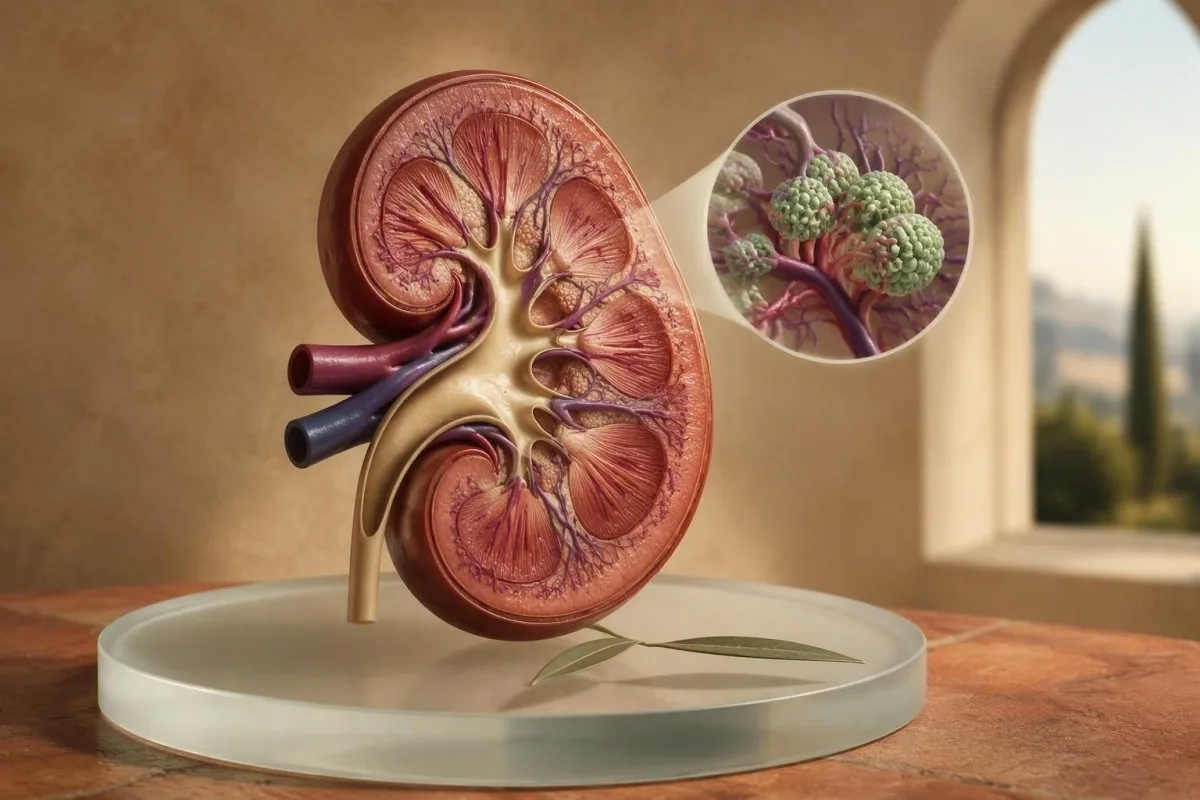
A high or borderline eGFR is usually a calculation issue or a normal finding, not kidney failure. The useful interpretation comes from creatinine, urine albumin, glucose, blood pressure, age, and the direction of change over time.


- Borderline eGFR meaning: An eGFR of 90 mL/min/1.73 m² or higher is not chronic kidney disease unless urine, imaging, or other evidence shows kidney damage for at least 3 months.
- High eGFR: A result of 100-120 mL/min/1.73 m² is often normal in a younger adult and is not, by itself, evidence of kidney failure.
- Hyperfiltration threshold: Persistent eGFR above roughly 135 mL/min/1.73 m² can suggest hyperfiltration, but no single cutoff applies to every age, sex, or laboratory.
- Low muscle mass: Low creatinine from small body size, frailty, muscle loss, vegetarian eating, or pregnancy can make creatinine-based eGFR look higher than true filtration.
- ACR companion test: A urine albumin-to-creatinine ratio below 30 mg/g is normal; 30-300 mg/g is moderately increased albuminuria and changes a high-eGFR interpretation.
- Diabetes clue: High eGFR plus raised fasting glucose, HbA1c, or urine albumin deserves follow-up because early diabetes can cause glomerular hyperfiltration.
- Best confirmation: Cystatin C-based eGFR is especially useful when creatinine may be misleading because of unusual muscle mass, diet, amputation, or chronic illness.
- Яаралтай шинж тэмдгүүд: A high eGFR does not cause emergency symptoms, but swelling, breathlessness, markedly reduced urine, visible blood in urine, or severe hypertension need prompt clinical assessment.
What a borderline or high eGFR usually means
Borderline eGFR meaning is usually reassuring when the result is 90 mL/min/1.73 m² or higher and urine testing is normal. A high estimated GFR does not mean the kidneys are failing; it commonly reflects a low creatinine concentration, younger age, pregnancy, or genuinely efficient filtration. As of September 21, 2026, clinicians diagnose chronic kidney disease from an eGFR below 60 for 3 months or more, or from persistent markers of kidney damage—not from eGFR being high.
eGFR is an estimate, not a direct measurement. The laboratory enters serum creatinine, age, and sex into an equation, then reports filtration standardized to 1.73 m² of body surface area; it does not count individual nephrons. Кантешти is an AI blood test analyzer that reads eGFR alongside creatinine, urine markers, and the broader metabolic panel rather than treating one flag as a diagnosis.
A laboratory may display “>90” or “>60” rather than a precise high number because creatinine equations become less accurate at higher filtration rates. The 2024 KDIGO guideline classifies eGFR of 90 or above as G1, which is normal or high; G1 alone is not CKD (KDIGO, 2024).
In my clinical work, the anxious calls often come from people seeing eGFR 118 beside a low-normal creatinine of 0.58 mg/dL. In a healthy 29-year-old with normal blood pressure and a negative urine albumin test, that pattern is far more often physiology than disease; our биомаркерийн гарын авчим explains why reference flags need context.
The phrase “borderline” can mislead
A borderline flag can be a laboratory display convention rather than a medical threshold. eGFR varies by about 5-10% from biological fluctuation and assay variation, so a single isolated result should not be used to label someone with kidney disease or hyperfiltration.
Why creatinine can make eGFR look unexpectedly high
A slightly elevated eGFR most often occurs because serum creatinine is lower than the equation expects for a person of that age and sex. Creatinine is produced by skeletal muscle and cleared by kidneys, so the same filtration rate can generate very different eGFR values in a bodybuilder and a small older adult.
The 2021 CKD-EPI creatinine equation removed race from eGFR reporting and uses age and sex alongside creatinine. Inker and colleagues found the new creatinine-cystatin C equation was more accurate than creatinine alone, particularly when precision matters (Inker et al., 2021). See our practical BUN ба креатинины гарын авлага for why these two values answer different questions.
A serum creatinine of 0.50 mg/dL may produce eGFR above 120 mL/min/1.73 m² in an adult, but the number can overestimate filtration in sarcopenia, neuromuscular disease, cirrhosis, limb amputation, or substantial recent weight loss. High protein intake and creatine supplements usually push creatinine upward, which lowers calculated eGFR—the opposite direction.
Kantesti AI is an AI blood test interpretation platform that identifies when a creatinine-based estimate conflicts with weight change, CBC clues, liver markers, or prior results. That mismatch is a prompt for confirmation, not a reason to self-diagnose kidney damage.
Is eGFR of 100, 110, or 120 normal for your age?
An eGFR of 100-120 mL/min/1.73 m² is commonly normal in younger adults, whereas the expected average declines gradually with age. eGFR naturally falls from roughly 120 mL/min/1.73 m² in early adulthood by about 0.75-1 mL/min/1.73 m² per year after age 40, although individual variation is wide.
There is no universal “too high” range printed on every report. A value of 108 in a 25-year-old can be ordinary, while an abrupt rise from 72 to 110 in a 70-year-old should first make us check creatinine calibration, hydration, illness, and loss of muscle rather than assume healthier kidneys.
Body surface area adjustment matters. eGFR is normalized to 1.73 m², so in a very small or very large person, the reported value may differ materially from absolute filtration in mL/min; nephrologists may calculate non-indexed GFR for chemotherapy dosing or living-donor assessment.
If your eGFR is high but stable, record the actual creatinine value and date of each test. Trend review is more useful than comparing your number with a fit 22-year-old; урт хугацааны лабораторийн шинжилгээ нь тэрхүү нөхцөл байдлыг хадгалахад тусалж чадна.
When high eGFR can indicate glomerular hyperfiltration
High eGFR becomes more clinically relevant when it is persistent, usually above about 135 mL/min/1.73 m², and occurs with diabetes, albumin in urine, obesity, or high blood pressure. This pattern is called glomerular hyperfiltration, but the cutoff is debated because age, body size, and the estimating equation alter the result.
Hyperfiltration means individual glomeruli filter unusually large volumes, often because intraglomerular pressure is elevated. It can precede later eGFR decline in type 1 and type 2 diabetes, but a creatinine-based eGFR above 135 alone does not prove that physiology; Tonneijck et al. describe this uncertainty clearly in their 2017 CJASN review.
The combination that concerns me is eGFR 138, HbA1c 7.4%, blood pressure 146/92 mmHg, and ACR 85 mg/g. By contrast, eGFR 138 with HbA1c 5.1%, ACR 5 mg/g, and a creatinine of 0.48 mg/dL in a lean young adult may simply be imprecision in the estimate; CKD үе шатууд ба ACR put these categories together.
Kantesti AI flags persistent high-filtration patterns for clinician discussion when companion markers point the same way. Thomas Klein, MD, advises patients not to chase a lower eGFR number with dehydration, fasting, or unnecessary supplements—those tactics only distort the test.
The companion results that change a high eGFR interpretation
Urine albumin-to-creatinine ratio, urinalysis, blood pressure, glucose, HbA1c, and creatinine trend are the results that determine whether a high eGFR needs attention. A normal eGFR cannot rule out early kidney damage when urine albumin is elevated.
Ан ACR нь 30 мг/г-аас доогуур (below 3 mg/mmol) is normal to mildly increased; 30-300 мг/г is moderately increased albuminuria, and 300 мг/г-аас дээш is severely increased. A first-morning urine sample is preferable because exercise, fever, urinary infection, menstruation, and marked hyperglycaemia can cause transient albumin elevation.
Dipstick protein is less sensitive than ACR for early albuminuria, while red cells, casts, or persistent glucose in urine point to different renal questions. Our ACR бэлтгэх заавар covers how to avoid a misleading collection.
Serum albumin, potassium, bicarbonate, urea/BUN, and blood pressure provide useful supporting evidence. An eGFR of 115 with normal ACR, potassium 4.2 mmol/L, bicarbonate 25 mmol/L, and stable creatinine has a very different meaning from the same eGFR with abnormal urine sediment.
Diabetes, glucose, and the high eGFR pattern
Diabetes is one of the best-established high eGFR causes because early hyperglycaemia can increase glomerular pressure and filtration. Persistent fasting glucose of 126 mg/dL or higher, HbA1c of 6.5% or higher, or diabetes symptoms should shift the focus from eGFR alone to metabolic and urine-kidney risk.
Early diabetic hyperfiltration may occur before creatinine rises, particularly in younger people with recently diagnosed diabetes. Tonneijck et al. reported that hyperfiltration is biologically plausible but difficult to define accurately with estimated GFR, which is why clinicians repeat tests and use urine albumin rather than making a diagnosis from one value.
An HbA1c of 5.7-6.4% indicates prediabetes, while 6.5% or above meets the laboratory criterion for diabetes when confirmed in an appropriate clinical setting. High triglycerides, central adiposity, and hypertension add risk; see high glucose warning signs if symptoms are present.
Kantesti is an AI-powered blood test analysis tool that interprets eGFR with HbA1c, glucose, triglycerides, and liver markers, because metabolic risk is a pattern rather than a single creatinine calculation.
Other high eGFR causes: pregnancy, diet, and physiology
Pregnancy, a recent high-protein meal, recovery from illness, and some medicines can raise measured or estimated filtration without indicating kidney failure. Pregnancy commonly increases true GFR by roughly 40-50% by the second trimester, so non-pregnant eGFR reference assumptions do not apply.
Most laboratories do not validate routine creatinine eGFR equations during pregnancy. A creatinine above about 0.9 mg/dL can be more concerning in pregnancy than it would be outside pregnancy, while a low creatinine may be entirely expected; our жирэмсний GFR-ийн заавар нь илүү аюулгүй аргыг тайлбарладаг.
High dietary protein can transiently raise actual GFR, but it rarely explains a striking eGFR result by itself. Non-steroidal anti-inflammatory medicines usually lower GFR in susceptible people, whereas SGLT2 medicines often produce a small initial eGFR dip that reflects a beneficial haemodynamic reset rather than injury; read about the SGLT2 eGFR-ийн бууралт.
A 52-year-old endurance athlete I reviewed had eGFR 124 after a large recovery shake and a low creatinine baseline. Her ACR was 4 mg/g and repeat fasting creatinine was unchanged—reassuring, but still worth documenting rather than calling it “super-kidneys.”
Low muscle mass and frailty can falsely elevate eGFR
Low muscle mass can make creatinine-based eGFR look higher than the kidney’s true filtration capacity. This is most relevant after unintentional weight loss, prolonged immobility, advanced liver disease, eating disorders, neuromuscular conditions, or in frail older adults.
Creatinine generation may fall before a patient or clinician notices visible muscle loss. A creatinine of 0.42 mg/dL in a thin 79-year-old recovering from a hospital stay can produce eGFR above 100, yet cystatin C may suggest lower filtration; this discrepancy is clinically meaningful for medication dosing.
Cystatin C is produced by most nucleated cells and is less dependent on muscle mass, although thyroid disease, corticosteroids, smoking, and systemic illness can affect it. A combined creatinine-cystatin C eGFR is generally the most reliable estimate when the two markers disagree, according to Inker et al. (2021).
Do not use a high eGFR to dismiss frailty or nutritional risk. A low cystatin C result has different implications from low creatinine, and the clinical history decides which marker deserves more weight.
How clinicians confirm whether a high eGFR is real
The best confirmation for an unexpectedly high eGFR is repeat creatinine with urine ACR, followed by cystatin C or measured GFR when the answer will change care. Repeating a stable outpatient test in 1-3 months is usually more informative than ordering urgent imaging for an isolated high result.
For a clean repeat, avoid unusually strenuous exercise for 24-48 hours, maintain ordinary hydration, and tell the clinician about creatine, trimethoprim, cimetidine, and recent illness. Exercise can raise creatinine through muscle release, whereas excessive water intake can dilute it slightly; neither produces a reliable “better” kidney result.
Cystatin C-based eGFR is particularly helpful when creatinine is below 0.6 mg/dL or clinical muscle mass is clearly atypical. Directly measured GFR using exogenous filtration markers is reserved for selected situations such as donor work-up, certain drug dosing decisions, and unresolved discordance.
Repeat urine results matter as much as repeat blood results. A urine creatinine review can explain why a spot ACR was unreliable when the sample was extremely dilute or concentrated.
When to worry about eGFR and seek medical care
A high eGFR itself is rarely urgent, but high eGFR with albuminuria, diabetes, uncontrolled blood pressure, blood in urine, or a fast creatinine change warrants medical review. New swelling, breathlessness, confusion, a major reduction in urine output, or blood-coloured urine should be assessed promptly regardless of the eGFR displayed.
Persistent blood pressure at or above 140/90 mmHg should trigger assessment, while 180/120 mmHg with chest pain, neurological symptoms, or breathlessness is an emergency. Kidney disease can be silent, so a normal or high eGFR never overrides substantial albuminuria or a concerning urine sediment.
A new ACR above 30 mg/g should usually be repeated to establish persistence, ideally after excluding urinary infection and heavy exercise. Visible blood in urine, especially with clots, flank pain, or fever, needs timely evaluation; our guide to шээсэнд цус explains the usual pathway.
Thomas Klein, MD, has seen patients reassured too quickly by an eGFR of 95 despite ACR 600 mg/g. The kidney’s filtration rate and its barrier function are different jobs, so urine protein can be the earlier warning signal.
Why a high eGFR is not kidney failure
Kidney failure causes low filtration, not high eGFR; an eGFR below 15 mL/min/1.73 m² is the conventional threshold for kidney failure. The confusion happens because “out of range” on a report can sound dangerous even when the high direction is often benign.
An eGFR below 60 mL/min/1.73 m² for at least 3 months is one route to diagnosing CKD, and values below 30 merit more active evaluation and medication review. The symptoms people associate with renal failure—fluid retention, nausea, itch, fatigue, and reduced appetite—usually relate to advanced low filtration or another illness, not high eGFR.
Creatinine can rise temporarily after intense resistance exercise, dehydration, or a large cooked-meat meal, making eGFR appear lower. That counterpart is covered in our дасгалын дараах креатинин гарын авлага; it reinforces why one result should not be over-read.
A low eGFR and a high eGFR can both be inaccurate when creatinine is distorted. The right question is not “Which number is best?” but “Does the estimate fit the urine, symptoms, medicines, body composition, and prior baseline?”
Medication safety when eGFR seems unusually high
An unexpectedly high eGFR should not automatically be used to approve a higher medication dose, especially in older or low-muscle-mass adults. Drug dosing sometimes uses creatinine clearance by Cockcroft-Gault rather than lab-reported eGFR, and the two figures can differ substantially.
Antibiotics, metformin, lithium, direct oral anticoagulants, and some chemotherapy medicines have renal dose rules. For drug decisions, clinicians consider age, actual weight, creatinine trend, and the product label rather than relying on an eGFR above 90 as proof of normal clearance.
Trimethoprim and cimetidine can increase serum creatinine by reducing tubular secretion without reducing true GFR. Conversely, very low creatinine can hide impaired clearance in muscle wasting; lithium monitoring is a good example of why longitudinal renal data matter.
Never stop a prescribed medicine merely because eGFR is 125. Bring the full medication and supplement list to the prescriber, including creatine powders, anti-inflammatory pain medicines, and over-the-counter acid suppressants.
A practical retest plan for a borderline eGFR result
For an isolated high or borderline eGFR with no symptoms, repeat creatinine and urine ACR under usual conditions within 1-3 months. If diabetes, albuminuria, hypertension, pregnancy, or low muscle mass is present, arrange clinician review sooner and consider cystatin C.
Before the repeat, keep ordinary fluid intake, avoid a marathon or maximal gym session for 24-48 hours, and do not deliberately load protein or water. Record recent fever, vomiting, diarrhoea, medication changes, menstrual bleeding, and supplements—small details can explain apparent changes better than a new diagnosis.
Ask for creatinine, eGFR, urine ACR, urinalysis, blood pressure, fasting glucose or HbA1c when appropriate, and cystatin C if body composition makes creatinine unreliable. The бодисын солилцооны суурь самбарын заавар helps you identify the supporting electrolytes and bicarbonate.
Most patients find a written two-date comparison more calming than a single reference flag. Kantesti’s trend analysis can organize that comparison, while our AI цусны шинжилгээний жишиг (benchmark) дээр describes how we assess consistency across complex lab reports.
What not to do after seeing a high eGFR flag
Do not restrict water, start kidney supplements, or change a prescribed drug simply to alter a high eGFR result. A high creatinine-derived estimate is not an instruction to treat the kidneys, and dehydration may temporarily lower eGFR while causing real harm.
“Kidney detox” products can contain concentrated herbs, stimulants, or minerals with uncertain safety and no evidence that they correct hyperfiltration. Protein restriction is not appropriate for everyone either; it can worsen nutrition in frail adults and should be individualized if CKD is actually present.
Do not diagnose proteinuria from foamy toilet water alone. Persistent foam can be worth testing, but urine concentration and cleaning products can create bubbles; use an ACR rather than visual inspection, as explained in our хөөсөрхөг шээсний гарын авлагад.
A sensible next step is modest: verify the result, look for albuminuria, and address real drivers such as diabetes and blood pressure. The clinicians on our Эмнэлгийн зөвлөх зөвлөл support a safety-first approach in which AI interpretation complements—not replaces—individual clinical assessment.
Байнга асуудаг асуултууд
хязгаарлагдмал eGFR гэж юу вэ?
Хилийн eGFR утгын учир нь хязгаарын аль талд байгаагаас хамаарна. 90 мл/мин/1.73 м² ба түүнээс дээш eGFR нь хэвийн эсвэл өндөр бөгөөд шээсний ACR 30 мг/г ба түүнээс дээш байх зэрэг архаг урьдчилан сэргийлэх өвчин байхгүй бол архаг бөөрний өвчнийг илтгэхгүй. Шээсний шинжилгээ болон дүрс оношлогоо хэвийн үед 60-89 eGFR нь олон насанд хүрэгчдэд хэвийн байж болно. Архаг бөөрний өвчин нь ерөнхийдөө 3 сар ба түүнээс дээш хугацаанд 60-аас доош eGFR эсвэл бөөрний гэмтлийн өөр нэг бат бөх шинж тэмдэг шаарддаг.
eGFR хэт өндөр байж болох уу?
100 эсвэл 120 мл/мин/1.73 м² -ээс дээш eGFR нь ихэвчлэн хэвийн гэж тооцогддог, ялангуяа залуу насанд, мөн өөрөө аюултай байдаггүй. 135 мл/мин/1.73 м² -ээс дээш байнгын үзүүлэлт нь гломеруляр хэт шүүлт үүссэнийг илтгэж болно, ялангуяа чихрийн шижин, өндөр цусны даралт, таргалалт, эсвэл шээсний альбумин байгаа тохиолдолд. Өндөр шүүлттэй үед креатининий тэгшитгэлүүд тийм ч нарийвчлалтай байдаггүй тул өндөр eGFR-ийн нийтлэг хүлээн зөвшөөрөгдсөн хязгаар байдаггүй. Креатинин, шээсний ACR, глюкозын шинжилгээ, заримдаа цистатин C-ийн давтан шинжилгээ нь өндөр үр дүн нь ач холбогдолтой эсэхийг тодруулна.
eGFR-ийн бага зэрэг өндөр байхын шалтгаан юу вэ?
eGFR-ийн бага зэрэг өндөр түвшин нь ихэвчлэн биеийн жингийн масс багатай, саяхан жин хассан, жирэмсэн, залуу нас, эсвэл хэвийн биологийн хувьсал зэргээс шалтгаалсан сийвэнгийн креатинины бага түвшинтэй холбоотой байдаг. Жирэмслэлт нь бодит GFR-ийг ойролцоогоор 40-50%-иар нэмэгдүүлж болох бөгөөд сул дорой байдал эсвэл булчингийн алдагдал нь бодит шүүлтүүрийг нэмэгдүүлэхгүйгээр креатинин-д суурилсан eGFR-ийг хуурамчаар дээшлүүлж болно. Чихрийн шижингийн эхний үе шат нь гиперфильтрацийг үүсгэж болно, ялангуяа eGFR нь ойролцоогоор 135 мл/мин/1.73 м²-аас тогтмол дээгүүр байвал. ACI нь 30 мг/г-аас доош, HbA1c хэвийн байвал хор хөнөөлтэй гиперфильтрацийг багасгадаг.
eGFR 120-ийг санаа зовох ёстой юу?
120 мл/мин/1.73 м²-ийн eGFR нь хэвийн, тогтвортой креатинин, цусны даралт хэвийн, шээсний ACR 30 мг/г-аас доогуур байвал эрүүл, залуу насанд хүрсэн хүнд санаа зовох шалтгаан болохгүй. Хэрэв энэ нь шинээр гарсан, креатинин 0.6 мг/дл-ээс доогуур, эсвэл чихрийн шижин, жирэмслэлт, жин хасах, альбуминури зэрэг шинж тэмдэг илэрвэл энэ үр дүн нь илүү их мэдээлэл шаардана. Ихэнх шинж тэмдэггүй хүмүүст 1-3 сарын дараа ердийн усны хэрэглээтэйгээр дахин шинжилгээ хийлгэх нь боломжит эхний алхам юм. Хэрэв булчингийн масс нь креатинин-д суурилсан eGFR-ийг найдвартай бус болгодог бол Cystatin C нь туслах болно.
eGFR өндөр байвал чихрийн шижингийн шинж үү?
Өндөр eGFR нь чихрийн шижингийн улмаас үүссэн хэт шүүрэлтийн эрт шинж тэмдэг байж болох ч, дангаараа чихрийн шижинг оношлох боломжгүй. Чихрийн шижинг HbA1c 6.5% ба түүнээс дээш, өлсөж байх үед сийвэнгийн глюкоз 126 мг/дл ба түүнээс дээш, эсвэл зохих эмнэлзүйн нөхцөлд глюкозын бусад хүлээн зөвшөөрөгдсөн шалгуур үзүүлэлтээр оношлоно. Өндөр eGFR нь HbA1c-ийн өсөлт, өлсөж байх үеийн гипергликеми, 140/90 мм.муб.ба түүнээс дээш цусны даралт, эсвэл 30 мг/г ба түүнээс дээш шээс ACR-тэй хамт тохиолдоход илүү анхаарал татаж байна. Хэвийн глюкоз ба хэвийн шээсний альбумин нь чихрийн шижинтэй холбоотой бөөрний стрессийг багасгадаг.
Өндөр eGFR-ийн үнэн зөвийг баталгаажуулах шинжилгээ нь юу вэ?
Шээсээр ялгардаг креатининий хэмжээ нь булчингийн масс бага эсвэл хэвийн бус үед шүүрэлтийг хэтрүүлэн харуулж болзошгүй тохиолдолд креатинин-based eGFR-ийг ихэвчлэн өөрөөр батлах зорилгоор цистатин C-based eGFR-ийг ашигладаг. Бөөрний шүүх чадварын саатлыг баталгаажуулахын тулд өглөөний шээсний ACR 30 мг/г-аас бага байх нь чухал. Шууд хэмжигдсэн GFR нь амьд донорын үнэлгээ эсвэл өндөр тунгаар эм өгөх зэрэг сонгогдсон тохиолдлуудад хадгалагдана.
Өнөөдөр AI-аар дэмжигдсэн цусны шинжилгээний тайлал аваарай
Лабораторийн шинжилгээний агшин зуур, үнэн зөв тайлалд итгэдэг дэлхийн 2 сая гаруй хэрэглэгчтэй нэгдээрэй. Цусны шинжилгээний хариугаа байршуулж, 15,000+ биомаркеруудын цогц тайллыг хэдхэн секундын дотор аваарай.
📚 Иш татсан судалгааны нийтлэлүүд
Клейн, Т., Митчелл, С., ба Вебер, Х. (2026). Urobilinogen in Urine Test: Complete Urinalysis Guide 2026. Zenodo. https://doi.org/10.5281/zenodo.18226379. ResearchGate: https://www.researchgate.net/search.Search.html?query=Urobilinogen%20in%20Urine%20Test%20Complete%20Urinalysis%20Guide%202026. Academia.edu: https://www.academia.edu/search?q=Urobilinogen%20in%20Urine%20Test%20Complete%20Urinalysis%20Guide%202026. Kantesti AI Медикл Рисерч.
Клейн, Т., Митчелл, С., ба Вебер, Х. (2026). Iron Studies Guide: TIBC, Iron Saturation & Binding Capacity. Zenodo. https://doi.org/10.5281/zenodo.18248745. ResearchGate: https://www.researchgate.net/search.Search.html?query=Iron%20Studies%20Guide%20TIBC%20Iron%20Saturation%20Binding%20Capacity. Academia.edu: https://www.academia.edu/search?q=Iron%20Studies%20Guide%20TIBC%20Iron%20Saturation%20Binding%20Capacity. Kantesti AI Медикл Рисерч.
📖 Гадаад эмнэлгийн лавлагаа
⚕️ Эмнэлгийн мэдэгдэл
Энэ нийтлэл зөвхөн боловсролын зорилготой бөгөөд эмнэлгийн зөвлөгөө биш болно. Оношилгоо, эмчилгээний шийдвэр гаргахдаа мэргэшсэн эрүүл мэндийн үйлчилгээ үзүүлэгчтэй заавал зөвлөлдөнө.
E-E-A-T итгэлийн дохио
Туршлага
Эмчийн удирдлагатай лабораторийн тайлалын ажлын урсгалын клиник хяналт.
Мэргэшсэн байдал
Биомаркерууд клиникийн нөхцөлд хэрхэн ажиллаж/өөрчлөгдөж байгаад чиглэсэн лабораторийн анагаах ухаан.
Эрх мэдэл
Доктор Томас Клейн бичсэн, Доктор Сара Митчелл, Проф. Доктор Ханс Вебер нар хянан тохиолдуулсан.
Найдвартай байдал
Сэрэмжлүүлгийг бууруулахын тулд тодорхой дараагийн алхамтай, нотолгоонд суурилсан тайлал.