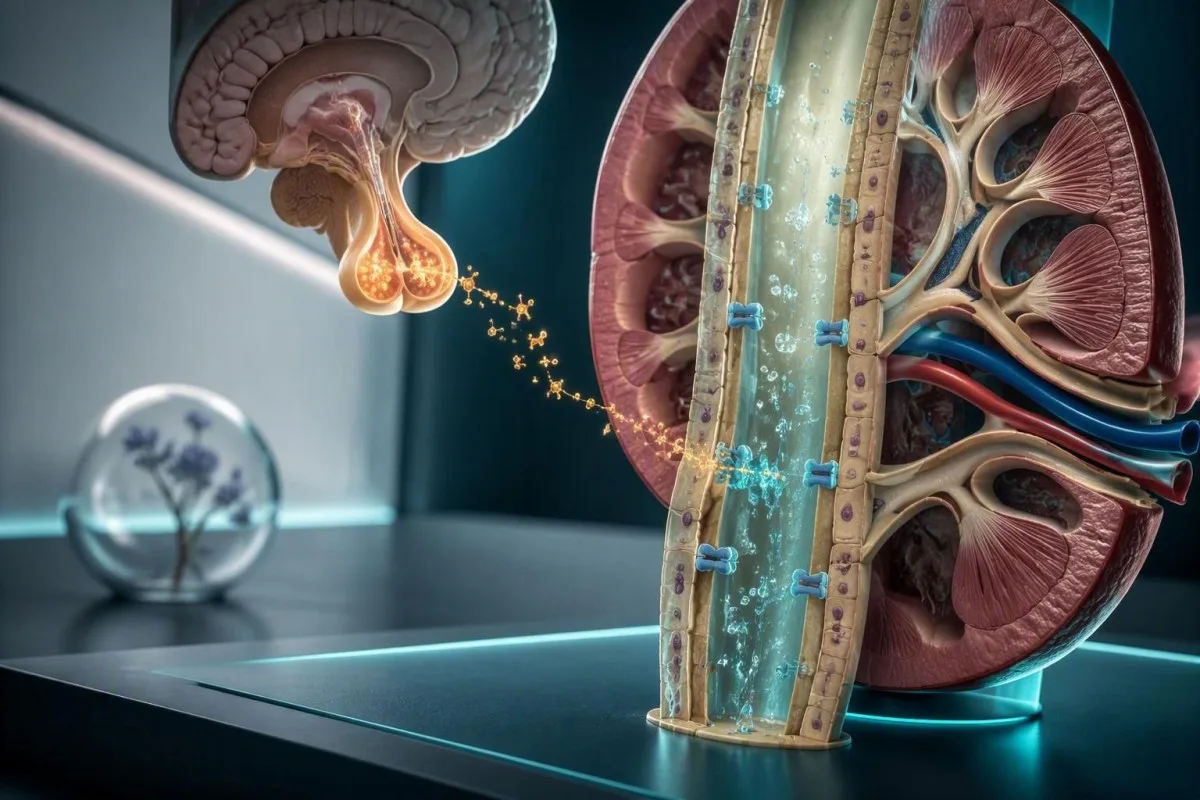
A high copeptin result usually reflects vasopressin-system activation from dehydration, physical stress, or illness—not a diagnosis by itself. Its real value comes from reading it beside sodium, serum osmolality, urine osmolality, and collection conditions.


- High copeptin often reflects dehydration, nausea, pain, exercise, infection, surgery, or low circulating volume rather than a single disease.
- Copeptin ≥21.4 pmol/L in a hypotonic polyuria work-up strongly supports nephrogenic diabetes insipidus when measured with appropriate clinical context.
- Stimulated copeptin >4.9 pmol/L after a supervised hypertonic-saline protocol generally argues against central diabetes insipidus and supports primary polydipsia.
- Low sodium plus high copeptin can occur in SIADH, but copeptin alone cannot confirm SIADH because stress and medications also raise it.
- Serum sodium 135–145 mmol/L and measured serum osmolality about 275–295 mOsm/kg are essential paired results for interpreting copeptin.
- 소변 삼투압 <300 mOsm/kg during hypernatraemia or high serum osmolality suggests inadequate antidiuretic action and needs prompt clinical assessment.
- Collection conditions matter because strenuous exercise, vomiting, acute pain, fasting, and IV fluids can materially change copeptin concentrations.
- 응급 증상 with sodium ≥150 mmol/L, confusion, severe weakness, seizure, or inability to keep fluids down require urgent care rather than repeat outpatient testing.
What a high copeptin result usually means
A high copeptin level means the body has activated its arginine vasopressin system, usually to conserve water or respond to physiological stress. The result is most informative when it is paired with sodium and osmolality; a high number by itself cannot distinguish dehydration from SIADH, nephrogenic diabetes insipidus, acute illness, or a difficult sample collection day.
Copeptin is the stable C-terminal fragment released in equal amounts with arginine vasopressin (AVP). AVP itself breaks down rapidly and is technically awkward to measure, whereas copeptin remains measurable in plasma. In practical terms, copeptin tells us that the body has received a “hold on to water” signal, not why that signal was sent.
When I review a panel with copeptin above the laboratory interval, I first ask whether the sodium is high, low, or normal. High copeptin with sodium 148 mmol/L points us toward water loss or impaired renal water response; high copeptin with sodium 126 mmol/L points toward non-osmotic AVP release, including possible SIADH. This is one of those areas where context matters more than the flag beside the number.
칸테스티는 AI 혈액검사 분석기 that reads copeptin beside electrolytes, kidney markers, glucose, and prior results rather than treating one hormone fragment as a verdict. A useful companion review is our guide to serum osmolality results, because measured osmolality often explains the result more clearly than copeptin alone.
Why laboratories do not share one universal upper limit
Copeptin assays differ, and many laboratories report only a method-specific reference interval rather than a disease cutoff. A result of 12 pmol/L may be ordinary in a person with mild dehydration but inappropriate in someone with high serum osmolality who is producing litres of very dilute urine.
Why copeptin rises when the body needs to save water
Copeptin rises when osmoreceptors detect concentrated body fluids or when the circulation is under stress. The hypothalamus releases AVP with copeptin, and AVP helps the kidney reabsorb water through collecting-duct V2 receptors.
A serum osmolality increase of only 1% to 2% can stimulate AVP release in a healthy person. That sensitivity explains why a long flight, diarrhoea, an overnight fast, or a sweaty workout can produce a meaningful copeptin rise without endocrine disease. 소변 삼투압 검사 shows whether the kidney actually followed the signal.
Non-osmotic stimuli can be stronger than thirst. Nausea, pain, hypoglycaemia, hypoxia, major exercise, infection, myocardial injury, and surgery all stimulate AVP release even when sodium is not high. I have seen copeptin interpreted as “dehydration” in a patient whose sodium was 133 mmol/L after severe nausea—an example of stress signalling, not simple water deficit.
Dr. Thomas Klein’s clinical rule is simple: a copeptin value has to make physiological sense. If sodium, glucose, urea, measured osmolality, urine osmolality, medication exposure, and the patient’s fluid intake tell different stories, repeat or dynamic testing is usually safer than forcing a diagnosis from a resting result.
Copeptin test results: useful thresholds and their limits
There is no single normal copeptin range that diagnoses every condition. In specialist evaluation of hypotonic polyuria, basal copeptin of at least 21.4 pmol/L strongly supports nephrogenic diabetes insipidus, while hypertonic-saline stimulated copeptin above 4.9 pmol/L generally supports primary polydipsia over central diabetes insipidus.
The 21.4 pmol/L threshold is designed for a specific problem: suspected nephrogenic diabetes insipidus in a person producing excessive dilute urine. It is not a general “danger level.” A person with severe gastroenteritis or acute coronary illness may exceed that value because copeptin is also a stress biomarker.
In the multicentre trial by Christ-Crain and colleagues, a copeptin cutoff of 4.9 pmol/L after hypertonic saline distinguished primary polydipsia from central diabetes insipidus with substantially better accuracy than water deprivation alone (Christ-Crain et al., 2018). This protocol requires serial sodium monitoring and should not be attempted by drinking less water at home.
Kantesti AI interprets copeptin test results by checking whether the requested cutoff matches the assay, clinical question, and collection protocol. For perspective on why a laboratory flag is not automatically a diagnosis, see 범위를 벗어난 결과가 무엇을 의미하는지에 대한 더 나은 설명을 뒷받침합니다..
High copeptin from dehydration and volume loss
Dehydration commonly raises copeptin because concentrated plasma triggers AVP release. The most convincing pattern is high or rising sodium, serum osmolality above about 295 mOsm/kg, concentrated urine, and a history of fluid loss or limited access to water.
Dehydration does not always cause hypernatraemia. Someone who can drink freely may replace enough water to keep sodium at 140 mmol/L while still generating high copeptin and concentrated urine. Conversely, a sodium of 151 mmol/L with urine osmolality below 300 mOsm/kg is not the usual dehydration response and raises concern for diabetes insipidus or impaired thirst.
The BUN-to-creatinine pattern can offer a modest clue, but it is not definitive. Urea can rise with gastrointestinal bleeding, high protein intake, steroids, or catabolism; creatinine changes with muscle mass and medicines. Our detailed BUN 및 크레아티닌 비교 explains why neither marker replaces osmolality.
A 52-year-old endurance runner may have copeptin elevation after a race, a urine specific gravity above 1.025, and creatinine mildly above baseline for 24 to 48 hours. In my experience, a repeat morning sample after normal eating, drinking, and 24 hours without intense exercise is often more clinically useful than an alarmed interpretation of the post-race panel.
High copeptin causes beyond dehydration
Acute physiological stress is a major cause of high copeptin, even without a water-balance disorder. Nausea, pain, fever, sepsis, hypoxia, myocardial injury, stroke, surgery, severe exercise, and low blood pressure can all raise AVP and copeptin.
Copeptin has been studied as a prognostic biomarker in acute care because it integrates stress signalling. That usefulness also creates a common misunderstanding: it is not a screening test for heart attack, infection, or cancer in a well outpatient. A raised result obtained during illness may simply document that the neuroendocrine stress system was active.
Glucose deserves careful attention. Marked hyperglycaemia raises effective osmolality and can cause osmotic diuresis, thirst, and high copeptin; sodium should be interpreted after considering the glucose concentration. People with thirst and frequent urination should also review high glucose warning symptoms, particularly if ketones, vomiting, or weight loss are present.
칸테스티는 AI 혈액검사 결과 해석 플랫폼 that places acute-phase results in their time sequence, since a copeptin result during hospitalisation should not be compared casually with a healthy outpatient baseline. A recovering illness can change sodium, urea, creatinine, CRP, and fluid intake simultaneously.
Can high copeptin diagnose SIADH?
High copeptin can occur in SIADH, but it cannot diagnose SIADH on its own. SIADH is diagnosed from hypotonic hyponatraemia, inappropriately concentrated urine, urine sodium, normal thyroid and adrenal function, and exclusion of low effective circulating volume.
In SIADH, AVP activity is inappropriate for the low plasma osmolality, so copeptin may be measurable or high despite sodium below 135 mmol/L. Yet SIADH has several physiological subtypes, and copeptin overlaps substantially with nausea, medicines, pulmonary disease, and hospital stress. The more reliable practical framework is explained in our SIADH blood test guide.
The 2014 European hyponatraemia guideline defines hypotonic hyponatraemia using effective serum osmolality below 275 mOsm/kg and recommends urine osmolality and urine sodium early in the diagnostic sequence (Spasovski et al., 2014). A urine osmolality above 100 mOsm/kg shows antidiuretic activity, but it does not establish its cause.
Medication history changes the odds. SSRIs, carbamazepine, oxcarbazepine, desmopressin, some antipsychotics, cyclophosphamide, and thiazide diuretics can contribute to hyponatraemia; do not stop a prescribed medicine abruptly based on one result. Sodium below 120 mmol/L, seizure, confusion, repeated vomiting, or severe headache needs emergency assessment.
Copeptin and diabetes insipidus: the patterns clinicians use
Copeptin helps separate central diabetes insipidus, nephrogenic diabetes insipidus, and primary polydipsia in people with hypotonic polyuria. The starting question is whether urine output is truly excessive—typically more than 3 litres daily in an adult or more than 50 mL/kg per 24 hours—and whether urine is dilute.
Central diabetes insipidus results from inadequate AVP production or release, often after pituitary-region disease, neurosurgery, trauma, autoimmune inflammation, or infiltrative disease. In complete central DI, copeptin may be very low despite high sodium or high osmolality; a basal value below 2.6 pmol/L can support the diagnosis in the appropriate hyperosmolar setting.
Nephrogenic diabetes insipidus means the kidney does not respond adequately to AVP. Copeptin is usually high because the hypothalamus is sending the right signal, while urine remains inappropriately dilute. Lithium exposure, hypercalcaemia, hypokalaemia, chronic kidney disease, and inherited V2-receptor or aquaporin-2 defects are recognised causes; our 리튬 모니터링 가이드 covers one particularly important medication pathway.
Christ-Crain et al. (2018) found that copeptin-guided hypertonic-saline testing improved diagnostic accuracy for polyuria-polydipsia syndromes compared with the traditional water-deprivation approach. This does not mean every thirsty person needs copeptin: uncontrolled diabetes mellitus, diuretics, hypercalcaemia, kidney disease, and excessive caffeine intake should be considered first.
Why sodium and osmolality must be paired with copeptin
Sodium and measured serum osmolality determine whether a high copeptin level is physiologically appropriate. A result is generally appropriate when high copeptin accompanies hyperosmolality or fluid loss, and potentially inappropriate when it accompanies true hypo-osmolality and persistent concentrated urine.
Serum sodium normally runs about 135~145 mmol/L, although the laboratory interval should take priority. Measured serum osmolality is usually about 275 to 295 mOsm/kg; calculated osmolality may differ when ethanol, mannitol, radiocontrast agents, or other unmeasured osmoles are present. That gap can alter the entire interpretation.
Urine osmolality supplies the kidney-side answer. With hypernatraemia, a urine osmolality above 600 mOsm/kg usually shows a strong water-conserving response, whereas persistently dilute urine below 300 mOsm/kg suggests that AVP is absent or ineffective. Our 전해질 패널 가이드는 explains urgent combinations that should not wait for an online interpretation.
Kantesti’s neural network compares these values as a pattern and highlights contradictions, such as high copeptin with very dilute urine. That is a follow-up trigger, not a diagnosis: a timed 24-hour urine collection, simultaneous plasma and urine osmolality, and specialist-supervised stimulation testing may be needed.
How collection conditions can distort copeptin test results
Copeptin is highly sensitive to collection conditions because stress and acute fluid shifts stimulate AVP release. A value taken after strenuous exercise, vomiting, prolonged fasting, a painful procedure, IV fluid treatment, or acute illness may not reflect baseline water regulation.
For an outpatient baseline sample, I usually want the laboratory request to document time of draw, fluid intake, urine output, recent exercise, fever, nausea, and medicines. A patient who drank 3 litres in an hour to “prepare” for testing can suppress osmolality; someone who deliberately restricts water can create a potentially unsafe and misleading high-stress state.
Assay handling matters too. Copeptin is much more stable than AVP, but results remain method-dependent, and a laboratory’s stated specimen type and reference interval must be used. This is similar to the pre-analytical detail discussed in our ACTH 타이밍 가이드를, although copeptin itself is less fragile than ACTH.
As of September 19, 2026, I would not advise a home water-deprivation test. If a clinician suspects diabetes insipidus, controlled testing protects against sodium rising too rapidly; even mild baseline hypernatraemia can become dangerous when water access is restricted.
Medicines, kidney function, and high copeptin
Kidney disease and certain medicines can complicate a high copeptin result because they alter both water handling and biomarker clearance. Reduced eGFR, lithium, desmopressin, diuretics, glucocorticoids, and drugs that trigger nausea or SIADH all change the clinical picture.
Copeptin concentrations tend to rise as kidney function declines, so a result in chronic kidney disease should not be interpreted with a diabetes-insipidus cutoff designed for otherwise stable patients. eGFR below 60 mL/min/1.73 m² is a meaningful contextual threshold, but acute kidney injury, age, muscle mass, and hydration all affect creatinine-based estimates.
Lithium can cause nephrogenic DI after long exposure, often with thirst, nocturia, and dilute urine. Hypercalcaemia and hypokalaemia can also reduce the kidney’s concentrating ability; a calcium of 2.75 mmol/L or potassium of 3.0 mmol/L deserves separate assessment even if copeptin is elevated. Read our overview of 약간 높은 칼슘 for why calcium needs confirmation and cause-finding.
칸테스티는 AI 기반 혈액검사 분석 도구 that can surface medication-sensitive clusters—sodium, potassium, calcium, eGFR, glucose, and osmolality—before a clinical review. It cannot determine whether a prescription should be changed, and medication decisions belong with the prescriber who knows the indication and timeline.
When high copeptin results need urgent medical care
A high copeptin number itself is rarely an emergency; the accompanying sodium, symptoms, and fluid balance determine urgency. Seek urgent assessment for confusion, seizure, fainting, severe weakness, inability to drink, persistent vomiting, or sodium at or above 150 mmol/L.
Hypernatraemia can cause intense thirst, irritability, lethargy, muscle twitching, and neurological symptoms as brain cells lose water. Adults with sodium ≥160 mmol/L have a particularly high risk of complications, but the rate of change matters as much as the absolute value. Our high sodium symptom guide outlines warning signs in plain language.
Hyponatraemia is the opposite biochemical problem but can coexist with high copeptin in SIADH or nausea-driven AVP release. Symptoms become more concerning when sodium falls rapidly, especially below 125 mmol/L 미만이거나; severe headache, confusion, seizure, and reduced consciousness warrant emergency services rather than oral salt or water experiments.
A practical point from Dr. Thomas Klein: do not respond to an unexplained copeptin result by forcing fluids or restricting fluids. Both can be harmful when sodium is abnormal. Bring the full laboratory report, medication list, 24-hour fluid estimate, and urine-output history to the clinician.
What clinicians usually check after elevated copeptin
The next step after elevated copeptin is usually a targeted fluid-balance assessment, not a repeat copeptin test alone. Clinicians commonly review simultaneous sodium, glucose, calcium, potassium, creatinine/eGFR, serum osmolality, urine osmolality, urine sodium, and 24-hour urine volume.
A reliable history can be surprisingly diagnostic. We ask about thirst that wakes someone at night, measured urine volume, new headache or visual symptoms, head injury, pituitary surgery, lithium, diuretics, pregnancy, and recent hospital care. Polyuria means high volume, not simply frequent small voids—a distinction that prevents many unnecessary DI referrals.
If hypotonic polyuria is confirmed, an endocrinologist may use a hypertonic saline copeptin protocol, copeptin after arginine stimulation, or a carefully supervised water-deprivation test depending on local expertise. The 4.9 pmol/L hypertonic-saline threshold cannot be transplanted into an unsupervised random sample. For accurate reporting, see our blood test PDF checklist.
Kantesti AI supports the preparation step by organising the relevant results and prior trends for a clinician conversation. Our 의학적 검증 기준 explain why contextual interpretation and human clinical oversight remain necessary for complex endocrine testing.
Common misconceptions about high copeptin
High copeptin does not automatically mean SIADH, dehydration, diabetes insipidus, or a pituitary disorder. It signals AVP-system activity, and the same result can arise from several very different physiological states.
“High copeptin means diabetes insipidus” is backwards in many cases. In complete central DI, copeptin can be low because AVP release is deficient; in nephrogenic DI it can be high because AVP release is intact but the kidney does not respond. The urine and sodium pattern tells the difference.
“Drinking more water will fix the result” is also unsafe advice. Excessive free-water intake may worsen hyponatraemia in SIADH, while inadequate intake can worsen hypernatraemia in DI. The 저나트륨혈증 증상 가이드 is relevant because water advice must be matched to the actual sodium disorder.
A final misconception is that a normal sodium rules out a problem. Early DI, compensated polydipsia, or intermittent AVP stimulation can all occur with sodium between 135 and 145 mmol/L. Repeated paired tests under consistent conditions often reveal more than a single technically perfect but poorly timed result.
Using a copeptin result safely in real life
A copeptin result is safest when used as one piece of a documented fluid-balance story. Record the exact collection time, symptoms, recent fluid intake, urine output, exercise, illness, and medications before comparing it with a previous measurement.
Most patients find it helpful to write down fluid intake and urine volume for 24 hours before an endocrine appointment, without deliberately changing either. A measured urine volume over 3 litres per day, particularly with night-time thirst and low urine osmolality, is more actionable than a vague report of “urinating often.”
Kantesti can organise a copeptin report alongside sodium, osmolality, glucose, and kidney trends for discussion with a professional; our 임상 사용 사례 show how structured result summaries can reduce missed context. Our physician reviewers, listed on the 의료 자문 위원회, emphasise that dynamic endocrine protocols must remain clinician-led.
The bottom line is reassuring for many people: a high copeptin level often reflects a temporary and appropriate stress or dehydration response. But high copeptin plus major sodium disturbance, dilute urine despite hyperosmolality, or rapidly changing thirst and urine output warrants timely medical assessment rather than self-treatment.
Research publication and clinical evidence
The strongest current evidence supports copeptin mainly as a specialist diagnostic tool for polyuria-polydipsia syndromes, not as a stand-alone screening biomarker. Evidence publication and technical validation are useful, but neither replaces a clinician’s assessment of sodium, osmolality, symptoms, and safety.
The landmark randomised diagnostic comparison by Christ-Crain et al. used supervised hypertonic saline to evaluate copeptin in suspected diabetes insipidus and primary polydipsia (Christ-Crain et al., 2018). The European hyponatraemia guideline remains useful for SIADH-style work-ups because it prioritises serum and urine osmolality over isolated hormone values (Spasovski et al., 2014).
Kantesti Ltd is a privacy-focused health organisation, and Kantesti AI uses multilingual lab-context analysis with human clinical governance rather than claiming to diagnose endocrine disease from a PDF. Readers interested in methodology can review our AI 기술 가이드 and the referenced research publications below.
Klein, T. (2026). Women’s Health Guide: Ovulation, Menopause & Hormonal Symptoms. Figshare. https://doi.org/10.6084/m9.figshare.31830721. 리서치게이트 그리고 아카데미아.edu records may provide additional discovery routes. Klein, T. (2026). Multilingual AI Assisted Clinical Decision Support for Early Hantavirus Triage: Design, Engineering Validation, and Real-World Deployment Across 50,000 Interpreted Blood Test Reports. Figshare. https://doi.org/10.6084/m9.figshare.32230290. 리서치게이트 그리고 아카데미아.edu records may provide additional discovery routes.
자주 묻는 질문
코페프틴 수치가 높다는 것은 무엇을 의미하나요?
높은 코펩틴 수치는 일반적으로 아르기닌 바소프레신 시스템이 활성화되어 있음을 의미하며, 이는 종종 탈수, 높은 혈장 삼투압, 메스꺼움, 통증, 운동, 감염 또는 순환 혈액량 감소 때문입니다. 이 자체로는 하나의 질환을 진단하지 않습니다. 저삼투압성 다뇨증으로 평가받는 사람에게서 21.4 pmol/L 이상의 기저 코펩틴 수치는 신성 요붕증을 강력하게 시사하지만, 이 기준치는 일반적인 검진을 위한 것은 아닙니다. 나트륨, 혈청 삼투압, 소변 삼투압, 증상 및 채취 조건에 따라 의미가 결정됩니다.
탈수로 인해 높은 코펩틴 수치가 나올 수 있나요?
네. 탈수는 코펩틴 수치를 높일 수 있습니다. 왜냐하면 혈장 삼투압이 1%에서 2%만 상승해도 아르기닌 바소프레신 분비를 촉진하기 때문입니다. 예상되는 동반 패턴은 종종 소변 농축, 요소 증가, 그리고 때로는 나트륨 수치가 145mmol/L 이상으로 상승하는 것입니다. 하지만 사람이 물을 마실 수 있다면 나트륨 수치는 정상일 수 있습니다. 소변 삼투압이 300mOsm/kg 미만으로 높은 나트륨은 일반적인 단순 탈수 패턴이 아니며 임상적 검토가 필요합니다.
높은 코펩틴 수치는 SIADH를 의미하나요?
아니요. 고코펩틴은 SIADH에서 발생할 수 있지만, 메스꺼움, 통증, 폐 질환, 약물, 급성 질환 또한 코펩틴을 증가시킬 수 있기 때문에 SIADH를 확진할 수는 없습니다. SIADH 평가는 저장성 저나트륨혈증, 보통 혈청 삼투질 농도 275 mOsm/kg 미만, 소변 삼투질 농도 100 mOsm/kg 초과, 소변 나트륨 평가, 그리고 갑상선, 부신, 신장 및 체액 관련 원인을 배제하는 것이 필요합니다. 신경학적 증상과 함께 나트륨 수치가 125 mmol/L 미만이면 즉각적인 치료가 필요합니다.
요붕증을 시사하는 코펩틴 수치는 얼마인가요?
유용한 코페프틴 역치는 조사 중인 요붕증의 종류와 검사 프로토콜에 따라 달라집니다. 저긴장성 다뇨증이 확인된 환자에서 최소 21.4 pmol/L의 기저 코페프틴 수치는 신성 요붕증을 강력하게 지지합니다. 감독 하에 고장성 식염수 자극 후, 4.9 pmol/L 이상의 코페프틴은 일반적으로 중추성 요붕증보다는 원발성 다갈증을 지지합니다. 완전한 중추성 요붕증은 적절한 고삼투압 맥락에서 2.6 pmol/L 미만의 수치를 포함하여 매우 낮은 코페프틴을 보일 수 있습니다.
Should I drink extra water before a copeptin blood test?
Do not deliberately overdrink or restrict water before a copeptin test unless the ordering clinician gives specific instructions. Rapid water intake can lower osmolality and alter the physiology being measured, while water restriction can raise sodium and create avoidable risk. Record your usual fluid intake, recent exercise, vomiting, fever, medicines, and sample time instead. Specialist stimulation or deprivation tests require medical supervision with serial sodium measurements.
When is a high copeptin result urgent?
A high copeptin result is urgent when it occurs with dangerous fluid-balance symptoms or marked sodium abnormality, not because of the copeptin number alone. Seek urgent assessment for confusion, seizures, fainting, severe weakness, inability to drink, persistent vomiting, or sodium at or above 150 mmol/L. Sodium at or above 160 mmol/L is particularly concerning, especially when urine remains dilute. Do not try to correct major sodium abnormalities by forcing water, salt, or supplements at home.
오늘 AI 기반 혈액검사 분석 받기
즉시 정확한 검사 분석을 위해 Kantesti를 신뢰하는 전 세계 200만 명 이상의 사용자와 함께하세요. 혈액검사 결과를 업로드하고 몇 초 만에 15,000+ 바이오마커에 대한 포괄적인 해석을 받아보세요.
📚 참고된 연구 출판물
Klein, T., Mitchell, S., & Weber, H. (2026). 여성 건강 가이드: 배란, 폐경 및 호르몬 증상. Kantesti AI 의학 연구.
Klein, T., Mitchell, S., & Weber, H. (2026). 다국어 AI 기반 임상 의사 결정 지원 시스템을 이용한 한타바이러스 조기 분류: 50,000건의 해석된 혈액 검사 보고서에 대한 설계, 엔지니어링 검증 및 실제 배포. Kantesti AI 의학 연구.
📖 외부 의학 참고문헌
⚕️ 의료 면책 조항
이 글은 교육 목적만을 위한 것이며 의학적 조언을 구성하지 않습니다. 진단 및 치료 결정에는 항상 자격을 갖춘 의료 전문가와 상담하세요.
E-E-A-T 신뢰 신호
경험
의사가 주도하는 검사 해석 워크플로 임상 검토.
전문적 지식
임상 맥락에서 바이오마커가 어떻게 거동하는지에 대한 검사실 의학 중심.
권위
Dr. Thomas Klein이 작성했으며 Dr. Sarah Mitchell과 Prof. Dr. Hans Weber가 검토했습니다.
신뢰성
경고를 줄이기 위한 명확한 후속 경로가 포함된 근거 기반 해석.