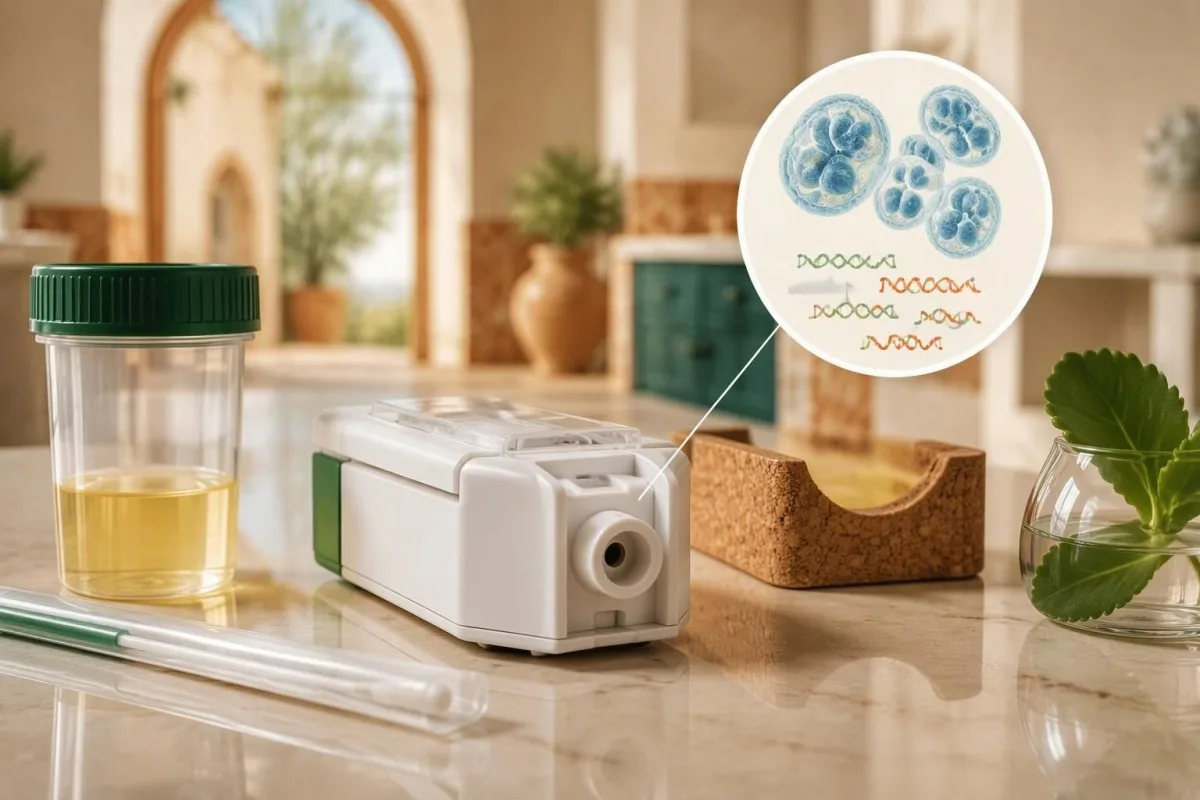
A positive chlamydia NAAT usually means infection at the sampled site; a negative result can miss an early exposure or an untested site. Testing around 2 weeks after exposure is a practical checkpoint, while testing for cure at approximately 4 weeks and retesting for reinfection at 3 months answer different questions.


- Оң нәтиже usually indicates chlamydia at the sampled site before treatment; it cannot establish when the infection began.
- Window period is not a precisely validated countdown: around 14 days after the last exposure is a practical testing checkpoint, not a guarantee.
- Теріс нәтиже applies to the specimen collected; 1 negative urine test does not exclude a separate rectal infection.
- Зәрдегі сезімталдық was 86.9% versus 94.1% for vaginal swabs in a 2023 meta-analysis of chlamydia testing in women.
- Residual genetic material can produce a positive NAAT within 4 weeks after treatment without proving that live bacteria remain.
- Емнің нәтижесін тексеру checks whether treatment cleared infection and is recommended approximately 4 weeks after treatment completion during pregnancy.
- Reinfection retesting is recommended around 3 months after treatment, even when partners reportedly received treatment.
- Sex after treatment should wait until 7 days after single-dose treatment or completion of a 7-day regimen, symptoms have resolved, and partners have been treated.
- Known exposure or symptoms warrants prompt clinical assessment; do not wait 14 days to seek care.
What does a chlamydia NAAT actually detect?
Chlamydia NAAT detects genetic material from Chlamydia trachomatis in a urine or swab specimen, rather than measuring antibodies or inflammation. A result describes the sampled site at collection; interpreting an early negative or a post-treatment positive requires 3 additional details: exposure date, specimen site, and treatment completion date.
NAAT means nucleic acid amplification test, and PCR is only 1 type of NAAT. Some assays amplify DNA, while others target RNA; neither routinely tells the laboratory whether the detected organism is still capable of causing infection, especially shortly after antibiotics.
Routine genital chlamydia testing is not a blood test, and a normal CBC or CRP cannot exclude it. Kantesti is an AI blood test analyzer that helps explain accompanying laboratory reports, but our ұйымдық фон should not be mistaken for evidence that blood-test interpretation can replace a site-specific chlamydia specimen.
Most chlamydia reports provide a detected or not-detected answer, not a validated severity score. I’m Thomas Klein, MD, Chief Medical Officer at Kantesti; when interpreting this kind of report, I would establish those 3 timing and specimen details before discussing prognosis, rather than treat a qualitative result as a numerical bacterial burden—the distinction explained in our qualitative result guide.
What does a positive chlamydia NAAT mean?
A positive chlamydia NAAT before treatment usually means chlamydia is present at the sampled site and warrants clinician-directed treatment. It does not establish infection duration, identify the transmitting partner, or prove that an exposure 3 days ago caused the result; an older, symptom-free infection may have been detected.
False-positive results are uncommon with validated NAATs, but no diagnostic test has 100% specificity. An unexpected positive deserves a review of specimen identity, recent treatment, exposure likelihood, and possible collection or laboratory contamination; a clinician may discuss a new specimen or an alternative assay without simply dismissing the original result.
Positive predictive value depends on prevalence as well as assay performance. In a hypothetical group of 10,000 people with 1% prevalence, a test with 90% sensitivity and 99.9% specificity would produce about 90 true positives and 10 false positives—roughly a 90% positive predictive value, not a real-world estimate for every clinic.
A chlamydia NAAT positive meaning differs from a positive antibody result because the tests measure different things. For example, 1 HSV-2 IgG result may require index-specific confirmation, as discussed in our HSV antibody confirmation guide; those antibody rules should not be imported into chlamydia NAAT interpretation or used to infer infidelity.
How reassuring is a negative chlamydia NAAT?
A negative chlamydia NAAT means the assay did not detect its target in that specimen; it does not rule out every possible infection or every exposure. Reassurance is strongest when the correct site was sampled, collection instructions were followed, and testing was not performed only a few days after exposure.
An early negative needs a timing plan rather than an absolute all-clear. For a hypothetical person tested 5 days after exposure, I would distinguish a useful baseline result from a later check around day 14; recent antibiotics, persistent symptoms, or another exposure would change that plan rather than merely restart an arbitrary countdown.
A negative urine NAAT does not exclude rectal chlamydia, and a negative vaginal swab does not exclude another unsampled site. Ask the clinic 3 direct questions: was the timing suitable, was the relevant site tested, and does the exposure history justify treatment despite a negative result?
Urinary white cells are not a substitute for chlamydia testing, even when the dipstick suggests irritation. A pattern such as leukocyte esterase without nitrites can occur with several conditions; 1 negative chlamydia NAAT should prompt evaluation for other causes of burning or discharge rather than repeated assumptions that the same organism must be responsible.
What is the chlamydia testing window period?
The chlamydia testing window period has no universally validated day-by-day sensitivity curve; around 14 days after the last exposure is a practical checkpoint used by many sexual health services. Earlier testing can detect infection, but an early negative may need repeating, especially when the exposure was recent and credible.
A 14-day checkpoint is not the same as a guarantee of detection or the incubation period for symptoms. Chlamydia may remain symptom-free, and detectable target levels vary with specimen type, organism burden, and assay; clinics may give slightly different timing advice because the evidence does not establish 1 perfect cutoff for every patient.
Known contact with a diagnosed partner warrants prompt assessment, not a mandatory 2-week wait. A clinic can test now and arrange presumptive treatment when indicated; if exposure was 3 days ago and symptoms are already present, evaluation should also consider infections or conditions that predated that encounter.
The relevant date is the most recent exposure to an untreated or potentially infected partner, not simply the first encounter. As of October 21, 2026, this article uses established CDC treatment guidance and published diagnostic evidence rather than claiming a newly verified 2026 window-period rule; our PCR timing discussion explains why detection windows differ by organism and cannot be borrowed from another infection.
How accurate is a chlamydia urine test?
Chlamydia urine test accuracy depends on anatomy, collection technique, and the assay; urine is not equally sensitive to every alternative specimen. In a 2023 meta-analysis, pooled chlamydia sensitivity in women was 86.9% for urine and 94.1% for vaginal swabs, supporting vaginal swabs as the preferred genital specimen when appropriate.
The 7.2-percentage-point sensitivity difference is a specimen comparison, not a universal prediction for an individual patient. Aaron et al. reported these pooled findings in Annals of Family Medicine in 2023; the studies used different assays and populations, so a clinic’s validated performance may differ, and these figures should not be applied to male urine testing.
First-catch urine is generally the preferred urine specimen for genital chlamydia NAAT, whereas midstream urine is commonly requested for bacterial urine culture. Many kits collect roughly the first 10–20 mL, but the exact volume and transfer requirements belong to the manufacturer’s instructions; collecting a large, diluted specimen is not automatically better.
Routine urine microscopy and chlamydia NAAT answer different questions, even if both start with a urine container. A specimen containing epithelial cells or white cells may help assess collection and irritation, as described in our urine sediment interpretation guide, but it cannot replace 1 specifically ordered NAAT or establish that a negative result was collected correctly.
Which sample site should be tested after exposure?
Chlamydia testing should match the exposed anatomical site: genital specimens assess genital infection, and rectal specimens assess rectal infection. A single urine test does not survey the whole body; discuss vaginal, anal, and oral exposure with the clinic so the testing plan covers the relevant sites without assuming that symptoms will identify them.
A self-collected vaginal swab is an accepted genital NAAT specimen when the test and collection procedure are validated. The CDC’s 2021 guidance recognizes comparable performance between patient-collected and clinician-collected vaginal specimens in clinical settings; avoiding an examination does not mean accepting a less useful test when a suitable kit is used.
Rectal chlamydia can be present without rectal symptoms, and a genital negative does not exclude it. For someone with 2 relevant exposure sites, the practical question is whether both were assessed; rectal testing may also be considered in other circumstances through shared decision-making, rather than relying solely on a remembered history of anal intercourse.
Routine throat screening for chlamydia is not generally recommended by the CDC, although throat chlamydia found during combined testing should be treated. A combined panel may also test for gonorrhea or other organisms, but each target has its own interpretation; our трихомониазды анықтау бойынша нұсқаулығымызда түсіндірілгендей explains why 1 negative STI result does not clear the rest of the panel.
How should you prepare for urine or swab collection?
Follow the specific kit’s collection, urination, storage, and transport instructions because specimen quality affects chlamydia NAAT sensitivity. Fasting is not normally required; many urine protocols ask patients not to urinate for at least 1 hour beforehand, but that interval is assay-specific rather than a universal rule.
First-catch collection usually means collecting the beginning of the stream, not performing a midstream clean-catch collection. If the clinic also wants a routine culture, ask whether it needs 2 separately collected specimens; our зәрді сынау тарелкесінің нұсқаулығы describes a different testing pathway, and its preparation advice should not override the NAAT kit.
Home swab kits can be useful when the laboratory validates the specimen and the transport conditions are followed. Check 3 items before posting: the correct sampling site, the required transport tube, and the permitted return time; menstrual bleeding or recent local products do not automatically invalidate every test, but the kit’s restrictions still apply.
Sensitive STI information should be shared only with deliberate consent, including within family accounts. Kantesti is an AI blood test interpretation platform, and a 60-second report explanation cannot recover an untested site or infer an unrecorded exposure date; our құпиялылық және деректер жөніндегі нұсқаулық is relevant when deciding which accompanying reports to share, not a reason to upload intimate records unnecessarily.
What should happen after a positive chlamydia result?
A positive chlamydia NAAT should lead to treatment, partner management, and assessment for other STIs rather than repeated testing before acting. The CDC’s 2021 recommended regimen for uncomplicated chlamydia in nonpregnant adolescents and adults is doxycycline 100 mg orally twice daily for 7 days; pregnancy and complications change the treatment plan.
Pregnancy requires a different antibiotic decision, and leftover antibiotics are not a safe substitute for prescribed treatment. The CDC recommends azithromycin 1 g orally as a single dose during pregnancy; allergies, vomiting, missed doses, or suspected pelvic inflammatory disease require individual advice, and our антибиотиктерден кейін ЖЖБИ-ге тестілеу article explains why recent medication must be disclosed.
Sex should be avoided for 7 days after single-dose therapy or until completing a 7-day regimen, with symptoms resolved and partners treated. Under CDC guidance, partners from the preceding 60 days should be evaluated and treated; the most recent partner should still be assessed when the last contact was more than 60 days earlier.
People diagnosed with chlamydia should also be offered testing for gonorrhea, HIV, and syphilis, with timing tailored to exposure. A possible HIV exposure within 72 hours needs urgent assessment for post-exposure prophylaxis rather than waiting for chlamydia follow-up; our PEP-тен кейін АИТВ тестілеуі guide addresses that separate schedule.
Why can chlamydia NAAT stay positive after treatment?
Chlamydia NAAT can remain positive after effective treatment because the assay may detect residual DNA or RNA from nonviable bacteria. The CDC advises against using NAAT less than 4 weeks after treatment completion to assess cure, because an early positive can be misleading and does not automatically demonstrate treatment failure.
Small clearance studies show that genetic targets often disappear sooner than 4 weeks, but individual clearance varies. Wind et al. followed 23 patients with chlamydia and gonorrhea coinfection in a 2016 prospective cohort: median clearance was 7 days for RNA and 6 days for DNA, with 95% clearing by days 13 and 14, respectively.
Those 23-patient results do not establish that everyone is cured by day 14 or that every early positive is harmless residue. The study involved a specific coinfected population and observed occasional isolated positive results after apparent clearance; the more cautious 4-week clinical interval accounts for variability that a median cannot capture.
A NAAT result does not directly measure contagiousness after treatment, so it should not replace the prescribed abstinence interval and partner plan. A repeat positive 10 days after completion needs a review of symptoms, adherence, and new exposure—not an automatic second antibiotic course; our PCR and timing discussion illustrates the broader distinction between detecting a target and establishing its clinical meaning.
How does a test of cure differ from reinfection retesting?
A test of cure asks whether treatment cleared the original infection; reinfection retesting looks for infection acquired again after treatment. The CDC recommends a test of cure approximately 4 weeks after completion during pregnancy and reinfection retesting around 3 months after treatment for everyone treated for chlamydia.
Routine test of cure is usually unnecessary in nonpregnant people who completed an appropriate regimen and have no ongoing concerns. Adherence uncertainty, persistent symptoms, or suspected reinfection can justify follow-up testing; 4 weeks is a timing safeguard when cure testing is indicated, not an instruction for every patient to obtain another specimen.
A 3-month retest is recommended even when the patient believes every partner was treated. Reinfection can follow an untreated partner, a new partner, or another exposure, and prior chlamydia does not provide dependable protective immunity; if a 3-month visit is impossible, CDC guidance recommends retesting at the next opportunity within 12 months.
Follow-up dates should be attached to treatment completion and the clinical question, not merely to when the result appeared in an app. Kantesti’s техникалық валидация туралы ақпараты concerns our interpretation system and does not establish chlamydia assay accuracy; keeping a clear laboratory result timeline helps distinguish a 4-week cure check from a 3-month reinfection screen.
Does a repeat positive mean treatment failure?
A repeat positive chlamydia NAAT does not automatically mean treatment failure; possible explanations include residual genetic material, reinfection, incomplete treatment, and genuine persistence. Timing matters: a result less than 4 weeks after completion is harder to interpret, while a later positive deserves a fresh assessment rather than being dismissed as residue.
Most post-treatment chlamydia infections described in CDC guidance are attributed to reinfection rather than antibiotic failure. Review 4 details with the clinician: which medicine was taken, whether all doses stayed down, whether partners were treated, and whether sex occurred before everyone completed treatment; the answers often explain a repeat positive more usefully than changing drugs immediately.
Treatment choice matters particularly for rectal chlamydia. A randomized trial cited in the CDC’s 2021 guideline reported microbiological cure of 100% with doxycycline versus 74% with azithromycin among men who have sex with men with rectal infection; these are trial-specific results, but they help explain the preference for doxycycline outside pregnancy.
Persistent symptoms with negative repeat chlamydia testing should trigger consideration of another diagnosis, not endless chlamydia treatment. Severe rectal symptoms can require specialist assessment for lymphogranuloma venereum, which uses a longer 21-day doxycycline course when diagnosed or strongly suspected; our Ureaplasma treatment discussion also explains why finding another organism does not automatically justify antibiotics.
What changes when chlamydia is diagnosed during pregnancy?
Pregnancy changes both treatment selection and follow-up: chlamydia should be treated promptly, followed by a NAAT test of cure approximately 4 weeks after treatment completion. Reinfection retesting around 3 months remains necessary, and further third-trimester screening may be recommended for patients younger than 25 or those with continuing exposure risk.
A pregnancy test and a chlamydia NAAT detect unrelated targets, even when both use urine. If pregnancy is possible, tell the prescriber before treatment; 1 early negative pregnancy test may need repeating according to the exposure and menstrual history, as explained in our early pregnancy testing guide, without delaying assessment of a positive chlamydia result.
The approximately 4-week pregnancy test of cure is recommended because persistent infection has consequences for both the pregnant patient and the newborn. An earlier positive can still reflect residual targets, so scheduling at 1 or 2 weeks often creates uncertainty rather than reassurance; persistent symptoms, meanwhile, require assessment before the scheduled cure test.
Pregnancy antibody results should not be interpreted using chlamydia NAAT rules. A report such as Toxoplasma IgG in pregnancy addresses exposure and immunity questions rather than the same bacterial target; bring the actual reports and 3 dates—collection, treatment completion, and any later exposure—to the maternity or sexual health team.
When do symptoms need care despite a negative test?
A negative chlamydia NAAT should not delay assessment of pelvic pain, fever, persistent discharge, or significant testicular symptoms. Sudden severe testicular pain, fainting with abdominal pain, or severe pain when pregnancy is possible requires emergency assessment now; waiting another 14 days for a better-timed STI specimen could miss a time-sensitive diagnosis.
Pelvic inflammatory disease is a clinical diagnosis, and a negative lower-genital chlamydia test does not exclude infection higher in the reproductive tract. A hypothetical patient with pelvic pain and tenderness after 1 negative swab needs examination and consideration of other causes; treatment, when indicated, is broader than the uncomplicated 7-day chlamydia regimen.
Not every episode of pelvic pain is an STI, and diagnostic anchoring can be dangerous. A sudden change over 1 hour, severe one-sided pain, vomiting, or collapse can point to conditions discussed in our жамбас тұсының ауыруы кезіндегі шұғыл әрекеттер жөніндегі нұсқаулығымыз; the clinical examination matters more than trying to force those symptoms to fit a previous laboratory label.
An interpretation tool cannot safely rule out an emergency from 1 laboratory result. Kantesti is an AI-powered blood test analysis tool, not a substitute for urgent examination; the rule I would emphasize as Thomas Klein, MD, is to act on concerning symptoms before a retesting deadline, with the role of clinical oversight explained through our медициналық консультативтік кеңес.
Research publications and the limits of this evidence
The chlamydia recommendations here rely on directly relevant clinical guidance and diagnostic studies, not on unrelated DOI-bearing educational guides. This October 21, 2026 article distinguishes 3 evidence questions—specimen sensitivity, treatment follow-up, and nucleic-acid clearance—because a publication addressing one cannot automatically settle the others.
The 2021 CDC STI guideline provides the treatment, partner-management, 4-week pregnancy cure-test, and 3-month reinfection-retesting recommendations. Aaron et al. (2023) provide the vaginal-versus-urine sensitivity comparison, while Wind et al. (2016) describe clearance in a small cohort; none establishes a universally conclusive 14-day post-exposure testing rule.
The first of the 2 requested educational publication records is unrelated to chlamydia diagnostic accuracy. Formal citation: B Negative Blood Type, LDH Blood Test & Reticulocyte Count Guide. (n.d.). Figshare. Its companion гематология маркері жөніндегі нұсқаулық concerns blood-group and cellular interpretation; the DOI and discovery links are listed separately below, without implying that the guide is a peer-reviewed NAAT validation study.
The second educational publication also does not support a chlamydia window period or cure-testing threshold. Formal citation: Diarrhea After Fasting, Black Specks in Stool & GI Guide 2026. (n.d.). Figshare. Its companion ас қорыту симптомдары бойынша нұсқаулық addresses a different clinical question; a 2026 title does not by itself establish publication date, study design, or relevance to STI testing.
Clinical claims should remain traceable to the right evidence, especially when a result could change antibiotic use. Kantesti’s медициналық мазмұн стандарттары describe that editorial expectation; for your own follow-up, retain 3 pieces of information—the actual assay report, the treatment completion date, and any subsequent exposure—rather than relying on a screenshot marked only positive or negative.
Жиі қойылатын сұрақтар
Хламидияға ұшырағаннан кейін қанша уақыттан соң NAAT инфекцияны анықтай алады?
Хламидияға арналған NAAT кейбір адамдарда инфекцияны 14 күн өтпей-ақ анықтай алады, бірақ күн сайынғы сезімталдық қисығы жалпыға бірдей валидацияланбаған. Соңғы ықтимал жұқтырудан кейін шамамен 14 күн өткенде тестілеу — көптеген жыныстық денсаулық қызметтері қолданатын практикалық бақылау мерзімі, бірақ бұл нәтижеге кепілдік бермейді. Ықтимал жұқтырудан бірнеше күн өткен соң ғана алынған теріс нәтиже тестіні қайталауды қажет етуі мүмкін. Симптомдар немесе диагнозы расталған серіктеспен байланыста болғаны белгілі болса, тестілеудің терезелік кезеңін күтпей, дереу медициналық бағалаудан өту керек.
Хламидияға NAAT нәтижесінің оң болуы белсенді инфекция бар екенін міндетті түрде білдіре ме?
Емдеуге дейін хламидияға NAAT нәтижесінің оң болуы, әдетте, сынама алынған жерде инфекция бар екенін көрсетеді және дәрігердің нұсқауымен емдеуді қажет етеді. Емдеу аяқталғаннан кейінгі 4 апта ішінде нәтиженің оң болуы тіршілікке қабілетсіз бактериялардың қалдық ДНҚ-сын немесе РНҚ-сын көрсетуі мүмкін. Бұл тест тірі микроорганизмдерді қалған генетикалық материалдан әдетте ажыратпайды. Кейінгі қадамды анықтауға уақыт, емді сақтау, сынама алынған жер, симптомдар және кейінгі жұқтыру ықтималдығы әсер етеді.
Хламидиозға жасалатын зәр талдауы қынаптан алынған жағындымен салыстырғанда қаншалықты дәл?
2023 жылғы мета-талдауда әйелдердегі хламидиозды анықтау сезімталдығының жинақталған бағалары несеп үшін 86.9%, ал қынап жағындылары үшін 94.1% деп хабарланды. Бұлар — жекелеген зерттеулер бойынша жинақталған бағалар, әр зертхана немесе пациент үшін кепілдендірілген көрсеткіштер емес. Алғашқы ағыннан алынған несеп көптеген жағдайларда, әсіресе ерлердің жыныс мүшелерін тексергенде, қолайлы үлгі болып қала береді, бірақ әйелдерге арналған жинақталған көрсеткіштерді ерлерге қолдануға болмайды. Үлгіні жинау әдісі мен жұқпа әсер еткен дұрыс аймақтан үлгі алу теріс нәтиженің қаншалықты сенімді екеніне әсер етеді.
Зәрдегі хламидиозға тест теріс нәтиже көрсетсе, тік ішектегі инфекцияны анықтамай қалуы мүмкін бе?
A negative urine chlamydia NAAT does not exclude rectal chlamydia because urine and rectal swabs assess different sites. If 2 sites were potentially exposed, discuss whether both need testing with a sexual health clinician. Rectal infection can occur without symptoms. A better-timed urine repeat does not correct the problem of never sampling the rectal site.
When should I have a chlamydia test of cure?
A chlamydia NAAT test of cure is recommended approximately 4 weeks after treatment completion during pregnancy. Routine cure testing is usually unnecessary in nonpregnant people who completed appropriate treatment and have no concerns about adherence, persistent symptoms, or reinfection. Testing earlier than 4 weeks can detect residual bacterial genetic material and create a misleading positive. Persistent or worsening symptoms need clinical assessment before that scheduled interval.
Why should I retest for chlamydia after 3 months?
Retesting around 3 months after chlamydia treatment checks for reinfection rather than proving that the original antibiotic course worked. CDC guidance recommends this retest even when partners reportedly received treatment. Reinfection can occur through an untreated partner or a subsequent exposure, and previous infection does not provide dependable immunity. If a 3-month retest is not possible, retesting at the next clinical opportunity within 12 months is recommended.
Does a repeat positive chlamydia test mean the antibiotics failed?
A repeat positive chlamydia NAAT does not automatically mean antibiotic failure. Within 4 weeks after completion, residual DNA or RNA is one possible explanation; later positives require assessment for reinfection, incomplete treatment, or persistence. Most post-treatment infections discussed in CDC guidance are attributed to reinfection rather than treatment failure. Tell the clinician the antibiotic regimen, completion date, missed or vomited doses, partner-treatment history, and any subsequent sexual contact.
Бүгін AI арқылы қан талдауы нәтижесін алыңыз
Kantesti-ті лезде әрі дәл зертханалық талдау үшін сенетін бүкіл әлем бойынша 2 миллионнан астам пайдаланушыға қосылыңыз. Қан анализінің нәтижелерін ж.үктеп, бірнеше секунд ішінде 15,000+ биомаркерлерінің жан-жақты түсіндірмесін алыңыз.
📚 Сілтеме жасалған ғылыми жарияланымдар
Кляйн, Т., Митчелл, С., & Вебер, Х. (2026). B теріс қан тобы, LDH қан талдауы және ретикулоциттер саны бойынша нұсқаулық. Kantesti AI медициналық зерттеулер.
Кляйн, Т., Митчелл, С., & Вебер, Х. (2026). Оразадан кейінгі диарея, нәжістегі қара дақтар және асқазан-ішек жолдары бойынша нұсқаулық 2026. Kantesti AI медициналық зерттеулер.
📖 Сыртқы медициналық сілтемелер
Aaron K et al. (2023). Vaginal Swab vs Urine for Detection of Chlamydia trachomatis, Neisseria gonorrhoeae, and Trichomonas vaginalis: A Meta-Analysis. Отбасылық медицина жылнамалары.
Wind CM et al. (2016). Time to clearance of Chlamydia trachomatis RNA and DNA after treatment in patients coinfected with Neisseria gonorrhoeae – a prospective cohort study. BMC Infectious Diseases.
⚕️ Медициналық ескерту
Бұл мақала тек білім беру мақсатында ғана және медициналық кеңес болып табылмайды. Диагноз және ем туралы шешімдер үшін әрдайым білікті медицина қызметкеріне жүгініңіз.
E-E-A-T сенім сигналдары
Тәжірибе
Дәрігер басқаратын зертханалық талдауды түсіндіру жұмыс ағындарын клиникалық шолу.
Сараптама
Биомаркерлердің клиникалық контексте қалай әрекет ететініне зертханалық медицина фокусы.
Билік
Доктор Томас Клейн жазған, доктор Сара Митчелл және профессор доктор Ханс Вебер шолған.
Сенімділік
Дабыл қаупін азайту үшін айқын бақылау жолдарымен дәлелге негізделген түсіндіру.