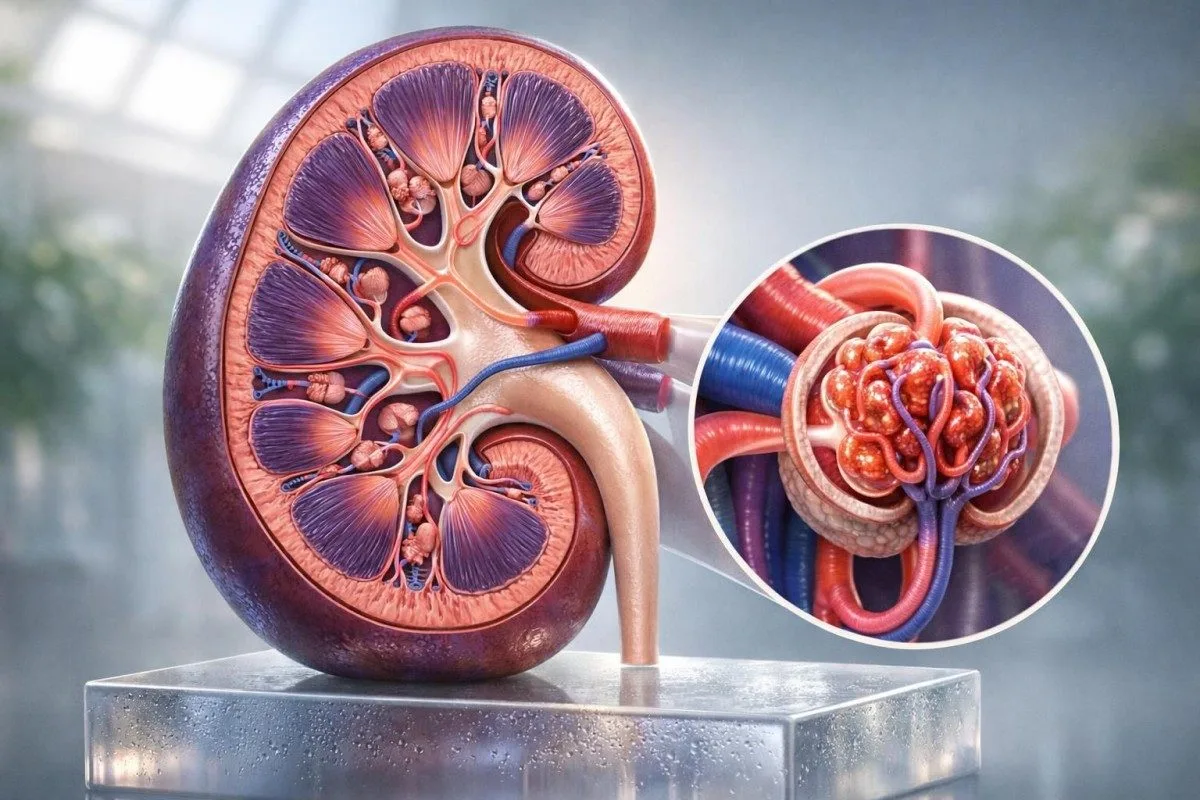
A low kidney number does not always mean kidney disease. The real question is whether your result is an estimate that fits your body, or a number that needs confirming with a measured test.


- eGFR is an estimate calculated from creatinine or cystatin C and reported in mL/min/1.73 m².
- Measured GFR usually uses iohexol or iothalamate clearance and is chosen when drug dosing or donor evaluation needs tighter accuracy.
- eGFR normal range is typically ≥90 mL/min/1.73 m², but 60-89 can be acceptable if urine ACR is <30 mg/g and there are no other kidney damage markers.
- Low GFR below 60 mL/min/1.73 m² for at least 3 months supports CKD only when it persists or comes with albuminuria, hematuria, or structural disease.
- AKI clue is a creatinine rise of ≥0.3 mg/dL in 48 hours or 1.5× baseline within 7 days.
- Creatinine trap happens in bodybuilders, frail adults, amputees, cirrhosis, pregnancy, and people taking trimethoprim, cimetidine, cobicistat, or creatine.
- Urgent pattern includes potassium >5.5 mmol/L, bicarbonate or total CO2 <20 mmol/L, rapidly falling urine output, or shortness of breath.
- Best follow-up after one abnormal kidney blood test is repeat testing, urine albumin-creatinine ratio, blood pressure review, and a medication check.
GFR test vs eGFR: the short answer patients actually need
eGFR is a calculated estimate of kidney filtration, while a measured GFR test tracks how quickly your kidneys clear a marker such as iohexol from the blood. Doctors usually rely on eGFR for routine care, but they switch to a true GFR test when creatinine is likely misleading, when medication dosing must be precise, or when someone is being assessed as a kidney donor. As of April 13, 2026, that is still the practical difference we explain most often on Kantesti AI and in our guide to eGFR normal range.
eGFR is reported in mL/min/1.73 m². Most labs now use the 2021 CKD-EPI creatinine equation described by Inker and colleagues, but some still truncate the result as >90 or >60, which hides nuance that matters in clinic; as Thomas Klein, MD, I often tell patients that the lab flag is the start of the conversation, not the diagnosis. If you want to see why a normal-looking creatinine can still fool you, our creatinine range guide is worth reading next.
A measured GFR test is slower and pricier because it uses an external filtration marker and repeated sampling over time. It is not part of a routine renal panel versus CMP, and in many hospitals it is reserved for transplant workups, oncology dosing, or those awkward cases where the estimate does not match the patient sitting in front of you.
In our analysis of more than 2 million uploaded reports across 127+ countries, the commonest kidney panic point is an isolated eGFR in the high 50s found on a routine wellness panel. Most patients expect a yes-or-no answer; in real nephrology, the pattern with urine albumin, blood pressure, potassium, bicarbonate, and trend over months usually matters more than the single number.
Why creatinine can mislead even when the lab looks confident
Creatinine reflects more than filtration. It also reflects muscle mass, meat intake, supplements, and how much of the molecule is secreted into the urine tubules, so a creatinine-based kidney blood test can undercall or overcall kidney trouble. If that pairing sounds familiar, our BUN/creatinine ratio guide shows how often context changes the story.
Creatinine can rise without true kidney damage. A hard gym week, 5 g/day of creatine, a steak dinner the night before testing, or drugs such as trimethoprim, cimetidine, cobicistat, and fenofibrate can shift creatinine by roughly 0.1 to 0.4 mg/dL in ways that change eGFR on paper but not kidney filtration in the way patients fear.
Dehydration is one of the most common false alarms. When I review a panel showing creatinine 1.3 mg/dL, sodium 147 mmol/L, albumin slightly high, and hemoglobin nudged upward, I worry first about hemoconcentration rather than intrinsic kidney disease; our review of dehydration-related false highs goes into the mechanics.
I see this pattern weekly in active patients: a 32-year-old lifter with creatinine 1.4 mg/dL and eGFR 58 may have very different kidney health from an 82-year-old with creatinine 0.7 mg/dL and eGFR 85. The first may be overcalled because of muscle mass, and the second may be falsely reassured because low muscle mass makes creatinine look deceptively gentle; our athlete blood test guide touches that problem from the sports side.
Cystatin C helps, but it is not magic
Cystatin C often improves accuracy when creatinine is suspect, and KDIGO 2024 still recommends it for confirmatory work in selected cases. But cystatin C also shifts with inflammation, smoking, corticosteroids, and some thyroid states, so even this marker benefits from context; that is one reason a standard blood test often misses what matters most.
When doctors use a measured GFR test instead of eGFR
Doctors order a measured GFR test when precision matters more than convenience. The clearest examples are kidney donor evaluation, carboplatin dosing, major discrepancies between creatinine and cystatin C, advanced liver disease, or body composition that makes equations unreliable; these are the situations our physicians discuss most often with the Medical Advisory Board.
Transplant programs often use measured GFR because a difference of 5 to 10 mL/min can change whether a living donor is accepted. In my experience, donor candidates are usually surprised that a perfectly ordinary eGFR of 82 may still be double-checked if body size is extreme, because donation decisions hinge on long-term safety rather than good-enough screening; our biomarkers guide explains how these markers sit within a larger panel.
Oncology is another big reason. Carboplatin dosing is commonly based on the Calvert formula, and an overestimated GFR can translate into avoidable marrow toxicity, particularly thrombocytopenia; when the dose is large, a filtration error of even 15 mL/min is not trivial.
A lot of patients ask whether a 24-hour creatinine clearance is the same thing. Not really. Collection errors are common, and many labs see incomplete urine collections that overestimate or underestimate function by 10% to 30%, which is why a formal tracer-based test is preferred when the stakes are high.
A measured GFR is also used when the estimate and the patient do not match
The mismatch case is the one we remember. A very frail older adult, an amputee, or someone with cirrhosis can have deceptively low creatinine production, so eGFR looks better than reality; on the other side, a muscular patient can look worse than reality. Those are the cases where measured GFR earns its keep.
What a measured GFR test is actually like for the patient
A measured GFR test usually involves a small dose of a filtration marker such as iohexol or iothalamate and then 2 to 4 timed blood samples over roughly 2 to 5 hours. Some centers add urine collection, some do plasma clearance only, and most patients need a specialty unit rather than a walk-in lab, which is why choosing a reliable local lab matters.
Preparation is usually simple. Many centers want you reasonably hydrated, avoiding strenuous exercise that morning, and bringing a medication list; fasting is often unnecessary, though some units still request 4 to 8 hours without food, so it helps to check the exact fasting rules.
Patients often worry that iohexol means the same risk as a CT contrast study. The doses used for GFR test measurement are much smaller, and in my experience most patients tolerate them well, but pregnancy, prior contrast reactions, and severe kidney impairment should always be discussed with the ordering team.
Costs vary wildly by country and by insurer. In self-pay settings, the difference between a routine creatinine test and a measured GFR can be dramatic, which is why I tell patients to ask the center for a bundled estimate up front; our blood test cost guide helps frame that conversation.
What eGFR normal range really means by age, urine findings, and lab method
The eGFR normal range in most adults is 90 mL/min/1.73 m² or higher, but a value of 60 to 89 is not automatically chronic kidney disease. Here is what matters: if urine albumin is normal, blood pressure is controlled, and the number is stable over time, that borderline range can be far less concerning than many patients assume; our BUN guide shows why kidney tests should rarely be read alone.
Urine albumin-creatinine ratio, or ACR, changes the interpretation fast. An eGFR of 68 with ACR 8 mg/g is a different clinical conversation from an eGFR of 68 with ACR 240 mg/g or persistent hematuria; that is why I nearly always pair a low kidney blood test with a urinalysis guide discussion before anyone labels it CKD.
Not every lab reports kidney function the same way. Some UK and European labs still cap the result as >90, some suppress reporting during pregnancy, and some use local unit conversions that confuse patients comparing old and new reports; on our AI blood test platform, we see unit mismatches often enough that our parser checks for them before interpretation.
Age complicates the story. A healthy 25-year-old with eGFR 72 deserves more scrutiny than a healthy 78-year-old with the same number, yet the evidence on age-calibrated CKD cutoffs is honestly mixed, and clinicians disagree more than most patient-facing websites admit.
What low GFR means, and when the pattern is more serious
Low GFR means reduced filtration, but urgency depends on the pattern around it. A persistent eGFR <60 mL/min/1.73 m² for at least 3 months or urine ACR ≥30 mg/g supports CKD, while a creatinine rise of ≥0.3 mg/dL in 48 hours or 1.5× baseline in 7 days supports AKI; that is why I cross-check every low kidney result with the electrolyte panel.
The combination that worries me is low GFR plus high potassium, low bicarbonate, edema, or reduced urine output. An eGFR of 42 is one thing; eGFR 42 with potassium 5.8 mmol/L and CO2 18 mmol/L is a very different level of urgency, and that is where a CMP versus BMP becomes clinically useful rather than academic.
Trends beat snapshots. A creatinine move from 0.9 to 1.2 mg/dL can still fall inside a lab's normal range, yet it represents a 33% increase, which is exactly the sort of hidden deterioration patients miss unless someone compares prior reports side by side; our trend comparison guide was built for that problem.
As Thomas Klein, MD, I worry more about the clustered pattern than the isolated number. Foamy urine, long-standing hypertension, diabetes, anemia, phosphate changes, and rising parathyroid hormone point toward chronic kidney stress, while vomiting, diarrhea, NSAID use, or sepsis point me toward a more acute story.
What patients should ask after a low kidney blood test
After a low kidney blood test, ask three things first: Is this new, does it need repeating, and what urine test comes next? One isolated low eGFR often gets repeated in 1 to 2 weeks if dehydration or acute illness is suspected, or by 3 months if the goal is to confirm or exclude CKD; if you want a clean summary before your visit, our free blood test review can organize the numbers for you.
The most useful question is whether you have a baseline. Patients remember the scary current result, but I often care more about whether last year's creatinine was 0.8, 1.0, or 1.3 mg/dL; if the abbreviations feel opaque, our blood test abbreviations guide helps decode what to compare.
Ask whether you need urine ACR, a plain urinalysis, blood pressure measurement, and possibly a kidney ultrasound. If the result does not fit your age, body build, or medication list, say that out loud during the appointment; when patients need help framing those questions, they can contact our team and we will point them toward the right data to gather.
Medication review matters more than people expect. NSAIDs can worsen kidney perfusion, but so can volume depletion from diuretics; and a creatinine increase of up to about 30% after starting an ACE inhibitor, ARB, or SGLT2 inhibitor may be acceptable if it stabilizes, which is why you should never stop those drugs on your own without checking the plan.
Questions worth writing down before the appointment
Write these down exactly: Do I have albumin or blood in the urine, has my creatinine changed quickly, could dehydration or supplements explain this, and do I need cystatin C or a measured GFR test? Most patients who bring those four questions get a clearer answer in 10 minutes than patients who only ask whether the number is bad.
The patients in whom eGFR fails more often than most websites admit
eGFR is less reliable in bodybuilders, frail older adults, amputees, cirrhosis, pregnancy, severe edema, and acute kidney injury. Creatinine equations assume stable creatinine generation, and that assumption breaks quickly in real life, which is why we keep a close eye on accuracy standards in our medical validation work.
The athletic patient and the frail patient are mirror-image traps. A muscular 40-year-old taking 3 to 5 g/day of creatine can look as if kidney function is worse than it is, while a sarcopenic 85-year-old can look reassuring because creatinine production is low even when true filtration is falling.
Pregnancy is a classic blind spot. Normal pregnancy increases GFR by roughly 40% to 50% early on, so a creatinine of 1.0 mg/dL that might look ordinary outside pregnancy can be unexpectedly high in pregnancy, and many labs avoid reporting eGFR at all because the equations were not validated there.
Cirrhosis and amputation create the opposite problem from bodybuilding. In advanced liver disease, creatinine production falls and fluid overload dilutes the value, so eGFR often looks better than reality; Thomas Klein, MD, teaches our clinical reviewers to be especially cautious when creatinine appears too good to match the rest of the panel.
Acute kidney injury is where formulas break fastest
eGFR formulas are not designed for rapidly changing creatinine. If a patient is septic, newly obstructed, or just had major surgery, the equation can lag badly behind what the kidneys are doing hour by hour, which is one reason nephrologists often ignore the printed eGFR in acute settings and focus on serial creatinine, urine output, and cause.
How Kantesti reads a kidney blood test differently from a single lab flag
Kantesti AI does not treat one eGFR line in isolation. Our platform cross-checks creatinine, BUN, electrolytes, prior trends, age, sex, units, and missing context, and our methodology is explained in our AI technology guide.
Unit errors still happen. In our 2M+ report archive, imported PDFs occasionally mix mg/dL with µmol/L, or list creatinine without prior baselines, so Kantesti flags those inconsistencies before interpretation; if you want to test that workflow yourself, our blood test PDF upload shows how the parsing step works.
Kantesti also checks whether the estimate is being used outside its comfort zone. If creatinine is changing too fast, if a report looks like acute illness, or if body composition is likely to distort the calculation, our engine lowers confidence and suggests what confirmatory data are missing rather than pretending the equation is gospel; you can read more about us on About Us.
The practical gain is pattern recognition. Thomas Klein, MD, asks our reviewers to pair any low GFR with potassium, bicarbonate, hemoglobin, calcium-phosphate balance, urine protein, and medication history, because that cluster predicts risk better than the kidney number alone; that approach sits inside Kantesti's CE Mark, HIPAA, GDPR, and ISO 27001-aligned clinical standards.
Bottom line: what to do next, and when not to wait
If your result is low, the next move is usually repeat testing, urine albumin measurement, blood pressure review, and a medication check. Same-day medical care is wise for very low urine output, shortness of breath, confusion, swelling that is rapidly worsening, or a potassium level above 6.0 mmol/L; for ongoing updates and deeper explainers, our blog is the best place to keep reading.
Do not try to outsmart the next test by drinking huge volumes of water right before the blood draw. That can muddy interpretation without fixing the underlying issue, and in patients with heart failure or severe kidney disease it can even make things worse.
Do not assume a low eGFR means dialysis. Many patients with stable CKD stage G3 live for years with eGFR in the 30s to 50s and never approach kidney replacement therapy, especially when blood pressure, diabetes control, and albuminuria are managed carefully.
Most patients do better when they think in timelines, not labels. I usually suggest: repeat and urine check soon, specialist input if the value stays low or falls, and urgent review if symptoms pile on; our patient success stories show how much clarity improves once trends replace panic.
Research publications and source transparency
These references are supporting publications from the Kantesti research library rather than kidney-specific GFR validation papers. As of April 13, 2026, our editorial workflow pairs physician review with DOI-traceable material and transparent citation practice, and related topic pages such as our iron studies guide and coagulation guide follow the same standard.
Kantesti LTD. (2026). Iron Studies Guide: TIBC, Iron Saturation & Binding Capacity. Zenodo. https://doi.org/10.5281/zenodo.18248745. ResearchGate: record. Academia.edu: record.
Kantesti LTD. (2026). aPTT Normal Range: D-Dimer, Protein C Blood Clotting Guide. Zenodo. https://doi.org/10.5281/zenodo.18262555. ResearchGate: record. Academia.edu: record.
For kidney-specific standards, the guiding framework in daily practice remains the 2024 KDIGO CKD guideline and the 2021 CKD-EPI equation papers, even though the bedside reality is messier than any equation suggests. That uncertainty is exactly why a measured GFR test still has a role in 2026.
Frequently Asked Questions
What is the difference between a GFR test and eGFR?
A GFR test directly measures how quickly your kidneys clear a filtration marker such as iohexol or iothalamate, while eGFR estimates kidney function from a blood marker, usually creatinine and sometimes cystatin C. eGFR is reported in mL/min/1.73 m² and is the routine tool used on most chemistry panels because it is fast and inexpensive. Doctors usually choose a measured GFR when the estimate may be inaccurate, such as in kidney donor evaluation, carboplatin dosing, advanced liver disease, or very unusual body composition.
What is a normal eGFR range in adults?
The usual eGFR normal range in adults is 90 mL/min/1.73 m² or higher, but that number needs context. A result of 60 to 89 may still be acceptable if urine albumin-creatinine ratio is <30 mg/g, the value is stable, and there are no other signs of kidney damage. Chronic kidney disease is generally diagnosed when eGFR stays below 60 for at least 3 months or when kidney damage markers such as albuminuria persist.
Can dehydration cause a low eGFR?
Yes, dehydration can temporarily lower eGFR by concentrating creatinine and reducing kidney perfusion. In practice, I often see creatinine rise by 0.1 to 0.3 mg/dL after vomiting, diarrhea, heavy exercise, or poor fluid intake, which can make eGFR look worse than the true long-term baseline. The fix is not guessing; it is usually repeating the test after recovery and checking whether the value returns toward baseline.
When do doctors order a measured GFR test?
Doctors order a measured GFR test when precision matters more than convenience. Common reasons include living kidney donor assessment, carboplatin chemotherapy dosing, disagreement between creatinine and cystatin C, pregnancy, cirrhosis, amputations, and bodybuilders or frail adults whose muscle mass makes creatinine unreliable. The measured test usually takes 2 to 5 hours and uses 2 to 4 timed blood samples, so it is reserved for specific questions rather than routine screening.
Is one low eGFR enough to diagnose kidney disease?
No, one low eGFR is usually not enough to diagnose chronic kidney disease. CKD generally requires an eGFR <60 mL/min/1.73 m² for at least 3 months or another persistent marker of kidney damage such as urine ACR ≥30 mg/g, structural abnormalities, or recurrent hematuria. An acute illness, dehydration episode, new medication, or lab variation can cause a single abnormal result that later normalizes.
Can creatine supplements make kidney numbers look worse?
Yes, creatine supplements can raise creatinine and make eGFR look lower even when true filtration has not changed much. A muscular person taking 3 to 5 g/day of creatine can show a creatinine result that alarms the lab software but does not reflect kidney injury in the usual sense. When the history fits, clinicians may repeat testing off supplements, add cystatin C, or use a measured GFR test if the answer matters for treatment.
What should I ask my doctor after a low kidney blood test?
Ask whether the result is new, whether it should be repeated in 1 to 2 weeks or by 3 months, and whether you need a urine ACR, urinalysis, blood pressure check, or kidney ultrasound. Ask whether your medications, supplements, dehydration, recent illness, or heavy exercise could have shifted creatinine. And ask whether the result is serious because of the number itself or because it is paired with higher-risk findings such as potassium >5.5 mmol/L, CO2 <20 mmol/L, or falling urine output.
Get AI-Powered Blood Test Analysis Today
Join over 2 million users worldwide who trust Kantesti for instant, accurate lab test analysis. Upload your blood test results and receive comprehensive interpretation of 15,000+ biomarkers in seconds.
📚 Referenced Research Publications
Klein, T., Mitchell, S., & Weber, H. (2026). Iron Studies Guide: TIBC, Iron Saturation & Binding Capacity. Kantesti AI Medical Research.
Klein, T., Mitchell, S., & Weber, H. (2026). aPTT Normal Range: D-Dimer, Protein C Blood Clotting Guide. Kantesti AI Medical Research.
⚕️ Medical Disclaimer
This article is for educational purposes only and does not constitute medical advice. Always consult a qualified healthcare provider for diagnosis and treatment decisions.
E-E-A-T Trust Signals
Experience
Physician-led clinical review of lab interpretation workflows.
Expertise
Laboratory medicine focus on how biomarkers behave in clinical context.
Authoritativeness
Written by Dr. Thomas Klein with review by Dr. Sarah Mitchell and Prof. Dr. Hans Weber.
Trustworthiness
Evidence-based interpretation with clear follow-up pathways to reduce alarm.