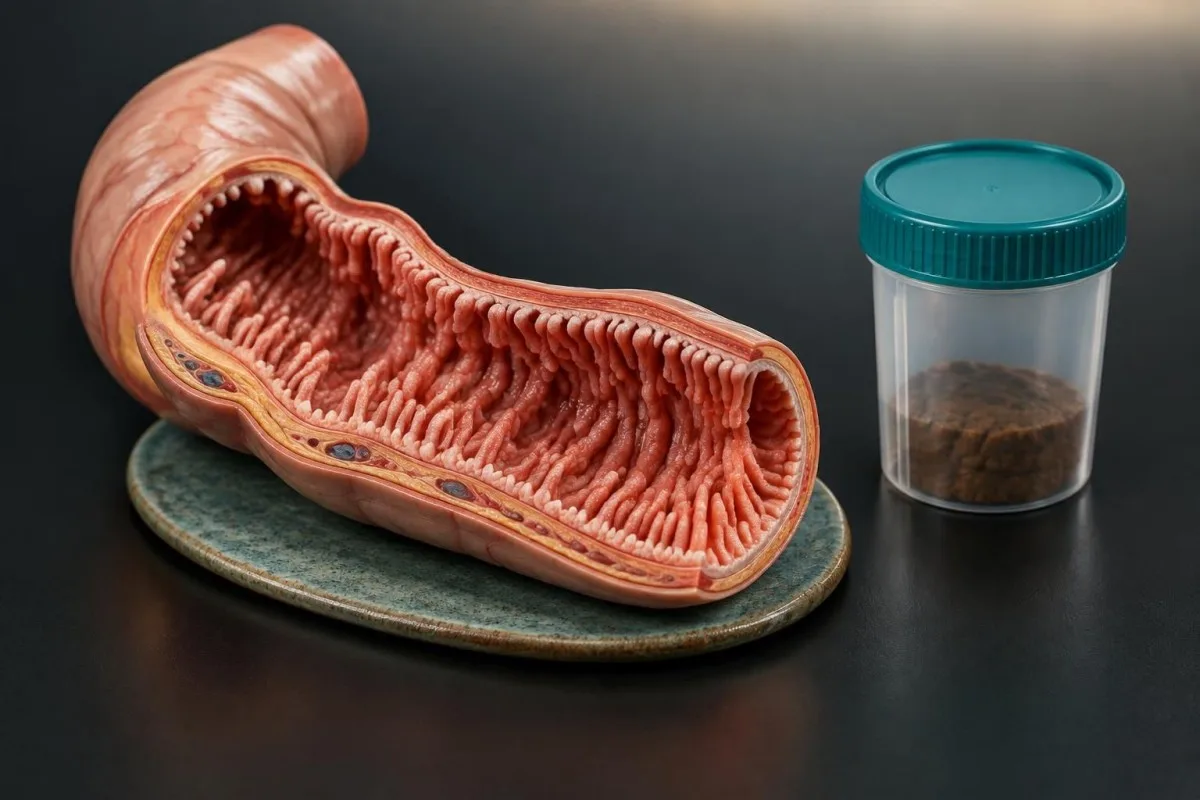
Commercial stool antibody results can be confusing. The sample type, gluten intake and follow-up plan all affect what a result can tell you.

أهم الخلاصات
- Stool testing: A commercial stool antibody test cannot reliably diagnose or rule out celiac disease or show whether intestinal villi are damaged.
- First blood tests: Tissue transglutaminase IgA, usually called tTG-IgA, and total IgA are commonly used together while the person is eating gluten.
- IgA deficiency: A low total IgA can make a tTG-IgA result falsely reassuring; a clinician may order an IgG-based celiac test instead.
- الخزعة: Adults usually need upper endoscopy with samples from the duodenum to confirm the diagnosis; selected children may qualify for a no-biopsy pathway.
- Gluten exposure: If you are already eating gluten, continue your usual intake until you discuss testing with a clinician, unless you have been advised otherwise for safety.
- High antibody levels: In selected children, tTG-IgA at least 10 times the laboratory’s upper limit of normal can be part of a specialist-led diagnosis without biopsy.
- Already gluten-free: Do not assume a negative blood test excludes celiac disease; ask about previous results, HLA testing and whether a supervised gluten challenge is appropriate.
- Other stool tests: Fecal calprotectin, stool infection tests and tests for gluten exposure answer different questions and cannot establish a celiac diagnosis.
Can a Stool Test Detect Celiac Disease or Gluten Damage?
No stool test can reliably diagnose or exclude celiac disease or establish whether gluten has damaged the small-intestinal lining. The usual diagnostic pathway uses celiac-specific blood antibodies, total IgA and, for most adults, small-intestinal biopsies while the person is eating gluten.
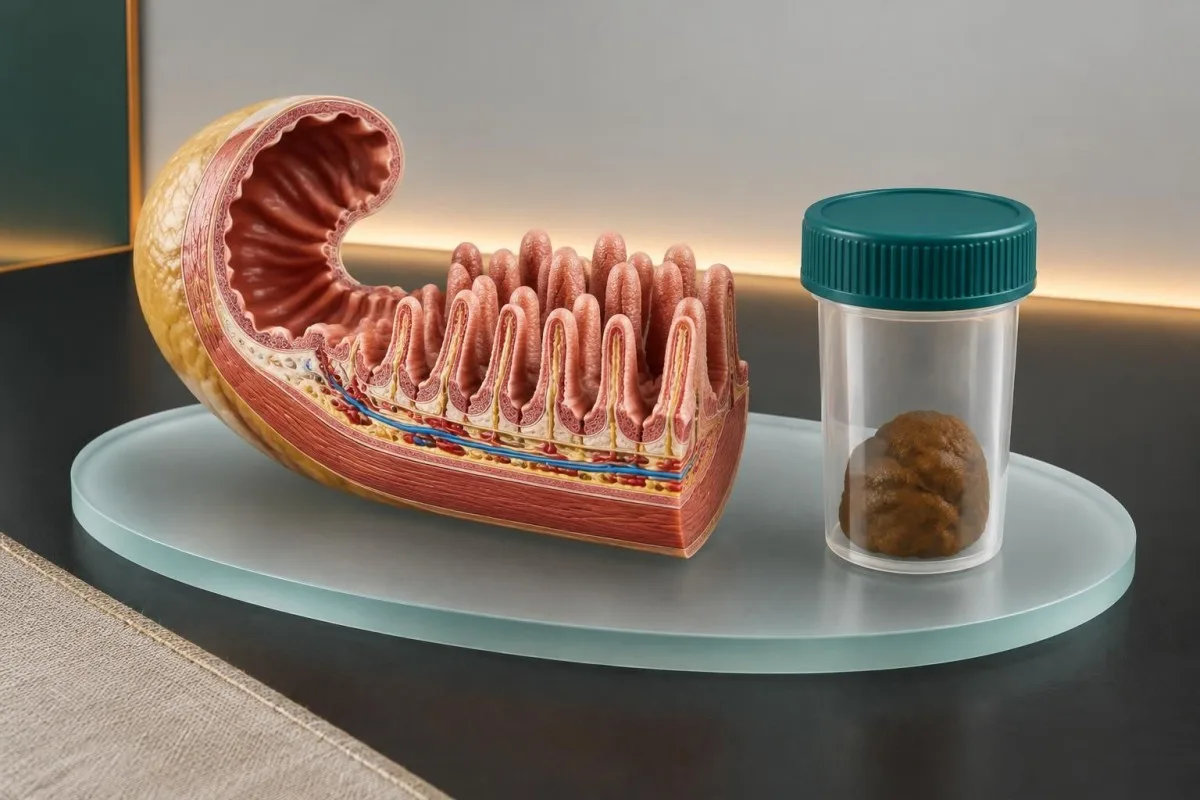
Celiac disease is an immune-mediated condition triggered by gluten in genetically susceptible people. Damage can flatten the finger-like villi of the small intestine, reducing the surface area available for nutrient absorption; a stool antibody result does not show their appearance.
A result labelled “gluten sensitivity” or “anti-gliadin IgA” in stool is not interchangeable with a validated blood tTG-IgA result. Ask the laboratory for the exact specimen type and analyte before comparing any two reports.
For example, a hypothetical adult with a negative stool antibody panel and unexplained iron deficiency still needs a clinician’s assessment for celiac disease. A separate digestive blood test guide explains why routine blood counts and nutrient results can provide clues without identifying the cause.
How Accurate Are Commercial Celiac Stool Antibody Tests?
Commercial stool antibody tests do not have enough consistent clinical validation to replace recommended celiac blood tests and biopsy. A positive stool result cannot confirm celiac disease, and a negative result cannot safely rule it out.
Sensitivity describes the proportion of people with the disease who test positive; specificity describes the proportion without it who test negative. A meaningful accuracy claim needs a clearly defined test, a representative patient group and comparison with an appropriate diagnostic standard—not just a manufacturer’s statement that the assay detects an antibody.
Stool assays can differ in the antibody target, collection process, cutoff and patient population studied. Because those details vary and evidence is insufficient for routine diagnosis, there is no single trustworthy sensitivity or specificity percentage that applies to every commercial celiac stool antibody test.
Analytical detection is not the same as clinical diagnosis: finding a substance in a sample does not establish that the result accurately identifies celiac disease. Our معايير المحتوى الطبي describe how health information should distinguish evidence from a test’s marketing claims.
Celiac Stool Test Versus Blood Test: What Should You Ask For?
A validated blood tTG-IgA test plus total IgA is a common first step for suspected celiac disease in people eating gluten. Unlike commercial stool antibody panels, this approach is supported by clinical guidelines, though a blood result still needs interpretation in context.
The American College of Gastroenterology guideline recommends celiac-specific serology as part of the diagnostic workup and emphasizes testing on a gluten-containing diet (Rubio-Tapia et al., 2023). The IgA الكلي result matters because someone with IgA deficiency may not produce enough IgA antibody for tTG-IgA to be dependable.
When total IgA is low or deficient, a clinician may use tTG-IgG أو الببتيد الغلياديني منزوع الأميد IgG, depending on the situation and local pathway. A negative IgA-based result should not be interpreted in isolation when total IgA is deficient; our نتائج الغلوبولين المناعي توجه explains the different antibody classes.
A positive blood result increases suspicion, but its significance depends partly on how far it exceeds that laboratory’s upper limit of normal. A borderline value and a result 10 times the upper limit are not equivalent, and laboratories may use different assays and cutoffs.
Blood tests can miss celiac disease, especially after gluten restriction, with IgA deficiency or occasionally despite adequate gluten intake. If symptoms, iron deficiency or family history keep suspicion high, ask whether gastroenterology review or biopsy is appropriate rather than treating one negative result as the final word.
When Is an Intestinal Biopsy Needed for Celiac Disease?
Most adults with suspected celiac disease need an upper endoscopy with duodenal biopsies to confirm the diagnosis. Some children can be diagnosed without biopsy when strict blood-test and specialist criteria are met.
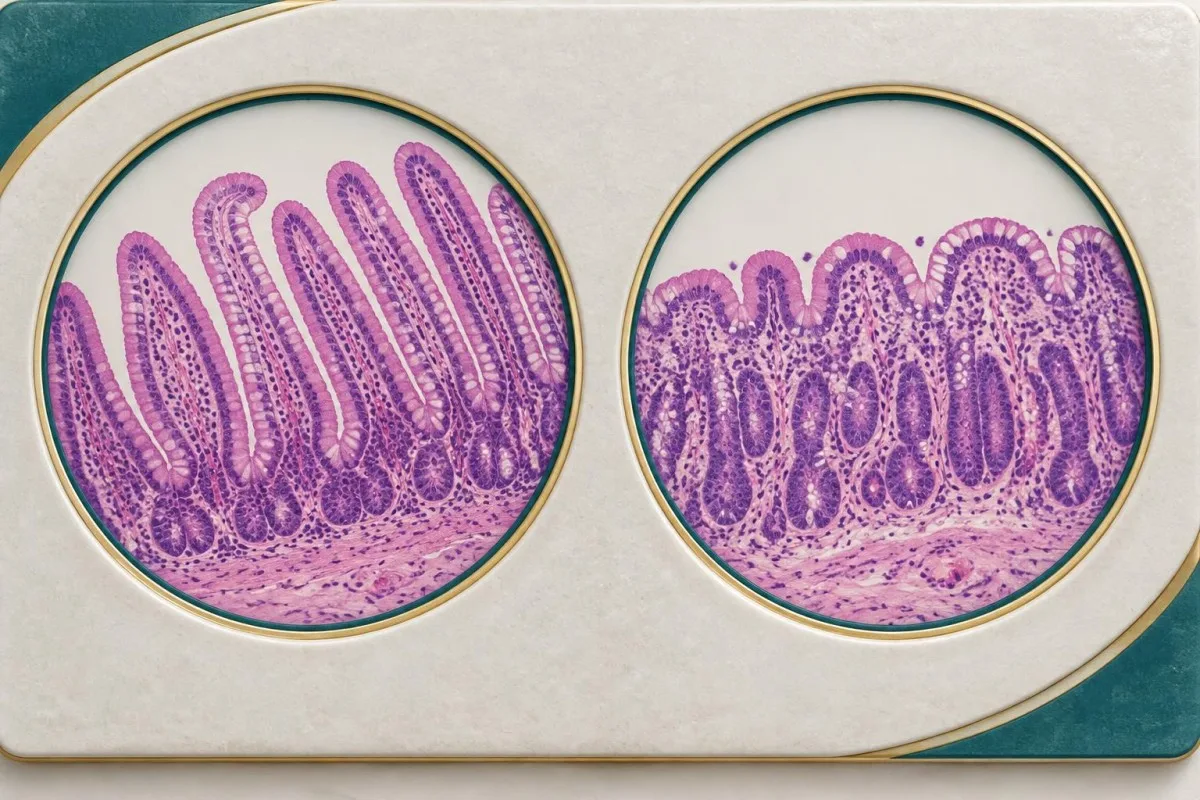
During upper endoscopy, a clinician passes a flexible camera through the mouth to the first part of the small intestine and takes small tissue samples. Damage may be patchy, so the 2023 American College of Gastroenterology guideline recommends multiple samples, including from the duodenal bulb and distal duodenum (Rubio-Tapia et al., 2023).
In the 2020 European Society for Paediatric Gastroenterology, Hepatology and Nutrition guideline, selected children with tTG-IgA at least 10 أضعاف الحد الأعلى للطبيعي may avoid biopsy if endomysial IgA is positive in a second blood sample and the specialist pathway is followed (Husby et al., 2020). That 10-fold rule is not a general licence to diagnose every adult or child from one result.
The appearance of villous flattening is not exclusive to celiac disease; a specialist considers the biopsy alongside gluten exposure, blood tests and other possible causes. Tissue examination also matters in other digestive conditions, although the location and diagnostic question differ, as explained in our esophageal biopsy guide.
Why Keep Eating Gluten Before Celiac Testing?
Reducing or removing gluten before testing can make celiac blood antibodies fall and allow intestinal changes to improve, increasing the chance of a false-negative workup. If you currently eat gluten, continue your usual intake until you have discussed the testing plan with a clinician, unless you have been told otherwise for safety.

Gluten is present in wheat, barley and rye, including many breads, pastas and cereals. A short period of eating less gluten is not automatically enough to invalidate every result, but the amount and duration can change how confidently a negative result is interpreted.
Tell the clinician roughly when you last ate gluten and how much you were eating in the weeks before any blood test or biopsy. Do not rely on a single gluten-containing meal to restore test sensitivity; the necessary exposure varies, and no short challenge reliably detects every case.
Do not deliberately continue or restart a food if it has caused an immediate serious reaction, such as breathing difficulty or throat swelling; seek urgent medical help for those symptoms. A possible wheat allergy needs a different assessment from celiac disease, and our allergy testing guide explains why the distinction matters.
What If You Already Stopped Eating Gluten?
If you are already gluten-free, speak with a clinician before restarting gluten or accepting a negative celiac blood test as conclusive. Previous records, genetic testing and a supervised gluten challenge can help decide whether further testing is worthwhile.

Bring any earlier tTG-IgA, total IgA, endoscopy and pathology reports—even if they are several years old. A previous biopsy taken while eating gluten may be more informative than a new negative antibody test obtained after a long gluten-free period.
HLA-DQ2 and HLA-DQ8 genetic testing is not affected by gluten intake. Absence of the relevant susceptibility types makes celiac disease very unlikely, but a positive result does not diagnose it because these genetic patterns also occur in many people without celiac disease.
A gluten challenge means reintroducing gluten for an agreed period before testing; the dose and duration should be individualized with a clinician or gastroenterologist. A short challenge can produce evidence in some people but a negative result may be inconclusive, as discussed in our دليل تحدي الغلوتين.
If gluten causes substantial symptoms, ask about the expected burden, what result would change management and whether genetic testing should come first. Children should have a challenge plan made with their pediatric specialist rather than being asked to restart gluten without clinical guidance.
What Can Other Stool Tests Show Instead?
Other stool tests can help investigate diarrhea or intestinal inflammation, but they answer different questions from a celiac workup. A normal or abnormal result on one of these tests does not independently rule out or confirm celiac disease.
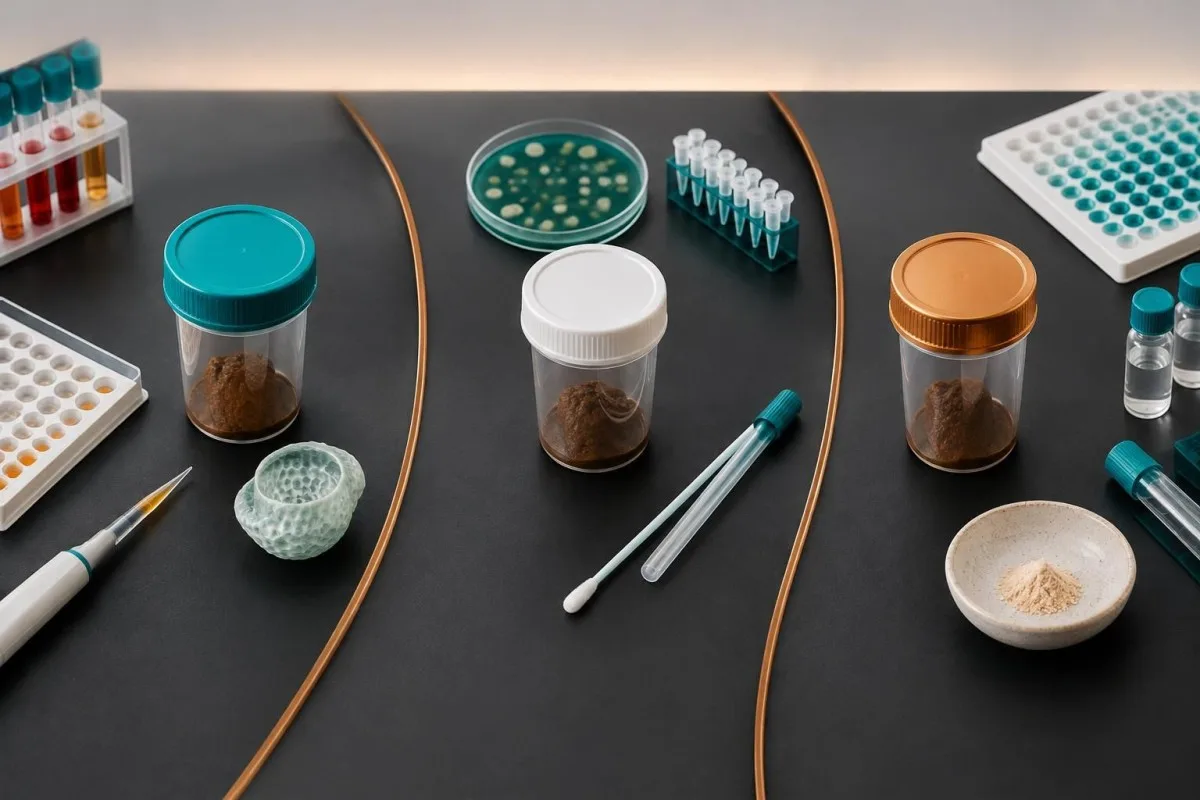
الكالپروتكتين في البراز is a marker of intestinal inflammation that can help clinicians investigate possible inflammatory bowel disease. It is not specific for celiac disease, and a normal result should not be used to dismiss a clinically appropriate celiac blood test; see our calprotectin result guide.
A stool test for gluten immunogenic peptides is designed to look for evidence of recent gluten exposure, not to show villous damage or establish celiac disease. A positive result may indicate exposure; a negative result is limited by timing, sampling and the amount of gluten consumed.
Infectious stool tests may identify a cause of diarrhea that requires its own treatment. For example, a مستضد Giardia addresses a parasite, not celiac antibodies; a person’s clinician decides which tests fit the symptoms and exposure history.
Stool appearance alone is also nonspecific. Greasy, pale or difficult-to-flush stool can occur with fat malabsorption from several causes, while visible undigested food does not by itself establish intestinal damage.
What Should You Do With a Positive or Negative Stool Result?
Bring either a positive or negative commercial stool antibody report to a clinician and ask whether standard celiac testing is appropriate. Do not start a lifelong gluten-free diet solely because of that result, and do not dismiss persistent symptoms because it was negative.

Write down the test name, laboratory, result, reference interval and whether the sample was stool or blood. Also note gluten intake, relevant symptoms, a family history of celiac disease and any previous endoscopy; these details can change the next test more than the label “positive” alone.
Ask whether a complete blood count and iron studies are suitable if fatigue, anemia or malabsorption is a concern. Low ferritin can precede anemia, but it has several causes and cannot diagnose celiac disease; our دليل دراسات الحديد explains how related results fit together.
Seek urgent care for severe or worsening abdominal pain, fainting, signs of significant dehydration, or black or bloody stool—especially with weakness or dizziness. The دليلنا على الدم فالبراز explains why the amount, color and associated symptoms matter.
For questions about how health information is reviewed, consult our المجلس الاستشاري الطبي و معلومات على الإشراف السريري. Neither an article nor an automated interpretation replaces a clinician’s assessment or the laboratory’s own reference interval.
أسئلة متكررة
واش تحليل البراز يقدر يكشف مرض السيلياك؟
تحليل البراز ما كيقدرش يشخّص ولا يستبعد مرض السيلياك بشكل موثوق، ولا يثبت الضرر المرتبط بالغلوتين فزُغابات الأمعاء. أول تحاليل الدم اللي كتدار عادةً هي tTG-IgA وIgA الكلي، وكيتم إجراؤها بينما الشخص كياكل الغلوتين. أغلب البالغين اللي كيتشتبه يكون عندهم مرض السيلياك كيحتاجو حتى لخزعات من الاثني عشر لتأكيد التشخيص.
شحال دقيق تحليل الأجسام المضادة ديال السيلياك فالبراز؟
There is no single reliable accuracy percentage for all commercial celiac stool antibody tests because tests, cutoffs and study populations differ. These tests are not sufficiently validated to replace recommended celiac blood testing or biopsy. A positive or negative stool antibody result should be reviewed with a clinician alongside symptoms and gluten intake.
What is the difference between a stool test and a blood test for celiac disease?
A commercial stool antibody panel uses a stool specimen, whereas the recommended first-line celiac workup commonly measures tTG-IgA and total IgA in blood. Validated blood testing has a stronger evidence base, but no single blood result is definitive in every situation. Low IgA or eating little gluten can make a negative result less reliable.
Should I eat gluten before a celiac blood test?
If you already eat gluten, generally continue your usual gluten-containing diet until you discuss celiac testing with a clinician. Restricting gluten can lower antibody levels and make intestinal changes harder to detect. Do not deliberately eat a food that has caused an immediate serious allergic reaction; seek urgent help for breathing difficulty or throat swelling.
Can celiac disease be diagnosed without a biopsy?
Some children can be diagnosed without a biopsy under a specialist-led pathway. The 2020 European pediatric guideline requires tTG-IgA at least 10 times the laboratory’s upper limit of normal and a positive endomysial IgA result in a second blood sample, among other pathway requirements. Most adults still undergo duodenal biopsy to confirm the diagnosis.
Does a negative celiac test rule out the disease if I am gluten-free?
A negative celiac blood test after gluten restriction does not reliably rule out celiac disease. Reduced gluten exposure can cause antibody levels to fall and intestinal tissue to heal. A clinician may review older results, consider HLA-DQ2 and HLA-DQ8 testing, and discuss whether a supervised gluten challenge is appropriate.
خذ شرح لنتائج تحليل الدم ديالك
حمّل تقرير التحاليل ديالك، وكيشرح AI ديال Kantesti كل مؤشر حيوي بلغة بسيطة فثواني. كايستعملوه أكثر من 2 مليون شخص فالعالم.
مراجع
- كلاين، ت.، ميتشل، س.، و ويبر، هـ. (2026). شرح نسبة BUN/كرياتينين: دليل اختبار وظائف الكلى. الأبحاث الطبية ديال Kantesti AI. DOI
- كلاين، ت.، ميتشل، س.، و ويبر، هـ. (2026). اختبار أوبوريلينوجين في البول: دليل تحليل البول الكامل 2026. الأبحاث الطبية ديال Kantesti AI. DOI
- Rubio-Tapia A وآخرون. (2023). تحديث إرشادات American College of Gastroenterology: تشخيص وتدبير الداء الزلاقي. المجلة الأمريكية لأمراض الجهاز الهضمي. DOI
- Husby S et al. (2020). European Society Paediatric Gastroenterology, Hepatology and Nutrition Guidelines for Diagnosing Coeliac Disease 2020. Journal of Pediatric Gastroenterology and Nutrition. DOI
- 2 مليون+الاختبارات المُحلَّلة
- 127+بلدان
- 100+اللغات
نبذة عن الفريق الطبي


إشارات الثقة E-E-A-T
خبرة
مراجعة سريرية يقودها الأطباء لسير عمل تفسير التحاليل.
خبرة
تركيز طب المختبر على كيفية سلوك الـ biomarkers في السياق السريري.
السلطة
راجعها طبياً الدكتور Thomas Klein، بمساهمات من الدكتورة Sarah Mitchell والأستاذ الدكتور Hans Weber.
الجدارة بالثقة
تفسير قائم على الأدلة مع مسارات متابعة واضحة لتقليل الإنذار.





إخلاء المسؤولية الطبية
هذه المقالة لأغراض تعليمية فقط ولا تشكل نصيحة طبية. استشر دائمًا مقدم رعاية صحية مؤهلًا لاتخاذ قرارات التشخيص والعلاج.
نُشر · تواصل مع فريق التحرير
منشور من طرف Kantesti Ltd، مسجل في إنجلترا وويلز، رقم الشركة. 17090423, ، لندن، المملكة المتحدة.
