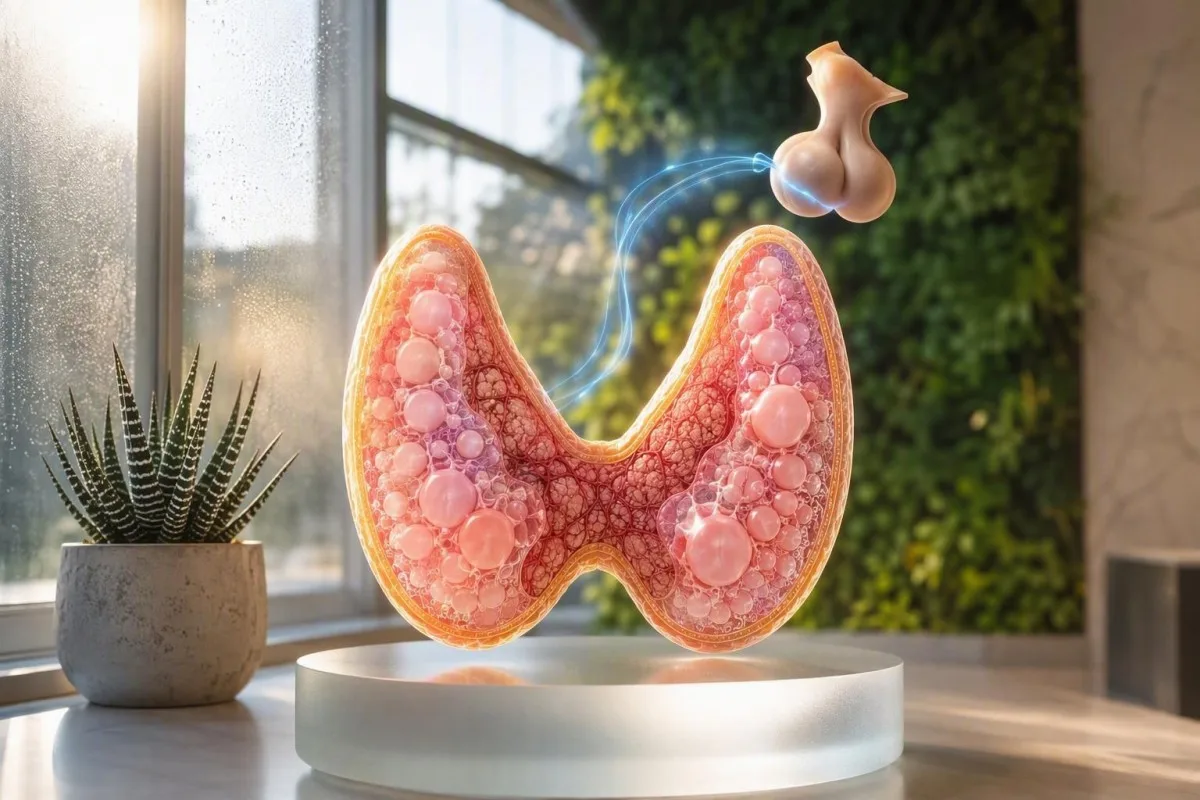
'n Lae vry T4 met 'n TSH binne die laboratorium se verwysingsreeks is nie die gewone patroon van primêre skildklierversaking nie. Dit verdien 'n noukeurige ondersoek na hipofise-seinwerking, onlangse siekte, medikasie en die toetsmetode voordat enige behandeling begin word.


- Lae vrye T4 onder 'n lab-spesifieke onderste limiet, dikwels onder 10 pmol/L of 0.8 ng/dL, kan verminderde skildklierhormoon beskikbaarheid aandui, selfs wanneer TSH normaal is.
- Normale TSH sluit nie betroubaar sentrale hipotiroïdisme uit nie omdat die hipofise-sein biologies swak kan wees, ondanks dat dit binne die verwysingsinterval val.
- Sentrale hipotireose word gewoonlik bevestig deur lae vry T4 op twee aparte monsters met 'n lae, normale of slegs effens verhoogde TSH.
- Akute siekte kan vry T3 en soms vry T4 tydelik verlaag; skildkliertoetsing word gewoonlik herhaal na herstel eerder as om onmiddellik behandel te word.
- Glukokortikoïede, dopamien, bexaroteen en somatostatïen analoë kan TSH onderdruk en 'n patroon van lae-vry-T4, nie-verhoogde TSH skep.
- Biotien veroorsaak gewoonlik vals hoë vry T4 en lae TSH, so dit verduidelik selde 'n geïsoleerde lae vry T4 uitslag.
- Levotiroksienmonitering by sentrale hipotiroïdisme berus hom hoofsaaklik op vry T4, wat dikwels mik na die boonste helfte van die verwysingsinterval eerder as TSH.
- Onmiddellike hersiening is toepaslik vir ernstige hoofpyn, nuwe sigverandering, flouheid, lae natrium, swangerskap, of simptome wat byniers Öncelikle aandui.
Waarom 'n lae vry T4 met 'n normale TSH kan saamval
Wat beteken lae vry T4 wanneer TSH normaal is? Dit kan sentrale hipotiroïdisme, tydelike effekte van siekte, medikasie-verwante TSH-onderdrukking, of 'n toetskwessie weerspieël; dit is nie outomaties bewys van 'n onderaktiewe skildklier nie. 'n Tipiese volwasse vry T4-interval is ongeveer 10-23 pmol/L (0.8-1.8 ng/dL), maar die verslag se eie reeks bepaal interpretasie. In my praktyk is die sleutelvraag of TSH gepas is vir daardie lae T4—nie of dit toevallig as normaal gemerk is nie.
In primêre hipotireose, 'n lae vry T4 behoort 'n duidelik verhoogde TSH te veroorsaak, dikwels bo 10 mIU/L. 'n TSH van 1.6 mIU/L langs vry T4 van 8.5 pmol/L kan dus onvanpas normaal wees, omdat 'n funksionerende hipofise gewoonlik stimulasie sou verhoog.
Kantesti is 'n KI-bloedtoetsontleder wat vry T4, TSH, medisyne en vorige resultate as een patroon lees eerder as om 'n groen TSH-vlag as 'n skoon gesondheidsertifikaat te behandel. Dit is veral nuttig wanneer 'n afkorting vir skildklierfunksietoets sonder kliniese aantekeninge gerapporteer is.
Een grenslyn resultaat is algemeen; 'n aanhoudende patroon is meer betekenisvol. Ek vra pasiënte oor onlangse koors, hospitaalopname, kaloriebeperking, swangerskap, aanvullings en die presiese tyd van enige skildklierpil voordat ek 'n diagnose aan 'n waarde koppel.
Wanneer die patroon sentrale hipotiroïdisme aandui
Bloedtoetse vir sentrale hipotiroïdisme toon lae vry T4 met lae, normale, of effens verhoogde TSH. Die toestand ontstaan wanneer hipotalamus of hipofise seine ontoereikend is, sodat TSH sy rol as 'n betroubare siftingsmarkeder verloor.
Die 2018 Europese Skildkliervereniging se riglyn beveel aan om sentrale hipotiroïdisme te bevestig met twee bepalings van lae vry T4 plus 'n onvanpas lae of normale TSH, na die uitsluiting van nie-skildklier siekte en toets inmenging (Persani et al., 2018). TSH kan soms effens verhoog wees, gewoonlik onder 10 mIU/L, omdat sommige hipofise TSH verminderde biologiese aktiwiteit het.
Hipofise oorsake sluit in makroadenoom, vorige hipofise chirurgie of radioterapie, traumatiese breinbesering, infiltratiewe siekte en postpartum hipofisebesering. 'n Nuwe laevry-T4 patroon plus aanhoudende hoofpyn, verminderde perifere visie, erektiele disfunksie, afwesige periodes of onverwags melkafskeiding verdien tydige endokriene assessering.
Sentrale hipotiroïdisme kom dikwels saam met ander hipofise tekorte. Daarom kan klinici 09:00 kortisol, prolaktien, IGF-1, LH, FSH en geslagshormone nagaan eerder as om net nog 'n TSH te bestel; ons gids tot ACTH-toets tydsberekening verduidelik hoekom versamelingsomstandighede saak maak.
Hoe om vry T4 en TSH verwysingsintervalle te lees
Vry T4-reekse is toetsspesifiek, terwyl TSH-verwysingsintervalle op bevolkingsgebaseerde eerder as persoonlike teikens gebaseer is. Die meeste nie-swanger volwasse laboratoriums gebruik ongeveer 10-23 pmol/L vir vry T4 en 0.4-4.0 mIU/L vir TSH, maar geen van die reekse kan sentrale hipotiroïdisme alleen diagnoseer nie.
'n Resultaat van 9.8 pmol/L mag laag wees in 'n laboratorium wie se onderste limiet 12 pmol/L is, maar heeltemal binne die reeks waar die onderste limiet 9 pmol/L is. Eenheidskonversie is benaderd: 1 ng/dL vry T4 gelyk aan 12.87 pmol/L, tog moet die toetsverwysingsinterval nooit meganies omgeskakel word nie.
Swangerskap verander bindingsproteïene en kan sommige roetine-vrye T4-immunoassays minder betroubaar maak. Trimester- en metode-spesifieke limiete is verkieslik, daarom is vry T4-reekse by vroue meer konteks nodig as 'n algemene volwasse interval.
'n Laboratoriumvlag identifiseer statistiese afstand van sy verwysingsbevolking, nie erns nie. Waardes net onder die reeks kan klinies betekenisvol wees in hipofise-siekte, terwyl 'n groter tydelike daling tydens kritieke siekte dalk nie permanente skildklierversaking verteenwoordig nie.
Hoe siekte vry T4 kan verlaag sonder om TSH te verhoog
Ernstige akute siekte kan skildklierhormoonmetings verlaag sonder permanente hipotiroïdisme. Hierdie nie-skildklier siekte patroon begin gewoonlik met lae vry T3, en vry T4 kan daal in langdurige of ernstige siekte terwyl TSH normaal of laag bly.
Sepsis, groot chirurgie, trauma, hartversaking, nierversaking en langdurige vas kan hipotalamiese TRH-vrystelling verminder en hormoonomskakeling verander. Fliers en kollegas beskryf dit as 'n aanpasbare maar komplekse reaksie in kritieke siekte, nie 'n eenvoudige skildklierdefek nie (Fliers et al., 2015).
Ek sien dit dikwels na 'n vierdaagse opname: vry T3 is laag, vry T4 is 9 pmol/L, TSH is 0.7 mIU/L, en die pasiënt verloor steeds gewig. Om daardie oomblikopname met levothyroxine te behandel, kan herstel vertroebel en soms oortreament later skep.
As daar geen hipofise-bekommernis is nie, herhaal skildkliertoetse 6-8 weke na herstel is gewoonlik meer insiggewend as daaglikse toetsing op 'n saal. Vergelyk die tydsberekening met ander veranderende merkers met hierdie na-hospitaal bloedtoets tydlyn.
Medikasie wat lae vry T4 met normale TSH veroorsaak
Verskeie medisyne kan TSH onderdruk of vry T4-meting verander. Dopamieninfusies, hoë-dosis glukokortikoïede, beksaroteen en somatostatien-analooë is gevestigde oorsake van 'n TSH wat nie verhoog is nie, ten spyte van verminderde beskikbaarheid van skildklierhormone.
Prednisoon-dosisse van 20 mg daagliks of meer, en ekwivalente glukokortikoïed-blootstelling, kan TSH tydelik onderdruk; dopamien het 'n soortgelyke sentrale effek in hospitaal-omgewings. Beksaroteen is veral opmerklik omdat sentrale hipotiroïdisme vinnig kan ontwikkel en beplande vry-T4 monitering vereis.
Karbamazepien, fenitoïen en fenobarbital verhoog skildklierhormoonmetabolisme en kan sommige vry-T4 imunoassay's verdraai. Metformien verlaag meer dikwels TSH in behandelde hipotiroïdisme as wat dit vry-T4 verlaag, dus is dit selde die hele verduideliking.
Biotien word dikwels verkeerdelik geblameer. Dosisse van 5-10 mg daagliks veroorsaak algemeen vals hoog is vry-T4 en vals lae TSH in biotien-streptavidiien-immunoassays, die teenoorgestelde van hierdie patroon; sien ons praktiese gids vir aanvullings voor bloedtoetse.
Wanneer die laboratoriumuitslag self misleidend kan wees
'n Onverwagte lae vry-T4 kan 'n immuno-analise-probleem wees, veral wanneer simptome en ander skildklierresultate nie ooreenstem nie. Vryhormoon-immunoassays skat 'n klein ongebundelde fraksie en is meer vatbaar vir bindingsveranderinge as wat baie pasiënte besef.
Heterofiele antiliggame, anti-skildklierhormoon-antiliggame, ongewone albumin-variante en abnormale bindingsproteïene kan teenstrydige resultate lewer. Die rigting van die fout wissel per immuno-analise, so geen klinikus kan inmenging betroubaar diagnoseer deur slegs na een syfer te kyk nie.
'n Nuttige bevestigingsroete is om vry-T4 op 'n ander vervaardiger se platform te herhaal of dit te meet met ewewigsdialise of ultrafiltrasie met massaspektrometrie waar beskikbaar. Totale T4, TBG en albumin verduidelik soms of die sigbare vry-hormoon abnormaliteit waarskynlik is.
Kantesti AI is ’n KI-labtoets-interpretasiediens wat 'n wanpassing aandui tussen vry-T4, TSH, totale T4 en vorige resultate vir oorsig, eerder as om 'n laboratorium artefak te verklaar. Skielike onverklaarbare verskuiwings is ook die moeite werd om na te gaan teen 'n delta-check-benadering.
Simptome en wenke wat die vlak van kommer verander
Simptome van lae vry-T4 is nie-spesifiek, maar sekere kombinasies dui sterker op egte hormoontekort of pituïtêre siekte. Moegheid alleen is algemeen; moegheid plus koue-intoleransie, hardlywigheid, stadige pols, droë vel en progressiewe kognitiewe vertraging verdien meer gewig.
In sentrale siekte kan verminderde libido, onvrugbaarheid, menstruasie-verandering, lae bloeddruk of herhalende lae natrium dui op gepaardgaande pituïtêre hormoontekorte. 'n Oggendkortisol onder 83 nmol/L (3 mcg/dL) is kommerwekkend vir bijnier-insuffisiëntie, hoewel immuno-analise-spesifieke interpretasie en dringende kliniese konteks saak maak.
Dr. Thomas Klein se praktiese reël is eenvoudig: moenie skildklierhormoon begin voordat kortisol oorweeg is nie wanneer pituïtêre siekte moontlik is. Levotiroksien verhoog metaboliese aanvraag en kan bijnier-krisis uitlok by iemand met ongekende ernstige ACTH-tekort.
Kinders benodig 'n ander drempel vir kommer omdat lae vry-T4 groei en neuro-ontwikkeling kan beïnvloed. Swak groeisnelheid, vertraagde puberteit of hoofpyne moet pediatriese endokriene oorsig veroorsaak; groeihormoon toetsing in kort statuur sit dikwels in dieselfde diagnostiese gesprek.
Waarom herhaalde skildkliertoetsing anders gestruktureer is
Om lae vry-T4 te herhaal is die nuttigste wanneer die tweede monster die veranderlikes beheer wat die eerste een verdraai het. Die herhaal moet gewoonlik TSH en vry-T4 saam insluit, dieselfde laboratorium gebruik as die doel is om tendense te vergelyk, en plaasvind nadat akute siekte bedaar het.
Vir 'n stabiele buitepasiënt met grenswaardige vry-T4, dokumenteer ek gewoonlik monster tyd, onlangse siekte, aanvullings en alle medisyne, en toets dan weer in 6-8 weke. Indien pituïtêre simptome teenwoordig is, kan herhalings binne dae tot weke plaasvind saam met kortisol en ander pituïtêre toetse.
Mense wat levotiroksien neem, moet verkieslik die monster voor die oggenddosis trek of ten minste teen dieselfde interval na dosering elke keer. Vry T4 styg vir etlike ure na inname, wat ondertrekking kan verbloem of vergelyking kan verwar.
Kantesti is 'n KI-aangedrewe bloedtoets-analisehulpmiddel deur meer as 2 miljoen mense in 127 lande gebruik word, en sy neigingsaansig kan die versamelingkonteks behou wat papierverslae weglaat. Vir behandelde pasiënte, TSH na 'n levotiroksien-handelsmerkwisseling is 'n aparte tydsberekeningskwessie.
Toetse wat klinici mag byvoeg na 'n bevestigde patroon
Bevestigde lae vry T4 met nie-verhoogde TSH lei dikwels tot 'n pituïtêr-gefokusde paneel eerder as slegs 'n skildklier-teenliggaampaneel. Die bykomende toetse identifiseer ander hormoontekorte, onderskei toetseffekte en assesseer of beelding gepas is.
Algemene byvoegings is 8-9 vm kortisol, ACTH, prolaktien, IGF-1, LH, FSH, estrogeen of testosteroon, natrium en serum osmolaliteit. Lae vry T4 plus prolaktien bo 100 ng/mL is nie op sigself diagnosties nie, maar dit verhoog kommer vir pituïtêre stingel- of klierpatologie.
Pituïtêre MRI word gewoonlik oorweeg wanneer biochemie bevestig word of wanneer visuele simptome, ernstige hoofpyn, veelvuldige hormoonabnormaliteite, vorige breinbehandeling of onverklaarde hiperprolaktinaemie bestaan. MRI is nie 'n eerstelynreaksie op een ligte lae vry T4-resultaat na griep nie.
Auto-immuun skildklier siekte kan saam voorkom met pituïtêre toestande, so TPO teenliggaampies kan steeds nuttig wees in geselekteerde pasiënte. 'n Positiewe teenliggaamtoets met normale TSH word bespreek in ons TPO teenliggaam opvolggids, maar teenliggaampies verduidelik nie 'n onderdrukte pituïtêre reaksie nie.
Hoe behandeling verskil wanneer die probleem sentraal is
Sentrale hipotiroïdisme word met levotiroksien behandel, maar vry T4 — nie TSH nie — lei dosisaanpassing. Baie endokrinoloë mik vir vry T4 in die boonste helfte van die laboratoriuminterval, aangepas vir ouderdom, kardiovaskulêre siekte, swangerskap en simptome.
'n Tipiese gesonde volwasse begin dosis is ongeveer 1.6 mcg/kg/dag levotiroksien, maar ouer volwassenes of diegene met koronêre siekte begin dikwels by 12.5-25 mcg daagliks. In sentrale hipotiroïdisme word 'n normale of onderdrukte TSH na behandeling verwag en moet nie 'n outomatiese dosisvermindering aandui nie.
Die Amerikaanse Skildkliervereniging riglyn beveel herwaardering ongeveer 4-6 weke na 'n dosis aanpassing aan omdat tirokisien 'n nuwe bestendige toestand stadig bereik (Jonklaas et al., 2014). In die praktyk gee vry T4 wat voor die daaglikse tablet getrek word die skoonste vergelyking.
Moenie 'n enkele lae resultaat self behandel met jodium, kliere aanvullings of oorblywende skildklier tablette nie. Oormatige jodium kan outo-immuun skildklier disfunksie vererger, en skildklieraanvullings bevat dikwels dosisse wat swak ooreenstem met die werklike oorsaak.
Swangerskap, vrugbaarheidsbehandeling en postpartum oorwegings
Lae vry T4 met normale TSH tydens swangerskap benodig spesialis interpretasie omdat beide fisiologie en toetsuitvoering verander. Swangerskap verhoog tirokisien-bindende globulien, en vry T4 immunoassays kan laer lees as 'n verwysingsmetode, veral na die eerste trimester.
Trimester-spesifieke TSH reekse word verkies; waar plaaslike reekse nie beskikbaar is nie, gebruik baie riglyne 'n boonste TSH drempel naby 4.0 mIU/L eerder as die ouer universele 2.5 mIU/L reël. 'n Geïsoleerde effens lae vry T4 moet geïnterpreteer word met totale T4, tydsberekening en simptome voor behandeling veranderinge.
Vroue met vorige hipofise-chirurgie, bekende sentrale hipotiroïdisme of 'n geskiedenis wat daarop dui op postpartum hipofise-besering benodig endokriene insette voor bevrugting, wanneer moontlik. Levotiroksien-vereistes mag vroeg in swangerskap toeneem, maar TSH kan nie die aanpassing in sentrale siekte rig nie.
Hormonale simptome oorvleuel aansienlik met skildklier-simptome. Ons vroue se hormonale gesondheidsgids bespreek help om tydsberekening leidrade te onderskei, terwyl mediese oorsig nodig bly vir 'n aanhoudende laboratoriumpatroon.
Wanneer lae vry T4 dringende mediese oorsig benodig
Soek dringende assessering vir lae vry T4 plus erge hoofpyn, gesigsverlies, verwarring, flouword, herhaalde braking, gemerkte lae bloeddruk of moontlike byniersinsufficientie. Hierdie kenmerke verhoog kommer oor hipofise-massa-effek of 'n gevaarlike gekombineerde hormoontekort eerder as ongekompliseerde skildklier-siekte.
'n Natriumkonsentrasie onder 125 mmol/L met swakheid, verwarring of braking vereis dieselfde-dag mediese assessering, ongeag skildklieruitslae. Erge hipotiroïdisme kan bydra tot hiponatremie, maar kortisoltekort, medisyne en vloeistofbalans is dikwels meer onmiddellike verduidelikings.
Nuwe dubbelvisie, verlies van perifere visie of 'n skielike erge hoofpyn moet nie wag vir 'n roetine skildklier-hertoetsing nie. Hierdie simptome kan uit baie toestande ontstaan, maar hipofise-kompressie is een rede waarom klinici vinnig optree wanneer skildklier- en ander hipofise-hormone abnormaal is.
Vir minder dringende gevalle, bring die oorspronklike verslae, medisyne lys en datums van siekte na die afspraak. 'n bloedtoets opsommings kontrolelys kan die 10-minute konsultasie meer produktief maak.
Algemene misverstande oor lae vry T4 en normale TSH
'n Normale TSH beteken nie altyd dat skildklier-funksie normaal is nie, en 'n lae vry T4 beteken nie altyd dat skildklier-behandeling nodig is nie. Beide stellings is waar omdat die hipofise-skildklier-stelsel en die toets op verskillende maniere kan misluk.
Wanopvatting een: “TSH is alles wat saak maak.” TSH is 'n uitstekende eerstelyn toets vir primêre skildklier-siekte, maar dit mis sentrale hipotiroïdisme en kan verander word deur siekte of medikasie. Die rede waarom ons bekommerd is oor lae vry T4 plus normale TSH is die kombinasie, nie enige resultaat in isolasie nie.
Wanopvatting twee: “Lae skildklier beteken ek benodig meer jodium.” Jodiumtekort is ongewoon in baie omgewings en produseer gewoonlik 'n verhoogde TSH wanneer skildklierhormoonproduksie val; oormatige aanvullende jodium bo 1,100 mcg/dag kan self skildklier-funksie ontwrig.
Wanopvatting drie: “Alle moegheid is skildklier-verwante.” Ystertekort, slaapontwrigting, depressie, B12-tekort, medisyne-effekte en kortisol-afwykings is gereelde nabootsers. 'n Breër lae vry T3 simptoom oorsig kan help om te verduidelik waarom skildklierhormone tydens stres verskuif.
Gebruik van tendense sonder om te oorreageer op 'n enkele uitslag
'n Vry T4 neiging is meer geloofwaardig wanneer dieselfde toets, soortgelyke versameling tydsberekening en stabiele medikasie toestande 'n herhaalde afname toon. 'n Verandering van 15 na 9 pmol/L is meer kommerwekkend as 11.2 na 10.4 pmol/L wanneer normale analitiese en biologiese variasie in ag geneem word.
TSH het 'n sirkadiese ritme en kan ongeveer 30-50% binne 'n individu wissel, veral oornag; vry T4 is gewoonlik egaliger, maar steeds toets-afhanklik. 'n Enkele grensverskuiwing moet geïnterpreteer word langs simptome, dosis nakoming, gewigsverandering en onlangse siekte.
Kantesti se KI-biomerkers-interpretasieplatform vergelyk langdurige skildklier-resultate en beklemtoon diskordansie tussen vry T4 en TSH vir menslike opvolg. Vanaf Augustus 23, 2026, bly ons kliniese benadering dat KI 'n patroon vinnig kan organiseer, maar dit kan nie ondersoek, medikasieversoening of endokriene toetsing vervang nie.
Dr. Thomas Klein beveel aan om die werklike getalle en verwysingsintervalle te stoor, nie net die H of L vlae nie. Ons longitudinale bloedtoetsgids toon waarom persoonlike basislyne dikwels vrae beantwoord wat 'n enkele nasionale reeks nie kan nie.
Kliniese toesig, navorsing en die volgende sinvolle stap
Die volgende sinvolle stap na lae vry T4 met normale TSH is 'n gestruktureerde klinikus-oorsig, nie 'n gehaaste etiket nie. Bevestig die resultaat, beoordeel siekte en medisyne, oorweeg hipofise-kenmerke, en kontroleer bijnierstatus voor tiroïedbehandeling wanneer sentrale siekte waarskynlik is.
Kantesti KI interpreteer tiroïedresultate deur ongeordende vry T4-TSH-kombinasies te identifiseer, dit met gerapporteerde konteks te skakel en gepaste opvolgvrae te vra. Ons metodologie en kliniese standaarde word in die mediese geldigheids-oorsig, met geneesheer-toesig van die Mediese Adviesraad.
Klein T. (2026). Vroue se HeALTh Gids: Ovulasie, Menopouse en Hormonale Simptome. Figshare. https://doi.org/10.6084/m9.figshare.31830721. Hormoon simptome verdien noukeurige patroonherkenning, veral waar swangerskap, siklus tydsberekening of hipofise funksie 'n tiroïedpaneel bemoeilik.
Kantesti Ltd. (2026) beskryf word. Meertalige KI-gesteunde Kliniese Besluitondersteuning vir Vroeë Hantavirus Triage: Ontwerp, Ingenieursvalidering en Real-World Implementering oor 50,000 Geïnterpreteerde Bloedtoetsverslae. Figshare. https://doi.org/10.6084/m9.figshare.32230290. Lees hoe ons KI interpretasie tegnologie ontwerp is om kliniese oordeel te ondersteun, eerder as te vervang.
Gereelde vrae
Kan jy hipotireose hê met normale TSH en lae vrye T4?
Ja. Lae T4 met 'n normale, lae, of effens verhoogde TSH kan sentrale hipotiroïdisme aandui, waar pituïtêre of hipotalamiese seine onvoldoende is. Sentrale hipotiroïdisme word oor die algemeen bevestig deur lae vrye T4 op twee monsters nadat siekte, medisyne en toets-interferensie uitgesluit is. In baie laboratoria is vrye T4 onder ongeveer 10 pmol/L of 0.8 ng/dL laag, maar die verslag-spesifieke reeks is deurslaggewend. 'n Klinikus kan ook oggendkortisol en ander pituïtêre hormone nagaan voordat levotiroksien begin word.
Wat is die mees algemene oorsaak van lae vrye T4 met normale TSH?
Onlangse ernstige siekte en medikasie-effekte is algemene verklarings vir 'n tydelike lae-vry-T4, normale-TSH-patroon, terwyl sentrale hipotiroïdisme minder algemeen maar klinies belangrik is. Langdurige siekte in die hospitaal, vas, glukokortikoïede, dopamien en bexarotene kan TSH- of tiroïedhormoonmetings verlaag. 'n Stabiele buitepasiënt met herhaalde lae vrye T4, geen onlangse siekte nie en 'n TSH rondom 0.5-2.5 mIU/L benodig meer gefokusde assessering. Herhaalde toetse na 6-8 weke is dikwels gepas wanneer geen rooi vlae teenwoordig is nie.
Moet ek levotiroksien neem as die vrye T4 laag is, maar die TSH normaal is?
Moenie levotiroksien begin bloot omdat 'n vrye T4-resultaat laag is terwyl TSH normaal is. Die eerste stap is om die patroon te bevestig en medisyne, akute siekte, aanvullings en moontlike toetsinterferensie te beoordeel. Indien sentrale hipotiroïdisme vermoed word, moet klinici eers bijnierfunksie assesseer, want onbehandelde kortisoltekort kan gevaarlik word wanneer skildklierhormoon bekendgestel word. Bevestigde sentrale hipotiroïdisme word met levotiroksien behandel, gewoonlik gemonitor deur vrye T4 eerder as TSH.
Kan stres lae vry T4 met normale TSH veroorsaak?
Ernsige fisiologiese stres, soos infeksie, chirurgie, trauma, langdurige kaloriebeperking of siekte in die intensiewe sorg, kan lae vry T3 en soms lae vry T4 veroorsaak met normale of lae TSH. Alledaagse sielkundige stres alleen is 'n veel minder betroubare verklaring vir 'n duidelik lae vry T4-waarde onder 8-10 pmol/L. Klinici herhaal gewoonlik die paneel na fisiese herstel eerder as om permanente hipotiroïdisme van 'n akute siekte-monster te diagnoseer. Aanhoudende abnormaliteite vereis verdere evaluasie.
Veroorsaak biotien lae vry T4 en normale TSH?
Biotien veroorsaak gewoonlik nie lae vrye T4 met normale TSH nie. In baie algemene immuno-toetse lewer biotien dosisse van 5-10 mg per dag vals hoë vrye T4 en vals lae TSH, wat eerder hipertiroïdisme kan naboots. Omdat effekte afhang van die laboratoriummetode en dosis, openbaar alle haar-, nael- en multivitaminprodukte voordat jy weer toets. Baie klinici vra pasiënte om hoë-dosis biotien vir ten minste 48 uur te stop voor skildklierbloedtoetse, volgens plaaslike laboratoriumadvies.
Wanneer is lae vry T4 met normale TSH 'n noodgeval?
Lae vry T4 met normale TSH benodig dringende assessering indien dit voorkom met erge hoofpyn, nuwe gesigsverlies, verwarring, floute, herhaalde braking, baie lae bloeddruk of simptome van bynierontoereikendheid. Natrium onder 125 mmol/L met neurologiese simptome is 'n mediese probleem vir dieselfde dag, ongeag die skildklierverklaring. Hierdie kombinasies kan pituïtêre siekte of veelvuldige hormoontekorte aandui. 'n Roetine buitepasiënt herhaling is nie die regte reaksie wanneer hierdie rooi vlae teenwoordig is nie.
Kry vandag KI-aangedrewe bloedtoets-analise
Sluit aan by meer as 2 miljoen gebruikers wêreldwyd wat Kantesti vertrou vir onmiddellike, akkurate laboratoriumtoetsanalise. Laai jou bloedtoetsresultate op en ontvang omvattende interpretasie van 15,000+-biomerkers binne sekondes.
📚 Verwysde navorsingspublikasies
Klein, T., Mitchell, S., & Weber, H. (2026). Klein, T. (2026). Vroue se Gesondheidsgids: Ovulasie, Menopouse & Hormonale Simptome. Figshare.. Kantesti KI Mediese Navorsing.
Klein, T., Mitchell, S., & Weber, H. (2026). Kantesti Ltd. (2026). Veeltalige KI-gesteunde kliniese besluitnemingsondersteuning vir vroeë Hantavirus-triagering: Ontwerp, ingenieurswese-validering en werklike implementering oor 50 000 geïnterpreteerde bloedtoetsverslae. Figshare.. Kantesti KI Mediese Navorsing.
📖 Eksterne mediese verwysings
⚕️ Mediese Vrywaring
Hierdie artikel is slegs vir opvoedkundige doeleindes en vorm nie mediese advies nie. Raadpleeg altyd ’n gekwalifiseerde gesondheidsorgverskaffer vir besluite oor diagnose en behandeling.
E-E-A-T Vertrouenseine
Ervaring
Kliniese oorsig gelei deur ’n geneesheer van laboratorium-interpretasie-werksvloei.
Kundigheid
Laboratoriumgeneeskunde fokus op hoe biomerkers in ’n kliniese konteks optree.
Gesagsvermoë
Geskryf deur dr. Thomas Klein met hersiening deur dr. Sarah Mitchell en prof. dr. Hans Weber.
Betroubaarheid
Bewysgebaseerde interpretasie met duidelike opvolgpaaie om alarm te verminder.