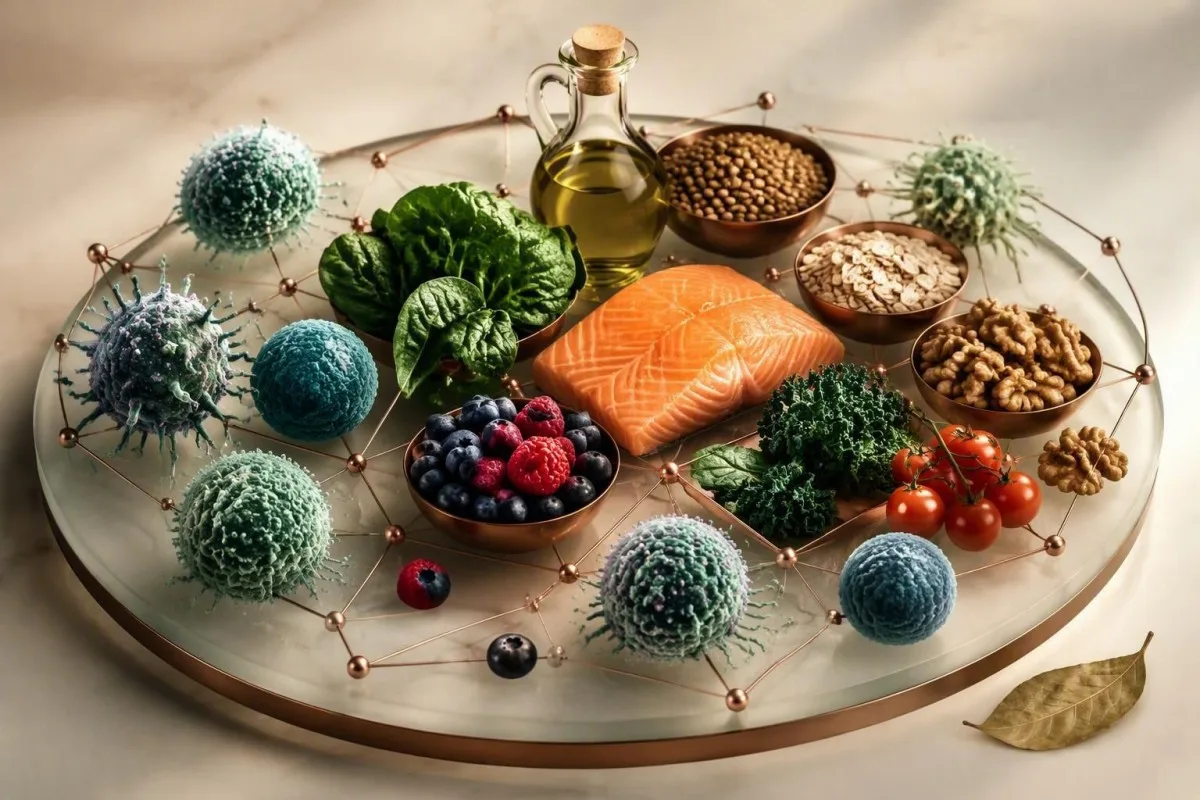
The best choices are ordinary foods eaten repeatedly, not expensive powders or “detox” protocols. This clinician-ranked list explains what food can realistically change—and what it cannot.


- Whole dietary pattern matters more than one “superfood”; Mediterranean-style eating has the strongest outcome evidence.
- Extra-virgin olive oil is a first-tier choice: use 1–2 tablespoons daily in place of butter or refined oils.
- Oily fish provides EPA and DHA; two 100–140 g servings weekly is a practical food-first target.
- සීආර්පී below 1 mg/L is commonly considered low cardiovascular-risk range, while a result above 10 mg/L should usually be repeated after acute illness settles.
- Berries, leafy greens, beans, nuts, and whole grains work through fibre, unsaturated fats, polyphenols, and displacement of ultra-processed foods.
- Turmeric, ginger, and green tea are reasonable additions, but their biomarker effects are smaller and less reliable than claims online suggest.
- ESR සහ CRP එකටම ඉහළ යාමට හේතු වේ, නමුත් සෑම විටම එකම මට්ටමට නොවේ. are not “diet scores”; infection, autoimmune disease, obesity, smoking, sleep loss, and medications can outweigh food effects.
- Consistency for 8–12 weeks is a more realistic interval for reviewing diet-related changes in lipids, glucose, and hs-CRP.
What anti-inflammatory eating can realistically change
ඇන් anti-inflammatory foods list is most useful when it helps you replace refined, ultra-processed choices with fibre-rich plants and unsaturated fats—not when it promises to cure pain or normalize a high CRP overnight. In practice, food may modestly improve low-grade inflammation over 8–12 weeks, but a CRP above 10 mg/L needs clinical context before anyone blames lunch.
Low-grade inflammation is a long-term metabolic signal, often linked with visceral fat, insulin resistance, smoking, poor sleep, periodontal disease, and fatty liver. A high-sensitivity CRP of less than 1 mg/L is conventionally a low cardiovascular-risk category, 1–3 mg/L is average, and above 3 mg/L is higher risk when acute illness has been excluded; see our guide to high hs-CRP symptoms.
I have seen patients become alarmed by a CRP of 7 mg/L after a week of poor sleep and a dental infection, then assume blueberries are the treatment. They are not. hs-CRP above 10 mg/L should generally be repeated at least 2 weeks after recovery, because acute infection, injury, and strenuous exercise can dominate the result.
As of September 21, 2026, Kantesti is an AI රුධිර පරීක්ෂණ විශ්ලේෂකය that places CRP alongside glucose, triglycerides, ALT, ferritin, and the rest of the panel rather than treating one marker as a dietary verdict. That pattern matters: raised CRP plus high triglycerides and ALT points us toward metabolic health, whereas CRP alone may simply reflect a recent cold.
The effect size is usually modest
Dietary change commonly shifts hs-CRP by fractions of a milligram per litre, not by 20 mg/L. A sustained fall is encouraging, but it does not rule out inflammatory arthritis, inflammatory bowel disease, infection, or cancer when symptoms or a rising trend are present.
How we ranked the best anti-inflammatory foods
The best anti-inflammatory foods have human outcome data, plausible mechanisms, and a realistic place in everyday meals. Foods supported only by cell studies, supplement marketing, or tiny short trials rank lower here—even if their chemistry sounds impressive.
I rank foods highest when they improve a dietary pattern and displace less helpful calories. The PREDIMED trial found that a Mediterranean diet supplemented with extra-virgin olive oil or nuts reduced major cardiovascular events compared with a low-fat control diet in high-risk adults (Estruch et al., 2018); that is stronger evidence than a single antioxidant measurement.
Fibre intake of 25–38 g daily is associated with better cardiometabolic health, although the right target depends on tolerance, bowel conditions, and usual intake. Increasing by 5 g every 4–7 days and drinking enough fluid avoids the bloating that makes many people abandon beans and whole grains; our gut-health food guide explains how stool changes can occur during that adjustment.
Dr. Thomas Klein’s practical test is boring but useful: could you eat the food four times a week without turning your kitchen into a supplement cabinet? If yes, it belongs higher on this list. A powdered extract with no clear food equivalent gets a cautious mention, not a first-place trophy.
Tier 1: 10 foods with the broadest practical support
The strongest everyday anti-inflammatory diet foods are extra-virgin olive oil, oily fish, nuts, beans, oats, leafy greens, berries, tomatoes, plain yogurt or kefir if tolerated, and whole grains. They work best as a repeatable pattern, not as occasional “healthy” add-ons.
1. Extra-virgin olive oil: aim for 1–2 tablespoons, or 15–30 mL, most days as a replacement for butter, coconut oil, or refined oil. 2. Salmon, sardines, trout, or mackerel: two servings of 100–140 g weekly provide marine omega-3 fats; people using anticoagulants should discuss concentrated fish-oil supplements separately from food.
3. Walnuts, almonds, pistachios, or mixed unsalted nuts: a small handful, roughly 28–30 g, is enough. 4. Beans, lentils, and chickpeas: ¾ cup cooked supplies about 10–13 g fibre. 5. Oats or barley: beta-glucan is especially helpful when LDL cholesterol is also a concern; review LDL risk beyond symptoms if your result is elevated.
6. Spinach, kale, chard, or other leafy greens: target one packed cup raw or ½ cup cooked daily. 7. Blueberries, strawberries, blackberries, or cherries: 1 cup fresh or frozen is practical. 8. Tomatoes: cooked tomato sauces release lycopene well. 9. Plain fermented dairy සහ 10. intact whole grains can fit, but neither is mandatory—lactose intolerance, coeliac disease, and cultural eating patterns matter more than a rigid list.
Tier 2: 10 useful foods with more conditional evidence
The next 10 foods are avocado, broccoli-family vegetables, citrus, pomegranate, soy foods, mushrooms, garlic, ginger, turmeric used in food, and green tea. They are worthwhile for variety, though the evidence for changing inflammatory markers is less uniform than for the Tier 1 pattern.
11. Avocado offers monounsaturated fat and fibre; use half a medium fruit in place of processed spreads. 12. Broccoli, cabbage, cauliflower, and Brussels sprouts supply glucosinolates, but steaming rather than boiling preserves more of these compounds. 13. Oranges, kiwi, and grapefruit provide vitamin C, although grapefruit can interact with statins, calcium-channel blockers, and other medicines.
14. Pomegranate is best eaten as seeds or unsweetened juice in a modest 120 mL portion, not as a sugary “shot.” 15. Tofu, tempeh, and edamame offer protein and isoflavones; 100–150 g of tofu is a reasonable serving. 16. Mushrooms add fibre and micronutrients, yet no specific mushroom has proven it can treat autoimmune inflammation.
17. Garlic, 18. fresh ginger, 19. culinary turmeric, සහ 20. unsweetened green tea are sensible flavour tools. The evidence here is honestly mixed: trials often use extracts at doses far beyond cooking, so a teaspoon of turmeric is a pleasant addition, not a replacement for prescribed therapy. For supplement-specific cautions, read our omega-3 dosing and safety guide.
Why fibre is often more important than antioxidants
Fibre is one of the most reliable dietary levers because it changes satiety, post-meal glucose, cholesterol handling, and microbial fermentation. Adults should generally aim for 25 g daily for women and 38 g daily for men, but a slower increase is safer for many guts.
Soluble and fermentable fibre from oats, beans, lentils, apples, citrus, and barley is metabolized by gut microbes into short-chain fatty acids such as butyrate. This is not a guarantee of lower CRP, but it helps explain why a fibre-rich pattern can improve insulin sensitivity and bowel regularity more reliably than an antioxidant supplement.
A useful minimum is one bean-based meal daily plus one whole-grain serving, which often adds 12–18 g fibre before fruit and vegetables enter the picture. People with active inflammatory bowel disease, a bowel stricture, severe gastroparesis, or recent abdominal surgery need individualized advice; more fibre is not automatically safer during a flare.
කන්ටෙස්ටි යනු AI biomarker interpretation platform that can help readers view fasting glucose, HbA1c, triglycerides, and liver enzymes together after a dietary trial. If symptoms include chronic diarrhea, weight loss, nocturnal pain, or visible blood, skip the self-experiment and seek clinical evaluation; calprotectin versus lactoferrin testing can clarify why stool testing may be more relevant than CRP.
Oily fish: the food source with a measurable lipid effect
Oily fish is one of the best anti-inflammatory foods because EPA and DHA can lower triglycerides, although food portions usually produce a smaller effect than prescription-strength omega-3 therapy. Two fish meals weekly is a good public-health target; very high triglycerides need medical management, not sushi alone.
Triglycerides of 150–499 mg/dL are mildly to moderately elevated, while 500 mg/dL හෝ ඊට වැඩි නම් increases pancreatitis concern and warrants prompt clinician-led assessment. Reducing alcohol, refined carbohydrate, uncontrolled glucose, and excess weight can matter more than adding fish when triglycerides are high; our high triglyceride causes guide සාමාන්ය රටා (usual patterns) පෙන්වයි.
A 100 g serving of salmon commonly supplies around 1–2 g of EPA plus DHA, but contents vary substantially by species and preparation. Fried fish does not confer the same overall benefit as baked, grilled, poached, or tinned fish in water or olive oil—preparation is part of the intervention.
The 2021 American Heart Association dietary guidance emphasizes minimally processed foods, plant oils, fish, fruits, vegetables, and whole grains rather than isolated nutrient chasing (Lichtenstein et al., 2021). In clinic, I tell patients with triglycerides of 280 mg/dL to start with two fish meals and a sober look at sweet drinks before buying a large tub of capsules.
Olive oil, nuts, and avocado: focus on replacement
Olive oil, nuts, and avocado are useful when they replace saturated-fat-rich or ultra-processed foods. Adding them on top of an unchanged high-calorie diet may improve food quality but can still worsen weight-related inflammation.
Extra-virgin olive oil contains monounsaturated fat and phenolic compounds, while nuts add fibre, magnesium, and plant sterols. A 30 g walnut serving has roughly 185 kcal, which is not a reason to avoid it—it is a reason to swap it for biscuits, crisps, or processed meat rather than treat it as a bonus snack.
The distinction between “anti-inflammatory” and “anti-calorie” is often missed. In a patient with an ALT of 68 IU/L, triglycerides of 210 mg/dL, and increasing waist circumference, I look first for liquid calories, late-night snacks, and alcohol; see MASLD lab and fibrosis clues for why this combination deserves attention.
Kantesti AI interprets diet-relevant panels by comparing trends instead of declaring that one improved result came from one ingredient. For adults with known coronary disease or diabetes, lipid targets and medication decisions should follow their clinician’s risk assessment; food supports treatment but does not compete with it.
Berries, greens, tomatoes, and colourful plants
Berries, leafy greens, tomatoes, and cruciferous vegetables are high-value choices because they package polyphenols, potassium, folate, vitamin C, and fibre in low-energy-density foods. Their individual CRP effect is variable; their benefit is clearer when they raise total plant-food intake.
Aim for at least five portions of fruits and vegetables daily, roughly 400 g in total, then build toward greater variety if that feels manageable. Frozen berries and frozen spinach are nutritionally credible, often cheaper, and less likely to become wilted evidence of good intentions in the fridge.
Tomato products deserve a small practical nuance: lycopene is more bioavailable after cooking with a little oil, while vitamin C is more vulnerable to heat. That does not make raw tomatoes inferior; it simply means variety beats arguments about the single perfect preparation.
If you take warfarin, keep vitamin K intake from greens relatively consistent rather than avoiding it outright. Sudden major changes in kale, spinach, or supplement intake can affect INR stability; our vitamin K food and warfarin guide explains the safer approach.
Fermented foods: promising, but not mandatory
Fermented foods may support immune and gut signalling, but they are optional rather than a required anti-inflammatory prescription. Plain yogurt, kefir, tempeh, kimchi, and fermented vegetables vary widely in live cultures, sodium, and individual tolerance.
A small 2021 trial by Wastyk and colleagues found that a high-fermented-food diet increased microbiome diversity and lowered several inflammatory proteins over 10 weeks, but it was not a proof that every fermented product lowers CRP for every person. Many commercial products are heat-treated after fermentation or contain enough sugar to blunt their appeal.
ආරම්භ කරන්න one small serving daily for 2 weeks: 150 mL plain kefir, 125 g unsweetened yogurt, or ½ cup tempeh works for most people who tolerate these foods. Bloating, hives, wheeze, or worsening reflux are not badges of “detox”; stop and discuss persistent symptoms with a clinician.
Patients on severe sodium restriction should be selective with salty fermented vegetables and miso. People with histamine intolerance-like symptoms find this area frustratingly inconsistent, and the evidence is not settled; use a symptom diary rather than making broad food bans.
Whole grains and legumes reduce glycaemic volatility
Whole grains and legumes help reduce post-meal glucose excursions by slowing digestion and increasing fibre intake. They do not make carbohydrate harmless, but replacing refined grains with intact grains is consistently more useful than eliminating every carbohydrate source.
HbA1c reflects approximately 8–12 weeks of average glucose exposure, with the most recent month contributing disproportionately. A fasting glucose of 100–125 mg/dL meets the usual prediabetes range, while a value of 126 mg/dL or above requires confirmation unless classic symptoms and unequivocal hyperglycaemia are present; use our HbA1c improvement timeline to plan a sensible retest.
Barley, steel-cut oats, bulgur, brown rice, quinoa, and rye are reasonable options, but portion and pairing matter. Combining ½–1 cup cooked grains with beans, vegetables, olive oil, or fish usually produces a steadier meal than a large bowl of refined cereal eaten alone.
Dr. Thomas Klein often sees a paradox in highly restrictive diets: glucose may improve briefly, while LDL rises sharply because butter, coconut oil, and processed meat quietly replaced grains. Why LDL can rise despite a healthy diet is particularly relevant when family history or ApoB suggests inherited risk.
Food choices when ALT or fatty liver is part of the picture
For metabolic dysfunction-associated steatotic liver disease, the best foods are those that help weight, insulin resistance, triglycerides, and alcohol exposure—not “liver detox” products. Even a 5% weight reduction can improve liver fat, while 7–10% is often associated with greater histologic improvement in appropriate patients.
ALT above the laboratory upper limit on repeated tests deserves context, particularly with obesity, diabetes, dyslipidaemia, alcohol use, viral hepatitis risk, or medicines. ALT can also rise transiently after intense exercise; a 52-year-old marathon runner with AST 89 IU/L the day after a race needs CK and timing considered before a liver diagnosis is assigned.
Coffee is an interesting exception to nutrition folklore: observational data repeatedly associate regular coffee intake with lower liver fibrosis risk, but adding syrup and cream changes the metabolic equation. Two to three cups of filtered coffee daily is reasonable for many adults, unless pregnancy, reflux, arrhythmia, anxiety, or medication effects make caffeine unsuitable.
Avoid “detox” teas and multi-ingredient herbal products marketed for inflammation. Some cause hepatotoxicity, and an unexplained ALT rise should be investigated rather than cleansed away; our food myths for liver health explains what actually supports the liver.
Overhyped anti-inflammatory claims to treat cautiously
No food detoxifies the body, melts systemic inflammation, or replaces treatment for autoimmune disease. Curcumin capsules, apple-cider vinegar, chlorophyll drinks, seed oils presented as poisons, and extreme elimination diets are commonly oversold relative to clinical evidence.
Curcumin supplements can interact with anticoagulants and may cause gastrointestinal symptoms; their bioavailability and formulation vary widely. Culinary turmeric is generally safer in food amounts, but anyone with gallbladder disease, kidney stone history, or anticoagulant therapy should ask before taking high-dose extracts.
Gluten-free eating lowers inflammation for people with coeliac disease or proven wheat-related disorders, not for everyone with fatigue. Starting gluten avoidance before testing can make coeliac blood tests falsely reassuring; if testing is relevant, read our ග්ලූටන් අභියෝග මාර්ගෝපදේශය.
The same goes for dairy, nightshades, and lectins: a short, structured elimination-and-reintroduction trial can occasionally identify a personal trigger, but indefinite restriction increases nutritional and social cost. Foods are not moral categories, and a flare after pizza is more often about the whole meal, alcohol, sleep, or an underlying condition than tomatoes alone.
Which inflammation-related labs are worth following
CRP, hs-CRP, ESR, fasting glucose, HbA1c, triglycerides, ALT, and waist-related metabolic risk provide more useful feedback than commercial “inflammation panels.” No single blood test can prove that a particular food is helping you.
ESR is a nonspecific marker that rises and falls more slowly than CRP, and anemia, age, pregnancy, and immunoglobulin levels can affect it. A normal CRP does not exclude autoimmune disease, and an elevated ESR does not diagnose one; our guide to why ESR changes slowly explains the mismatch clinicians often see.
For a clean dietary follow-up, repeat comparable fasting lipids and metabolic markers after සති 8–12, using the same laboratory where practical. Avoid an unusually hard workout for 24–48 hours before a planned draw, and record illness, alcohol intake, menstrual timing, and major medication changes because these can distort trends.
කන්ටෙස්ටි යනු AI මගින් බලගැන්වූ රුධිර පරීක්ෂණ විශ්ලේෂණ මෙවලම that reads longitudinal lab changes alongside stated context and highlights where clinician review is appropriate. Its approach and clinical limits are detailed in our වෛද්ය සනාථ කිරීමේ දළ විශ්ලේෂණය සඳහා මූලික වේ; a digital interpretation is educational support, never a substitute for diagnosing persistent inflammation.
A realistic 7-day way to use this food list
A workable anti-inflammatory pattern starts with two changes: eat plants at two meals daily and replace one refined or processed choice with a first-tier food. Most patients sustain this better than a sudden ban on every familiar food.
Breakfast can be oats with berries and plain yogurt or soy yogurt; lunch can be lentil soup, a grain-and-bean bowl, or leftovers with greens; dinner can rotate fish, tofu, beans, or poultry with vegetables and olive oil. This pattern typically reaches 25–35 g fibre daily without needing a specialised product.
Keep the first shop simple: extra-virgin olive oil, frozen berries, leafy greens, tinned fish or tofu, canned no-salt-added beans, oats, tomatoes, nuts, and one whole grain. If sodium is a concern, rinse canned beans; this can reduce surface sodium substantially without losing the fibre.
අපගේ blood biomarker trend guide is useful for documenting the start date, sleep, exercise, alcohol, weight, and meals around a retest. Kantesti’s medical team, including the physicians on our වෛද්ය උපදේශක මණ්ඩලය, recommends bringing that record to a clinician if CRP remains elevated, symptoms evolve, or medication changes are being considered.
නිතර අසන ප්රශ්න
දිනපතා ආහාරයට ගත හැකි හොඳම ප්රති-ගිනි අවුලන ආහාර මොනවාද?
The best everyday anti-inflammatory foods are extra-virgin olive oil, oily fish, beans, oats, nuts, leafy greens, berries, tomatoes, plain fermented dairy or soy foods, and intact whole grains. A practical goal is 1–2 tablespoons (15–30 mL) of olive oil, one 28–30 g handful of nuts, and at least 25 g of fibre daily. These foods are most effective when they replace refined grains, processed meats, sugary drinks, and frequent ultra-processed snacks. No single food reliably treats an inflammatory disease or rapidly normalizes a high CRP.
ආහාර මගින් CRP මට්ටම් අඩු කළ හැකිද?
ආහාර, විශේෂයෙන් මධ්යධරණී විලාසයේ රටාවක් 8-12 සති පුරා බර, ග්ලූකෝස් පාලනය, ට්රයිග්ලිසෙරයිඩ සහ සමස්ත ආහාරයේ ගුණාත්මකභාවය වැඩිදියුණු කරන විට, සමහර පුද්ගලයින් තුළ hs-CRP මධ්යස්ථව අඩු කළ හැකිය. 1 mg/L ට අඩු hs-CRP සාමාන්යයෙන් අඩු හෘද වාහිනී අවදානමක් ලෙස වර්ගීකරණය කරනු ලැබේ, එතැන් සිට 10 mg/L ට වඩා වටිනාකමක් තියුනු ලෙස රෝගාබාධ හෝ තුවාලය විසඳීමෙන් පසු නැවත නැවත සිදු කළ යුතුය. ආසාදනය, ස්වයංක්රීය රෝග, දුම්පානය, තරබාරුකම සහ medications ෂධ ආහාරයට වඩා CRP වලට ශක්තිමත් ලෙස බලපෑම් කළ හැකි බැවින් තිරසාර ඉහළ යාමක් වෛද්ය සන්දර්භයක් අවශ්ය වේ. සාමාන්ය CRP ද සෑම දැවිල්ලක්ම බැහැර නොකරයි.
වේගයෙන්ම දැවිල්ල අඩු කරන ආහාර මොනවාද?
ආහාර වලින් ගුණ වෙන වේගයෙන් සිරුරේ ආසාධනයක් ඉක්මනින් සුවපත් කළ නොහැකිය. තන්තු සහ අසංතෘප්ත මේද බහුල ආහාර දවස තුළ ආහාර ගැනීමෙන් පසු ග්ලූකෝස් සහ ට්රයිග්ලිසරයිඩ් මට්ටම් වැඩි දියුණු කළ හැකි අතර, hs-CRP හෝ HbA1c හි අර්ථවත් වෙනස්කම් සාමාන්යයෙන් සති 8-12 කට පසුව ඇගයීමට ලක් වේ. දරුණු වේදනාව, උණ, පපුවේ රෝග ලක්ෂණ, ඉදිමීම වේගයෙන් වැඩි වීම, හෝ අසනීපයේ රෝග ලක්ෂණ සමඟ CRP 10 mg/L ට වඩා වැඩි වීම සඳහා ආහාරමය පිළියමක් වෙනුවට වෛද්ය ඇගයීමක් අවශ්ය වේ. වේගවත්ම ප්රයෝජනවත් වෙනසක් වන්නේ හේතුව තක්සේරු කරන අතරතුර, අතිරික්ත සීනි සහිත බීම සහ මත්පැන් ජලය සහ සාමාන්ය ආහාර සමඟ ප්රතිස්ථාපනය කිරීමයි.
බිත්තර දැවිල්ල ඇති කරනවාද?
බොහෝ අයට බිත්තර සහජයෙන්ම දැවිල්ල ඇති නොකරන අතර ප්රති-ගිනි අවුලුවන ආහාර රටාවකට ගැළපේ. එක් බිත්තරයකින් ග්රෑම් 6 ක් පමණ ප්රෝටීන් ලැබේ, LDL කොලෙස්ටරෝල් කෙරෙහි වන බලපෑම පුද්ගලයන් අතර බෙහෙවින් වෙනස් වේ. දියවැඩියාව, හෘද වාහිනී රෝග, අධික ApoB, හෝ පවුල් හයිපර් කොලෙස්ටරෝල්මියා ඇති පුද්ගලයින් බිත්තර කෙරෙහි පමණක් අවධානය යොමු කරනවා වෙනුවට ඔවුන්ගේ මුළු සංතෘප්ත මේද පරිභෝජනය සහ ලිපිඩ ප්රතිචාරය වෛද්යවරයෙකු සමඟ සාකච්ඡා කළ යුතුය. එළවළු සහ ඔලිව් තෙල් සමඟ බිත්තර සකස් කිරීම සාමාන්යයෙන් සැකසූ මස් සහ පිරිපහදු කළ ටෝස්ට් සමඟ යුගල කිරීමෙන් වෙනස් පෝෂණ තේරීමකි.
කෝපි ප්රති-ගිනි අවුලුවන ද්රව්යයක්ද?
කෝපි වල පොලිෆෙනෝල් අඩංගු වන අතර, සාමාන්යයෙන් එය පානය කිරීමෙන් අක්මාවේ රෝග කිහිපයක අවදානම අඩු වන බව නිරීක්ෂණ අධ්යයනවලින් පෙනී යයි, නමුත් කෝපි නියම කරන ලද ප්රති-ගිනි අවුලුවන ප්රතිකාරයක් නොවේ. බොහෝ වැඩිහිටියන්ට දිනකට කෝප්ප දෙක තුනක් දරාගත හැකි වුවද, කැෆේන් නිසා අජීර්ණ, කාංසාව, හෘද ස්පන්දනය, නින්ද නොයාම සහ ගැබ්-ආශ්රිත රෝග ලක්ෂණ උග්ර විය හැක. සීනි එකතු කළ කෝපි පාන වලට ග්රෑම් 25 කට වඩා එකතු කළ සීනි අඩංගු විය හැකි අතර, එය පරිවෘත්තීය ඉලක්කයන්ට හානි කළ හැකිය. LDL කොලෙස්ටරෝල් පාලනය කරන පුද්ගලයින් සඳහා පෙරූ කෝපි වඩාත් සුදුසුය, මන්ද පෙරීමට ලක් නොකළ කෝපි වල LDL වැඩි කළ හැකි ඩයිටර්පීන අඩංගු වේ.
දැවිල්ල සඳහා ග්ලූටන් සහ කිරි නිෂ්පාදන මඟින් වැළකිය යුතුද?
තහවුරු කරන ලද coeliac රෝගය සහ තිරිඟු අසාත්මිකතාවයේදී, ග්ලූටන් මග හැරිය යුතු අතර, කිරි නිෂ්පාදන සීමා කළ යුත්තේ අසාත්මිකතාව, ලැක්ටෝස් නොඉවසීම හෝ පැහැදිලි තනි රෝග ලක්ෂණ රටාවක් පවතී නම් පමණි. සාමාන්ය ජනගහනයේ දැවිල්ල අඩු කිරීමට පුළුල් වළක්වා ගැනීම අනුකූලව ක්රියා නොකරන අතර, එය තන්තු, කැල්සියම්, ප්රෝටීන් හෝ ආහාර විවිධත්වය අඩු කළ හැකිය. Coeliac පරීක්ෂණයක් සැලසුම් කර ඇත්නම්, ග්ලූටන් රහිත ආහාරයක් ප්රතිදේහ පරීක්ෂණ වැරදියට සෘණාත්මක කළ හැකි බැවින්, පරීක්ෂණයට පෙර ග්ලූටන් දිගටම ගැනීම සාමාන්යයෙන් අවශ්ය වේ. සමාජ මාධ්ය හිමිකම් මත පදනම් වූ ස්ථිර සීමාවකට වඩා, නැවත හඳුන්වාදීම සමඟ සතියක 2-4 ක ගොඩනැගුනු උත්සාහයක් වඩාත් තොරතුරු සපයයි.
අදම AI බලයෙන් රුධිර පරීක්ෂණ විශ්ලේෂණය ලබාගන්න
තත්පර කිහිපයකින් ක්ෂණික හා නිවැරදි රසායනාගාර පරීක්ෂණ විශ්ලේෂණය සඳහා Kantesti විශ්වාස කරන ලොව පුරා මිලියන 2කට වැඩි පරිශීලකයන්ට එක්වන්න. ඔබගේ රුධිර පරීක්ෂණ ප්රතිඵල උඩුගත කර, තත්පර කිහිපයකින් 15,000+ ජෛව සලකුණු පිළිබඳ සවිස්තර අර්ථකථනය ලබාගන්න.
📚 යොමු කර ඇති පර්යේෂණ ප්රකාශන
ක්ලයින්, ටී., මිචෙල්, එස්., සහ වෙබර්, එච්. (2026). RDW රුධිර පරීක්ෂණය: RDW-CV, MCV සහ MCHC සඳහා සම්පූර්ණ මාර්ගෝපදේශය. Kantesti AI වෛද්ය පර්යේෂණ.
ක්ලයින්, ටී., මිචෙල්, එස්., සහ වෙබර්, එච්. (2026). BUN/ක්රියේටිනින් අනුපාතය පැහැදිලි කිරීම: වකුගඩු ක්රියාකාරීත්ව පරීක්ෂණ මාර්ගෝපදේශය. Kantesti AI වෛද්ය පර්යේෂණ.
📖 බාහිර වෛද්ය යොමු
⚕️ වෛද්ය වියාචනය
මෙම ලිපිය අධ්යාපනික අරමුණු සඳහා පමණක් වන අතර වෛද්ය උපදෙස් ලෙස නොසැලකේ. රෝග නිદાન සහ ප්රතිකාර තීරණ සඳහා සෑම විටම සුදුසුකම් ලත් සෞඛ්ය සේවා සපයන්නෙකුගෙන් උපදෙස් ලබාගන්න.
E-E-A-T විශ්වාස සංඥා
අත්දැකීම්
වෛද්යවරයා විසින් මෙහෙයවන ලද රසායනාගාර අර්ථකථන ක්රියාවලි පිළිබඳ සමාලෝචනය.
ප්රවීණතාව
සායනික සන්දර්භය තුළ ජෛව සලකුණු (biomarkers) හැසිරෙන ආකාරය පිළිබඳ රසායනාගාර වෛද්ය විද්යා අවධානය.
අධිකාරීත්වය
ආචාර්ය තෝමස් ක්ලයින් විසින් ලියන ලද අතර ආචාර්ය සාරා මිචෙල් සහ මහාචාර්ය ආචාර්ය හෑන්ස් වෙබර් විසින් සමාලෝචනය කරන ලදී.
විශ්වසනීයත්වය
අනතුරු ඇඟවීම් අඩු කිරීමට පැහැදිලි පසුකැඳවීම් මාර්ග සහිත සාක්ෂි-පාදක අර්ථකථනය.