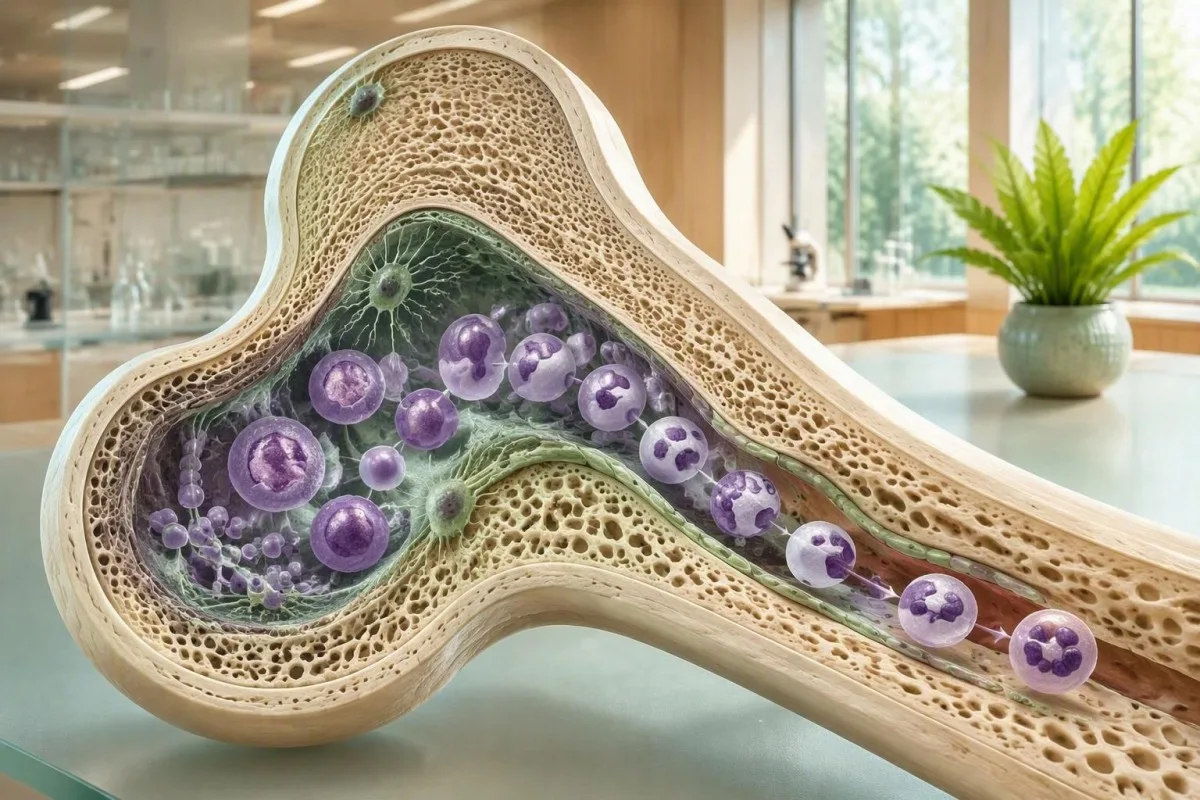
A monocyte percentage can look high simply because other white cells are low. The absolute count shows how many monocytes are actually circulating and usually gives the more useful clinical context.


- ژمارەی مطلقی مونۆسایتەکان is calculated as total white blood cells × monocyte percentage; it measures the actual circulating monocyte number.
- Normal absolute monocyte count for most adults is roughly 0.2–0.8 × 10^9/L, or 200–800 cells/µL, although laboratory intervals differ.
- High monocyte percentage can occur with a normal absolute count when neutrophils or lymphocytes fall, so percentage alone can mislead.
- موکۆسیتۆسزی بەردەوام above 1.0 × 10^9/L for more than 3 months deserves clinical review, especially with anemia, low platelets, or an enlarged spleen.
- Acute recovery after a viral illness, surgery, or severe stress can temporarily raise monocytes and often settles on repeat testing.
- ڕەخنەی CBC matters more than one result: white-cell total, neutrophils, lymphocytes, hemoglobin, platelets, symptoms, and trend change interpretation.
- نەخۆشی/ئەلامەتە فوریتەکان such as fever, drenching night sweats, unexplained weight loss, breathlessness, or new bruising need prompt medical assessment regardless of the number.
- تێکرارکردنی کات is commonly 4–8 weeks after a minor illness has resolved when an isolated mild elevation has no red flags.
Why the absolute count usually answers the real question
The absolute monocyte count usually matters more than the percentage because it tells us the number of monocytes per litre or microlitre of blood. A high percentage with a normal absolute count often reflects a fall in another white-cell group, not a true monocyte increase.
For the absolute monocyte count vs percentage question, start with the total white blood cell count. A result of 12% monocytes sounds high, but with a white blood cell count of 3.0 × 10^9/L it equals only 0.36 × 10^9/L—well within many adult reference intervals. By contrast, 8% at a white blood cell count of 16.0 × 10^9/L equals 1.28 × 10^9/L and is genuine monocytosis.
In my 15 years of clinical practice, I have seen patients worry about a percentage flag while missing the much more meaningful denominator. Kantesti is an AI blood test analyzer that calculates differential-cell absolute values from the reported CBC total and percentage, then reads them beside the rest of the panel. This is the same reason clinicians read an entire CBC differential rather than treating one column as a diagnosis.
Thomas Klein, MD, advises patients to compare values in the same units before comparing different laboratory reports. Monocytes are circulating precursors of macrophages and dendritic cells; they leave the circulation for tissues within roughly 1–3 days, so a single mild change is a snapshot rather than a verdict.
The calculation in one line
Absolute monocyte count = total white blood cell count × monocyte percentage ÷ 100. A white blood cell count of 7.5 × 10^9/L with 9% monocytes produces an absolute count of 0.675 × 10^9/L, which is usually normal.
Normal absolute monocyte count and laboratory ranges
A normal absolute monocyte count in adults is commonly about 0.2–0.8 × 10^9/L, equivalent to 200–800 cells/µL. Some laboratories set the upper boundary at 0.9 or 1.0 × 10^9/L, so the range printed beside your own result takes priority.
A monocyte percentage of roughly 2–10% is often quoted for adults, but it has no fixed meaning without the white blood cell total. Children can have somewhat different differential proportions, and pregnancy, smoking, recent exercise, and corticosteroid exposure can alter the white-cell distribution without indicating disease.
Reference intervals are statistical, usually covering the central 95% of a laboratory's reference population. That means approximately 1 in 20 healthy people will have at least one out-of-range result on a broad panel; our guide to پرچمەکانی لەدەرباز/لەسەر بازە explains why a flag is a prompt for context, not proof of illness.
Kantesti AI یەک پلاتفۆرمی تێکست/وەشاندنی تاقیکردنی خوێنی AI that normalizes units such as cells/µL and × 10^9/L before trend review. That practical step prevents a common error: assuming 0.85 × 10^9/L is lower-risk than 850 cells/µL when they are the same value.
When a high monocyte percentage is not high monocytosis
A monocyte percentage can be high while the absolute monocyte count is normal when total white cells, neutrophils, or lymphocytes are low. This is called a relative increase and is common during recovery from a viral illness.
Consider two people with 10% monocytes. At 10.0 × 10^9/L white cells, the absolute count is 1.0 × 10^9/L; at 3.5 × 10^9/L, it is 0.35 × 10^9/L. The same percentage therefore describes two clinically different situations.
A low lymphocyte count can inflate the monocyte percentage even if monocytes have not changed. Look closely at the normal lymphocyte count and percentage before interpreting the differential; denominator shifts are especially easy to overlook after acute illness or a short steroid course.
The reverse also happens. A 4% monocyte result can conceal an elevated absolute count of 1.2 × 10^9/L if the total white cell count is 30 × 10^9/L, which is why a percentage inside range is not automatically reassuring.
What a genuinely elevated monocyte count can mean
True monocytosis means the absolute monocyte count is above the laboratory upper limit, often above 0.8–1.0 × 10^9/L in adults. The commonest explanation is a temporary immune response, but persistence changes the clinical question.
Acute bacterial illnesses, tuberculosis, endocarditis, autoimmune conditions, inflammatory bowel disease, chronic liver disease, and tissue recovery after surgery can raise monocytes. Patnaik and Tefferi's clinical review recommends first separating transient monocytosis from a sustained pattern and checking the peripheral smear when the finding persists (Patnaik et al., 2021).
The duration matters. Monocytosis lasting more than 3 months, especially above 1.0 × 10^9/L, merits a structured assessment rather than repeated reassurance. A careful history should include fevers, recent travel, dental infection, bowel symptoms, joint swelling, rashes, smoking, and medicines.
Raised monocytes plus high CRP or ESR can support an inflammatory explanation, but neither test identifies the cause. Persistent fatigue with swollen joints, dry eyes, or dry mouth may justify targeted evaluation such as our overview of ئاماژەکانی پشکنینی نەخۆشی سوجرن.
How high and low total white cells change interpretation
Total white blood cell count changes the meaning of every differential percentage because it is the denominator used to calculate absolute values. A low total count commonly creates a relative monocyte percentage increase; a high total count can reveal absolute monocytosis despite a routine-looking percentage.
With leukopenia below 4.0 × 10^9/L, a monocyte proportion of 12–15% is frequently a mathematical consequence of fewer neutrophils or lymphocytes. It should prompt a look at the absolute neutrophil count, medications, recent viral illness, and whether counts are recovering; see our practical guide to خانە شێوانەکانی سنووردار.
With leukocytosis above 11.0 × 10^9/L, even a 7–9% monocyte percentage may yield an absolute count above 1.0 × 10^9/L. Neutrophilia with fever and toxic changes on a smear points in a different direction from sustained monocytosis with anemia or thrombocytopenia.
One underappreciated pre-analytic point: dehydration can concentrate cells modestly, while intravenous fluids can dilute them. These effects usually move several CBC values together, including hemoglobin and hematocrit, rather than selectively increasing monocytes.
The CBC pattern clinicians read alongside monocytes
Monocyte results are most useful when interpreted with hemoglobin, platelet count, total white cells, neutrophils, lymphocytes, and the blood-film comment. An isolated count of 0.9 × 10^9/L is usually less concerning than the same count accompanied by anemia and low platelets.
Anemia plus high monocytes can arise from chronic inflammation, nutritional deficiency, kidney disease, infection, or a marrow disorder; the red-cell size helps narrow the list. A rising MCV, increased RDW, and new cytopenias are reasons to examine the pattern rather than simply repeat the monocyte count—our ڕێنمایی MCV سنووردار shows why this matters.
Platelets are particularly informative. A platelet count below 150 × 10^9/L with sustained monocytosis is not diagnostic of a marrow disorder, but it lowers the threshold for a manual smear and hematology input. Conversely, platelets can rise reactively after infection or iron deficiency.
Kantesti AI interprets monocyte results by comparing the differential with red-cell indices, platelet trajectory, laboratory reference limits, and prior draws. Kantesti is an AI-powered blood test analysis tool used by more than 2 million people across 127+ countries, but an unexplained multi-lineage CBC change still requires a clinician and sometimes a hematologist.
When persistent monocytosis needs hematology assessment
Persistent absolute monocytosis above 1.0 × 10^9/L for at least 3 months, especially when monocytes are at least 10% of white cells, warrants evaluation for chronic causes and clonal blood disorders. It does not by itself diagnose cancer.
The 2022 International Consensus Classification uses persistent absolute monocytosis of at least 0.5 × 10^9/L and at least 10% of leukocytes, plus supporting clonal or morphologic evidence, in the diagnostic framework for chronic myelomonocytic leukemia (Arber et al., 2022). Older criteria often used 1.0 × 10^9/L, so online advice can appear inconsistent for a legitimate reason.
Clinicians usually begin with repeat CBCs, a manual differential and peripheral smear, clinical examination, and tests directed by symptoms. If the count is sustained and unexplained, hematology may consider flow cytometry, molecular testing, or bone marrow assessment; a ڕێگای تاقیکردنەوەی نەخۆشی سەربەخۆری خوێن puts these steps in sensible order.
The reassuring reality is that most mild monocytosis is reactive, particularly if it resolves and other cell lines are stable. The concern rises when there are circulating immature cells, splenic enlargement, anemia, platelet changes, or a progressive count trend—not from a single percentage flag.
Common temporary causes of a raised monocyte count
Recovery from an infection is one of the most frequent causes of a temporary high absolute monocyte count. A mild rise often appears days to weeks after fever, gastrointestinal illness, or a respiratory viral infection, even when the person feels mostly better.
Monocytes help clear cellular debris and coordinate tissue repair, so they often increase during the recovery phase rather than at the peak of an infection. Recent influenza-like illness, COVID-19, surgery, trauma, intense endurance training, and stopping corticosteroids can all contribute to a short-lived shift.
Smoking can produce chronic low-grade leukocytosis and can modestly alter differential counts. Medication review is equally useful: granulocyte colony-stimulating factor, some anticonvulsants, and immune-modulating therapies may affect white-cell populations, whereas corticosteroids more often raise neutrophils and lower lymphocytes.
If fatigue persists after a mono-like illness, the antibody pattern and timing matter more than monocytes alone. Our EBV result guide explains why VCA IgM, VCA IgG, and EBNA are interpreted together.
When to repeat a monocyte result
An isolated mild absolute monocyte elevation without red flags is commonly repeated in 4–8 weeks after recovery from illness. Repeat sooner when the count is rapidly rising, exceeds 1.5 × 10^9/L, or other CBC values are abnormal.
Repeat under comparable conditions when possible: use the same laboratory, avoid testing immediately after a marathon or acute infection, and bring an updated medication and supplement list. A difference of 0.1–0.2 × 10^9/L can occur from normal biological and analytical variation, particularly near the reference boundary.
I tell patients not to chase a perfect percentage. What matters is whether the absolute monocyte count is returning toward their usual baseline and whether hemoglobin, platelets, and total white cells remain stable. The broader principles in our article on گۆڕانکارییە گرنگەکانی تاقیکردنەوەی خوێن لێرەدا بەکاردێت.
As of September 17, 2026, Kantesti's trend analysis can place CBC values from different reports on one timeline, but it cannot replace examination or a smear review. Thomas Klein, MD, considers a stable 0.9 × 10^9/L count over years very differently from a rise from 0.4 to 1.2 × 10^9/L over 6 weeks.
Symptoms and CBC combinations that need faster care
A monocyte result alone rarely creates an emergency, but fever, breathlessness, confusion, new bruising, major bleeding, or severe weakness requires prompt medical assessment. The urgency comes from symptoms and the full CBC pattern, not from a percentage in isolation.
Seek same-day clinical advice for a persistent fever of 38.0°C or higher with low white cells, or for fever plus severe shortness of breath, chest pain, or confusion. Fever with a low absolute neutrophil count is a different and potentially urgent problem; our ANC cutoff explanation covers why infection risk rises sharply below 0.5 × 10^9/L.
Arrange timely review for drenching night sweats, unintentional weight loss, left-upper abdominal fullness, enlarged lymph nodes, recurrent infections, or unexplained bruising. These symptoms are nonspecific, yet they change the threshold for physical examination and a manual blood-film review.
Do not use a normal monocyte percentage to dismiss alarming symptoms. A person can have a normal percentage while the absolute count and total white count are abnormal, and a normal CBC does not rule out all causes of fever or weight loss.
Why laboratory method and sample quality still matter
Automated hematology analyzers estimate monocytes by cellular size, internal complexity, and staining or light-scatter characteristics, then calculate the absolute count from total white cells. Unusual cells, clumping, and delayed handling can occasionally make a manual smear necessary.
Most modern analyzers are highly reliable for routine differentials, but they are not infallible. Immature granulocytes, atypical lymphocytes, nucleated red cells, and sample degradation can overlap analytical clusters and trigger an instrument flag; that is why the laboratory may perform microscopy instead of simply releasing an automated result.
A peripheral smear can confirm whether cells classified as monocytes look morphologically typical and whether there are dysplastic or immature forms. For readers interested in how automated interpretation is assessed, our ڕوونکردنەوەی تاقیکردنەوەی کلینیکی describes the boundary between algorithmic pattern recognition and medical decision-making.
EDTA samples are ideally analyzed promptly; prolonged storage can change cellular appearance and differential reliability. If a result is surprising and conflicts with how you feel or with prior CBCs, a clean repeat sample is often wiser than a long list of speculative diagnoses.
Monocytes in children, pregnancy, and older adults
Age and physiological state alter white-cell distributions, so adult monocyte percentage ranges should not be applied blindly to children or pregnancy. The absolute value and the laboratory's age-specific interval remain the safer guide.
Children, particularly infants and toddlers, often have higher lymphocyte proportions than adults; this can make a monocyte percentage look lower despite an ordinary absolute count. A pediatric CBC should be interpreted with pediatric reference intervals and clinical context, not copied from an adult portal range.
Pregnancy naturally raises total white cells, predominantly neutrophils, especially later in gestation. A stable monocyte percentage may therefore produce a somewhat higher absolute count; symptoms, obstetric history, and serial change are more informative than one isolated result.
Older adults are more likely to take medicines and have chronic inflammatory conditions that affect counts, but age alone does not explain persistent monocytosis. Repeated counts above 1.0 × 10^9/L with new anemia deserve the same methodical assessment at 75 as at 35.
Questions to bring to your clinician after a monocyte flag
The most useful question is: “What is my absolute monocyte count, and has it changed over time?” Ask next whether total white cells, neutrophils, hemoglobin, platelets, and the smear comment point toward a temporary or persistent process.
Bring dates of recent infections, vaccinations, operations, travel, new medicines, smoking changes, and symptoms such as fever or unintentional weight loss. A clinical timeline often explains a count of 1.0–1.3 × 10^9/L more efficiently than broad testing, particularly when the rest of the CBC is normal.
Ask whether a repeat CBC, CRP, ESR, liver tests, infection testing, or blood film is justified for your situation. If you have frequent infections or persistent fever, our guide to first-line infection blood tests can help you understand why targeted tests beat indiscriminate panels.
Kantesti AI can organize results and generate a concise follow-up list across 75+ languages, while your clinician decides what requires examination or testing. For difficult persistent patterns, our desteya şêwirmendiya bijîşkî reflects the physician-led clinical oversight behind how we frame safety guidance.
Research publications and the sensible bottom line
The sensible bottom line is that absolute monocyte count provides the clinical quantity, while monocyte percentage provides context about the differential distribution. Use both, but let the absolute value, total white count, symptoms, and trend lead the interpretation.
Patnaik et al. (2021) emphasize a stepwise approach: confirm the finding, determine whether it is transient or persistent, review the smear when appropriate, and investigate clinical clues. Arber et al. (2022) show why duration, proportion, clonality, and other blood-count abnormalities matter before a clonal diagnosis is considered.
Kantestî yek e خزمەتگوزاری تێکست/تێگەیشتنی تاقیکردنی لابراتۆریی AI that helps users preserve the denominator, units, and longitudinal pattern when reviewing CBC reports. Our ڕێنمایی تەکنەلۆژی explains how result extraction and context checks work; neither tool nor article can diagnose the cause of unexplained persistent monocytosis.
Kantesti LTD. (2026). دۆزینەوەکەرێکی تاقیکردنەوەی خوێنی AI: 2.5M تاقیکردنەوە لێکۆڵکرا | ڕاپۆرتی تەندروستی گڵۆبال 2026. Zenodo. https://doi.org/10.5281/zenodo.18175532. ResearchGate: https://www.researchgate.net/search.Search.html?query=AI%20Blood%20Test%20Analyzer%202.5M%20Tests%20Analyzed. Academia.edu: https://www.academia.edu/search?q=AI%20Blood%20Test%20Analyzer%202.5M%20Tests%20Analyzed. Kantesti LTD. (2026). Testa Xwînê ya RDW: Rêbernameya Tevahî ji bo RDW-CV, MCV û MCHC. Zenodo. https://doi.org/10.5281/zenodo.18202598. ResearchGate: https://www.researchgate.net/search.Search.html?query=RDW%20Blood%20Test%20Complete%20Guide. Academia.edu: https://www.academia.edu/search?q=RDW%20Blood%20Test%20Complete%20Guide.
Pirsên Pir tên Pirsîn
گرنگترە ڕێژەی مۆنۆسایتەکان؟
بەڵێ. ڕێژەی موونۆسایتە ڕەهاکان بە گشتی زانیاری کلینیکی زیاتریان هەیە چونکە ژمارەی ڕاستەقینەی موونۆسایتەکان دەپێون، کە بە شێوەیەکی گشتی وەک خانە/میکرۆل (cells/µL) یان × 10^9/L ڕادەگەیەندرێت. ڕێژەیەکی نموونەیی بۆ گەورەکان نزیکەی 0.2–0.8 × 10^9/L ە، لەکاتێکدا پشکی 2–10% دەکرێت کاتێک کۆی خانە سپیەکانی خوێن بەرز یان نزم بێت، هەڵخڵەقێنەر بێت. پزیشکان هەردوو بەهای بەکاردەهێنن، بەڵام ڕێژەی ڕەها، CBC ی تەواو، نیشانەکان، و ئاراستە دیاری دەکەن کە ئایا پێویستە چاودێری بکرێت یان نا.
مانای percentage بەرز بوونی monocyte لەگەڵ count absolute ی ئاسایی چییە؟
ڕێژەیەکی بەرزتری خانەی مۆنۆسایت لەگەڵ ژمارەیەکی ئاسایی مووتلقی خانەی مۆنۆسایت بە شێوەیەکی گشتی مانای ئەوەیە کە ژمارەی جۆرێکی تر لە خانە سپییەکان کەمە، کە دەبێتە هۆی زیادبوونی ڕێژەیی. بۆ نموونە، ٣٦٪ مۆنۆسایت لەگەڵ ژمارەی گشتی خانە سپییەکاندا ٣.٠ × ١٠^٩/ل یەکسانە بە ٠.٣٦ × ١٠^٩/ل، کە زۆرجار ئاساییە. نەخۆشییە ڤایرۆسییەکانی دوایی، کەمبوونی نیوترۆفیل، یان کەمبوونی لیمفۆسایت دەتوانن هۆکاری ئەم دۆخە بن. ئەمە وەک مۆنۆسایتۆسی ڕاستەقینە نییە.
رێژەیەكی ئاسایی مۆنۆسایت چەندە؟
ژمارەی ئاسایی مۆنۆسایتی ڕەھا بۆ زۆربەی گەورەکان نزیکەی 0.2–0.8 × 10^9/L یان 200–800 خانە/µLـە. هەندێک تاقیگە سنوورێکی سەرەوەی 0.9 یان 1.0 × 10^9/L بەکاردەهێنن، بۆیە دەبێت یەکەمجار سنووری تاقیگە کە لەسەر ڕاپۆرتەکەت چاپ کراوە بەکاربهێنرێت. تەمەن، دووگیانی، شێوازی نموونە، و دانیشتووانی ناوچەکە کاریگەری لەسەر ماوەکە هەیە. ئەنجامێک کە نزیکە لە سنووری سەرەوە بە شێوازێکی جیاواز لێکدەدرێتەوە لە ئەنجامێکی بەرزبووەوە لە سەرووی 1.0 × 10^9/L.
کەی دەبێت نیگەران بم سەبارەت بە مونۆسایتی بەرز؟
مۆنۆسایت بەرز پێویستی بە پشکنینی پزیشکی خێراتر هەیە کاتێک ژمارەی ڕەها لە 1.0 × 10^9/L زیاتر بێت بۆ ماوەی زیاتر لە 3 مانگ یان بگاتە 1.5 × 10^9/L. نیگەرانی زیاترە کاتێک کەمخوێنی، پلێتلیتی کەم، خانەی نائاسایی لەسەر پشکنینی خوێن، گەورەبوونی سپڵ، تا، ئارەقەی شەوانەی زۆر، یان دابەزینی کێش بەبێ ویستی خۆت لەگەڵدا بێت. زۆربەی بەرزبوونەوە کەمەکان، تەنها دوای نەخۆشی، کاردانەوەن و ئاسایی دەبنەوە. پزیشک دەتوانێت بڕیار بدات کە ئایا پشکنینی دووبارەی CBC لە ماوەی 4-8 هەفتەدا یان پشکنینی خێراتر گونجاوە.
ئایا فشاری دهروونی یان وهرزش دهتوانێت مۆنۆسایت زیاد بكات؟
Yes, acute physiological stress, surgery, trauma, and strenuous endurance exercise can temporarily change monocyte counts. These shifts are usually modest and occur alongside changes in neutrophils, total white cells, or hydration markers rather than as a persistent isolated finding. Avoid drawing broad screening labs immediately after a marathon or severe sleep loss if the result is not urgent. A repeat CBC after recovery can clarify whether the count is truly sustained.
Does high monocytes mean leukemia?
No. High monocytes are much more often caused by infection recovery, chronic inflammation, smoking, medications, or other reactive conditions than leukemia. Persistent monocytosis of at least 0.5–1.0 × 10^9/L for 3 months can be part of the evaluation for chronic myelomonocytic leukemia, but diagnosis also requires clinical, morphologic, and often molecular evidence. A single high result or high percentage cannot diagnose leukemia. The presence of anemia, low platelets, immature cells, or a rising trend makes specialist review more appropriate.
ئەمڕۆ AI-پاوەرد لەسەر تاقیکردنەوەی خوێن بەدەست بهێنە
بە یارمەتی زیاتر لە 2 ملیۆن بەکارهێنەر لە هەموو جیهاندا کە Kantesti دەستپێدەکەن بۆ تاقیکردنەوەی لابراتۆری ڕاست و بەهێز لە کاتێکی کەم. ڕەخنەی تاقیکردنەوەی خوێنت بنێرە و تفسیرێکی تەواو لە 15,000+ نیشانەی زیستی (biomarkers) لە ماوەی چرکەکاندا وەرگرە.
📚 توێژینەوە سەرچاوە پەیوەندیدارەکان
کلاین، ت.، میچێڵ، س.، & وێبەر، ه. (2026). Kantesti LTD. (2026). AI Blood Test Analyzer: 2.5M Tests Analyzed | Global Health Report 2026. Zenodo. ResearchGate: https://www.researchgate.net/search.Search.html?query=AI%20Blood%20Test%20Analyzer%202.5M%20Tests%20Analyzed. Academia.edu: https://www.academia.edu/search?q=AI%20Blood%20Test%20Analyzer%202.5M%20Tests%20Analyzed. Kantesti توێژینەوەی پزیشکی AI.
کلاین، ت.، میچێڵ، س.، & وێبەر، ه. (2026). Kantesti LTD. (2026). RDW Blood Test: Complete Guide to RDW-CV, MCV & MCHC. Zenodo. ResearchGate: https://www.researchgate.net/search.Search.html?query=RDW%20Blood%20Test%20Complete%20Guide. Academia.edu: https://www.academia.edu/search?q=RDW%20Blood%20Test%20Complete%20Guide. Kantesti توێژینەوەی پزیشکی AI.
📖 سەرچاوەی پزیشکی دەرەکی
Arber DA et al. (2022). ڕێککەوتنی یەکگرتوو لە نێوان نێوەندەکان (International Consensus Classification) بۆ نەخۆشییە میێلوئیدەکان و لەوکێمیای هەڵکەوتوو: یەکگرتنەوەی داتای ڕوونکردنەوەی شێوەیی (morphologic)، کڵینیکی، و ژنۆمیک. Blood.
⚕️ Daxuyaniya Bijîşkî
ئەم مادەیە تەنها بۆ. I think I must continue but user expects all items.
سەنگەری باوەڕپێکردن E-E-A-T
Tecribe
ڕەوی پشکنینی کلینیکی لەلایەن پزیشکەوە بۆ ڕێکخستنی ڕووداوەکانی لێکدانەوەی ئازمایش.
Pisporî
گرێدانی لابراتۆرییەی پزیشکی بەوەی چۆن بایۆمارکەرەکان لە کۆنتێکستی کلینیکی دەگۆڕن.
Desthilatdarî
نووسراوە لەلایەن د. توماس کلاین بە پشکنینی لەلایەن د. سارا میچێڵ و پڕۆف. د. هانس وێبەر.
Bawerî
لێکدانەوە بە بنەمای دڵنیابوون (Evidence-based) بە ڕێڕەوی دوایینەوەی ڕوون بۆ کەمکردنەوەی هەست بە ترس/هەڵوەشاندن.