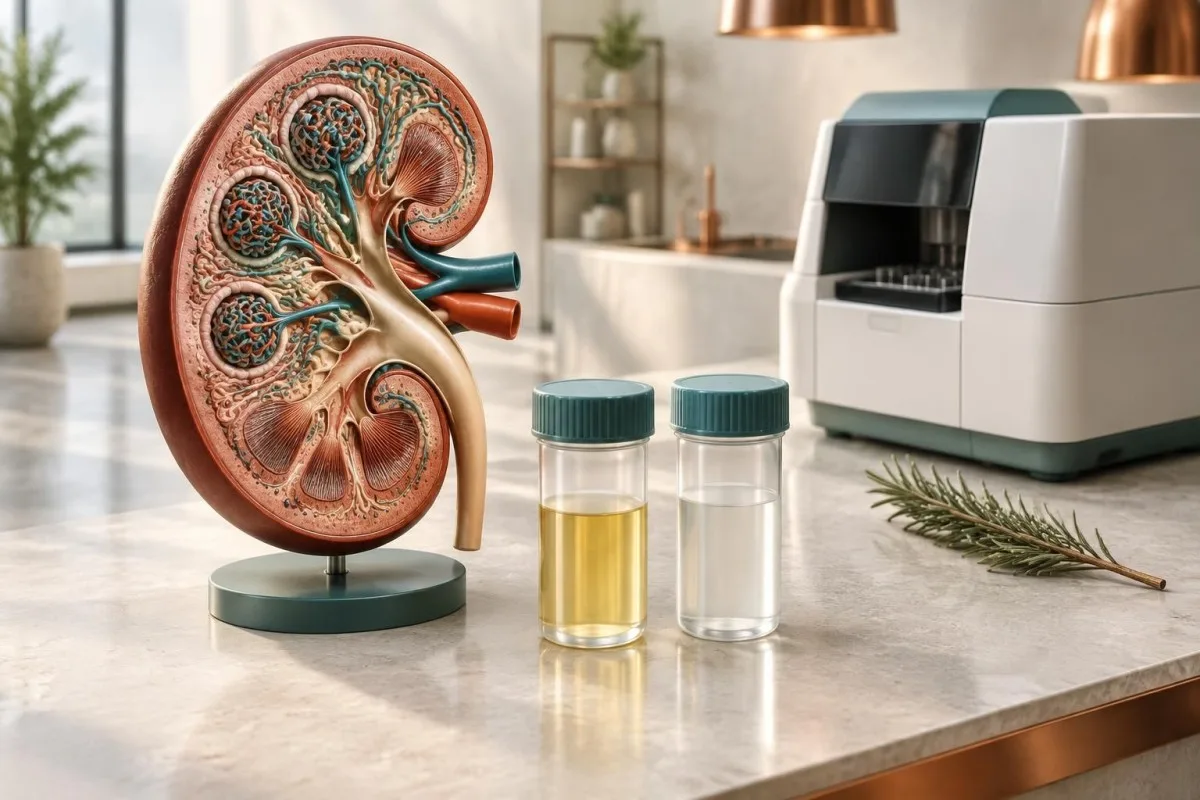
A spot urine sample can estimate daily protein loss, but the number only becomes meaningful when its units, collection conditions, kidney function and clinical setting are read together.

خاڵە سەرەکییەکان
- What it measures: A spot urine protein to creatinine ratio estimates protein excretion without requiring a timed 24-hour collection; 1 g/g is roughly equivalent to 1 g of protein per day.
- Typical adult result: A ratio below 150 mg/g, or 0.15 mg/mg, is commonly considered within the usual non-pregnant adult range, although laboratories may differ.
- ڕەسڵتی بەرز: A urine protein creatinine ratio above 500 mg/g generally deserves clinical review, while values above 3,500 mg/g are in the nephrotic-range zone.
- یەکەکان گرنگن: 0.3 g/g equals 300 mg/g and approximately 34 mg/mmol; these are different displays of the same ratio, not different levels of protein loss.
- Collection matters: Fever, strenuous exercise, urinary infection, dehydration, menstruation and contamination can temporarily increase a spot result.
- Protein versus albumin: Total protein includes albumin and other proteins, so the protein ratio and albumin-to-creatinine ratio answer related but different questions.
- دووبارە پێگیری: Persistent protein elevation, blood in urine, high blood pressure, reduced eGFR or swelling usually prompts repeat testing and a broader kidney assessment.
What a spot urine protein ratio actually measures
A urine protein to creatinine ratio estimates how much protein is being lost in urine by comparing urine protein with urine creatinine in the same sample. A result of 1 g/g is often interpreted as approximately 1 g of protein excreted per day, although this is an estimate rather than a direct 24-hour measurement.
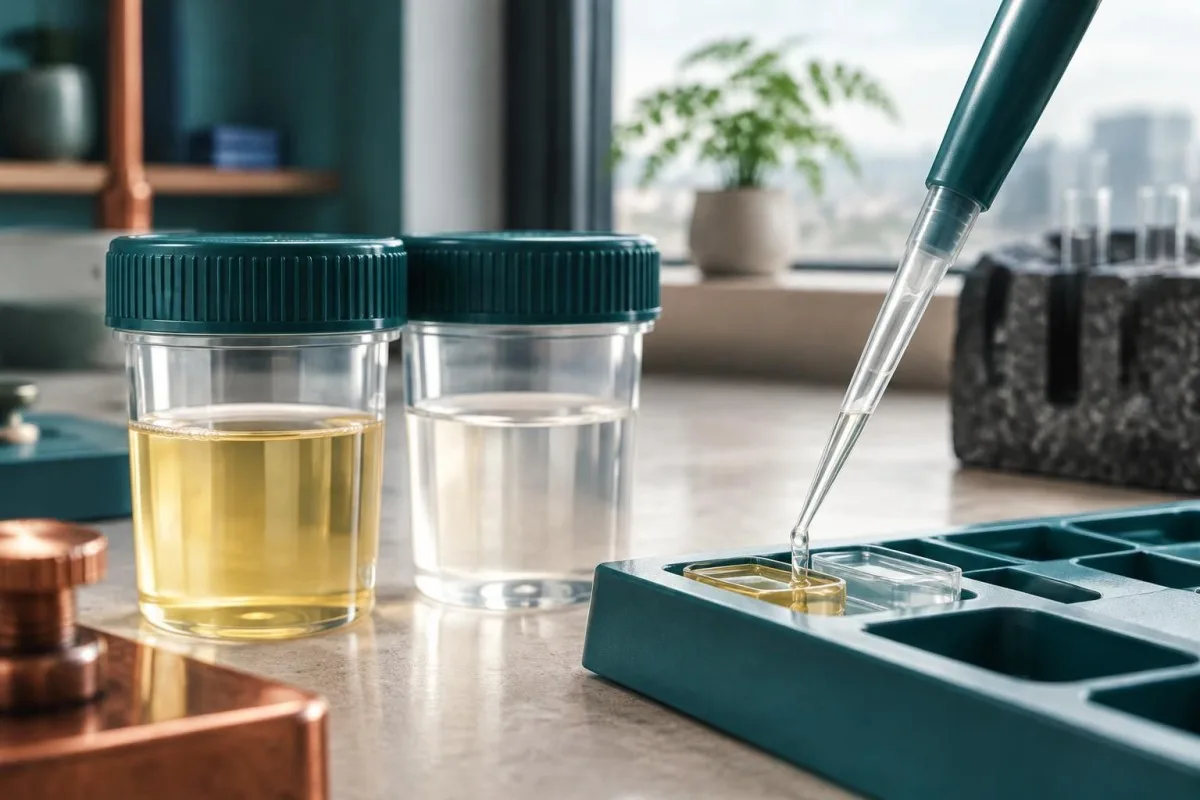
The ratio works because urine concentration changes throughout the day, while creatinine provides a rough correction for dilution. For example, 120 mg of protein in a concentrated sample and 40 mg of protein in a dilute sample may produce a similar ratio if their creatinine concentrations differ in proportion.
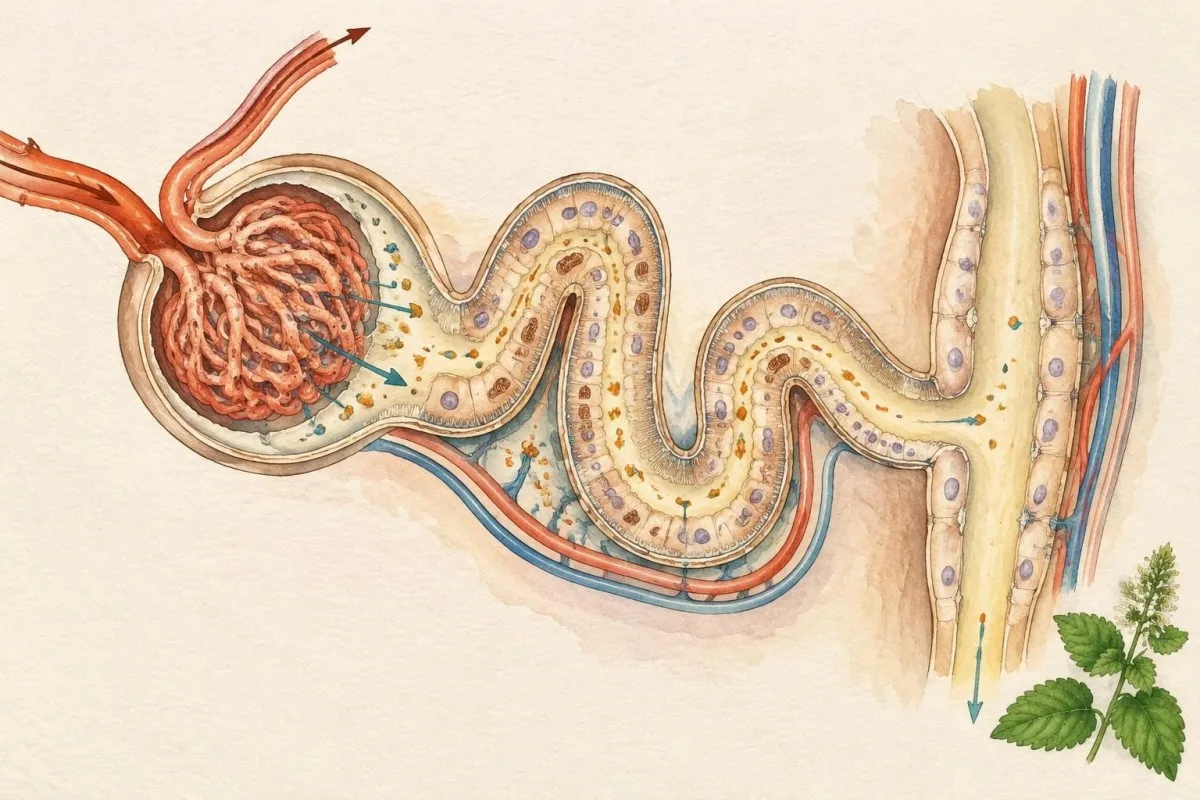
A spot urine protein creatinine ratio does not measure kidney filtration directly. The ratio reflects protein passage into urine, whereas estimated glomerular filtration rate, serum creatinine and cystatin C address how effectively the kidneys clear small waste molecules.
Kantesti is an AI blood test analyzer that can organize serum creatinine, eGFR, albumin and glucose beside a reported urine ratio; it cannot replace the urine assay or a clinician’s examination. Readers comparing several laboratory markers may find our rêbernameya referansê ya nîşankerên biyolojîk useful for understanding which results come from blood and which come from urine.
Why urine protein creatinine ratio units change the meaning
The same urine protein creatinine ratio may appear as mg/g, mg/mg, g/g or mg/mmol, so the unit must be read before judging the result. Numerically, 300 mg/g equals 0.3 mg/mg and 0.3 g/g, while it is approximately 34 mg/mmol.
For common reporting formats, 1 mg/mg equals 1 g/g, and 1 g/g is approximately 113 mg/mmol of creatinine. A practical conversion is to multiply g/g by about 113 to estimate mg/mmol, so 0.15 g/g is approximately 17 mg/mmol.
A result of 0.8 g/g should not be mistaken for 0.8 mg/g; the former equals 800 mg/g and is clinically much higher. The difference is 1,000-fold, which is why a missing prefix can completely reverse the interpretation.
Urine creatinine concentration itself may be flagged as unusually low or high, especially in very dilute urine, people with low muscle mass, highly muscular adults or those with unusual collection timing. Our guide to کرێاتینی میز و شلبوونەوە explains why the denominator can make a ratio less stable.
Typical adult urine protein creatinine ratio ranges
For non-pregnant adults, a urine protein creatinine ratio below 150 mg/g, or 0.15 g/g, is commonly used as a practical upper reference point. Results above 500 mg/g are more concerning than borderline elevations, but no single cutoff diagnoses chronic kidney disease without persistence or supporting findings.
These bands are practical interpretation zones, not universal disease stages. The 2024 KDIGO chronic kidney disease guideline emphasizes confirming abnormal results and integrating albuminuria, eGFR, urine sediment and clinical history rather than treating a single ratio as a diagnosis (KDIGO, 2024).
A ratio of 220 mg/g could represent a brief exercise-related rise in one person and early kidney disease in another. The difference often emerges from a repeat first-morning sample, blood pressure measurement and whether the ratio remains abnormal for at least 3 months.
هاوڕێی urinalysis helps distinguish protein quantification from dipstick findings, which are affected by urine concentration and mainly detect albumin. Some laboratories use slightly different decision limits, so the printed reference interval should remain part of the interpretation.
| ئاست | مەودا | مانای چییە |
|---|---|---|
| Usually low | <150 mg/g (<0.15 g/g; <17 mg/mmol) | Commonly within the usual adult range, though symptoms and other urine findings still matter. |
| بەرزی لەخۆیەوە (بەهێز نەبوو) | 150-500 mg/g (0.15-0.50 g/g) | May be transient or clinically meaningful; repeat testing and context are usually needed. |
| بهوضوح بالا رفته | 500-3,500 mg/g (0.50-3.50 g/g) | Often warrants kidney-focused assessment, especially with blood in urine, high blood pressure or reduced eGFR. |
| Nephrotic-range zone | >3,500 mg/g (>3.50 g/g; >396 mg/mmol) | Requires prompt clinical evaluation for substantial protein loss and possible glomerular disease. |
Protein-to-creatinine ratio versus albumin-to-creatinine ratio
A protein-to-creatinine ratio measures total urine protein, while an albumin-to-creatinine ratio measures albumin specifically. The difference matters because a urine sample can contain albumin, low-molecular-weight proteins, immunoglobulin fragments or proteins from the urinary tract.
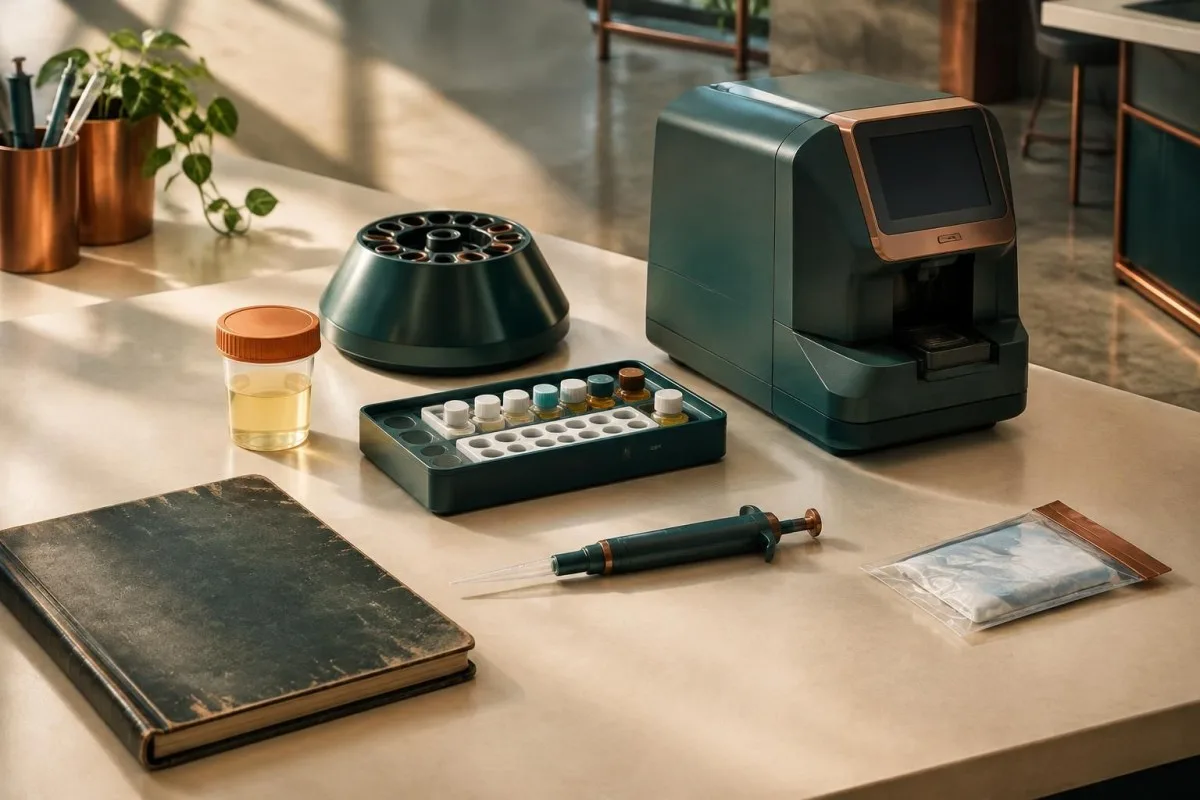
Albumin-to-creatinine ratio is usually preferred for detecting small increases in glomerular albumin leakage, especially in diabetes and hypertension. A PCR of 400 mg/g and an ACR of 30 mg/g do not describe the same protein pattern because most of the total protein may be something other than albumin.
A disproportionately high PCR with a relatively low ACR can suggest tubular protein loss, overflow proteins or urinary tract contributions, although laboratory methods and timing can also explain the mismatch. For example, a PCR of 1,000 mg/g with an ACR of 80 mg/g deserves a different workup from a PCR and ACR that are both near 1,000 mg/g.
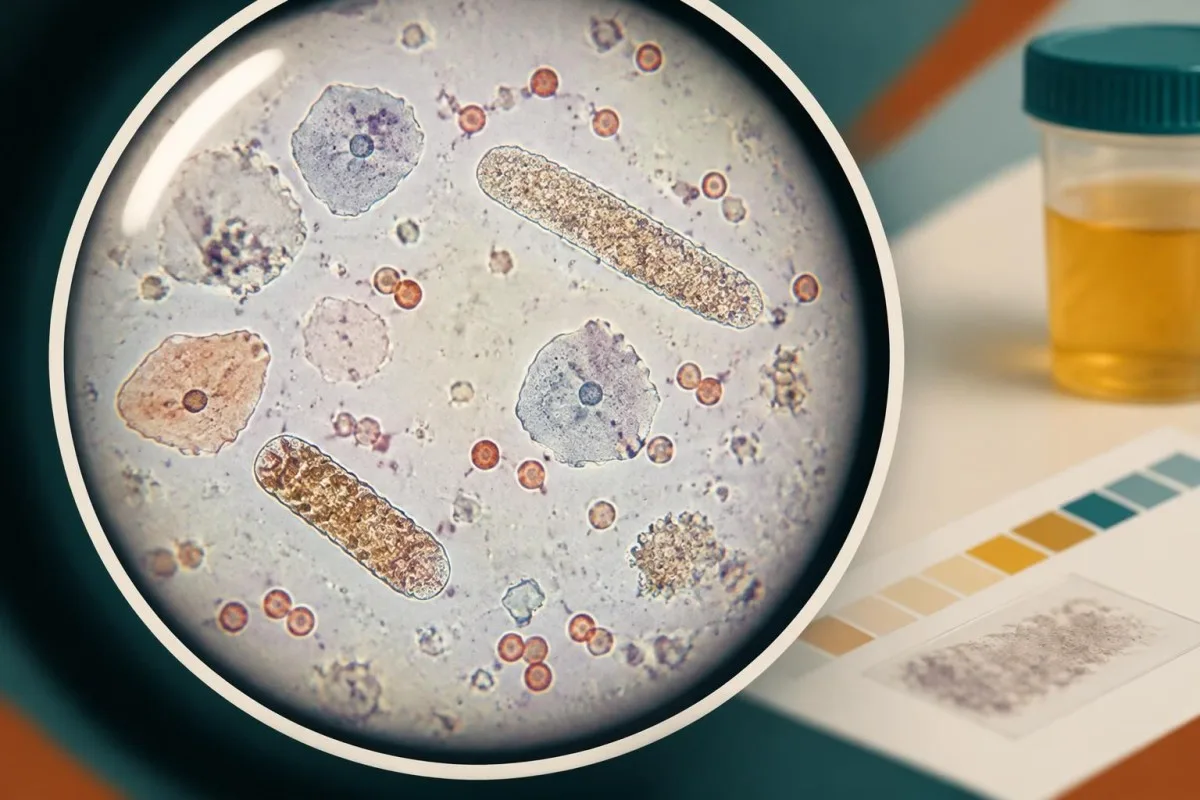
Urine sediment can add another layer: red cells, casts and tubular cells may indicate an active process even when the ratio is only 250 mg/g. Our explanation of دەرکەوتەکانی پاشماوەی میز covers why microscopy can change the significance of a quantitative result.
How collection conditions affect a spot result
A spot urine protein creatinine ratio is most interpretable when collected as a clean, preferably first-morning sample after avoiding unusual exertion. Fever, dehydration, urinary infection, menstruation, semen contamination and heavy exercise can produce temporary protein elevations that may fall within days.
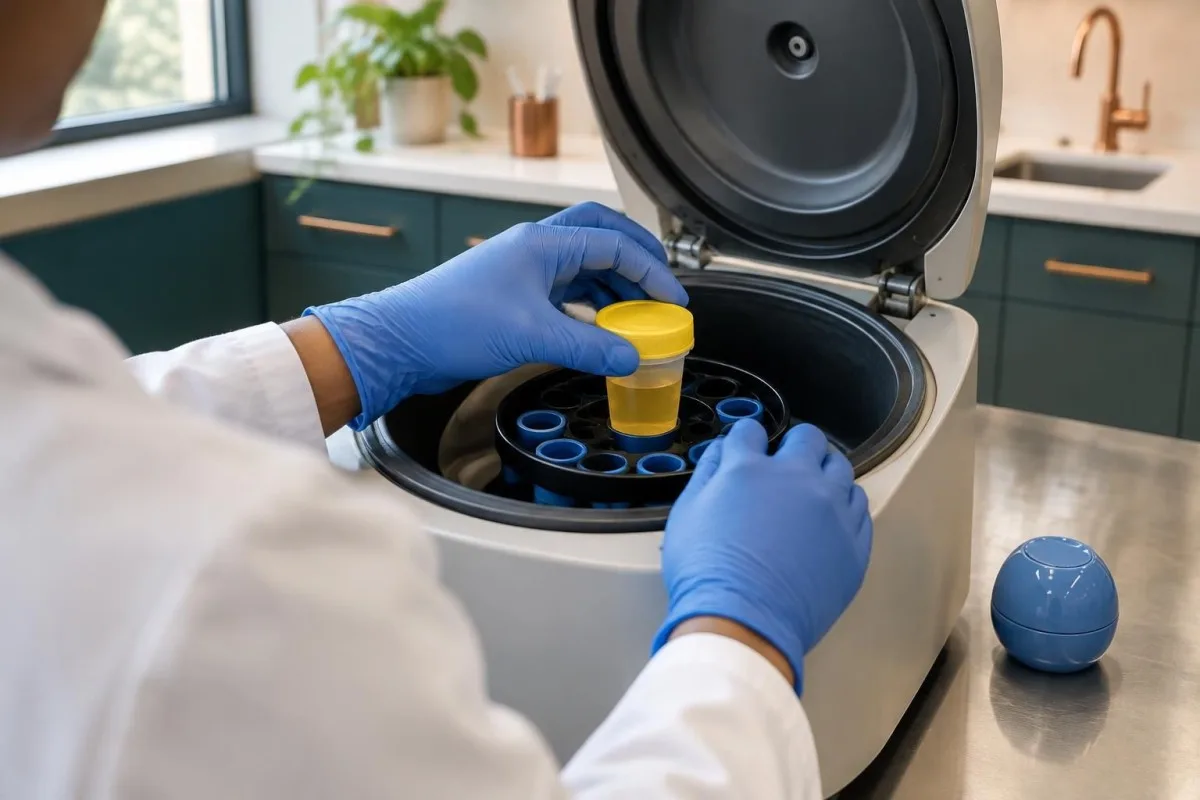
First-morning urine is often useful because it has been in the bladder for several hours and is less affected by daytime activity. A sample taken immediately after a long run may show a higher ratio than one collected after 24 to 48 hours of normal activity.
A dilute sample can create a ratio that is mathematically valid but less dependable when urine creatinine is very low. A practical collection plan includes washing hands, using the laboratory container, avoiding the first few seconds of flow when instructed and recording whether exercise or illness occurred within the previous 24 hours.
Persistent foamy urine is not proof of proteinuria, because rapid flow and concentrated urine can create bubbles, but foam that continues across several days deserves testing. Our article on میزە لووسی بەردەوام explains when appearance should be replaced by measurement.
What causes a high urine protein creatinine ratio
A high urine protein creatinine ratio can arise from glomerular leakage, tubular reabsorption problems, excess circulating proteins or inflammation below the kidneys. The reason clinicians combine the ratio with urine microscopy, eGFR and blood pressure is that the same numerical result can come from very different mechanisms.

Glomerular disorders often allow albumin and larger proteins to cross the filtration barrier, sometimes producing PCR values above 1,000 mg/g. Tubular disorders may produce smaller protein increases, while overflow states such as monoclonal light-chain production may require tests that a routine dipstick does not detect well.
A urinary infection can increase protein through inflammatory material and blood cells, particularly when leukocytes or nitrites are present. Treating an infection and repeating the ratio after approximately 1 to 2 weeks may clarify whether the elevation was temporary, although the exact interval depends on symptoms and clinical advice.
Protein without infection can also accompany high blood pressure, diabetes, autoimmune disease, heart failure or medication-related kidney stress. The presence of bacteria alone does not prove a symptomatic infection; our guide to bacteria in urine without symptoms explains why culture and symptoms must be considered together.
How clinicians interpret a high result
A high urine protein creatinine ratio becomes more concerning when it is persistent, rising or accompanied by reduced eGFR, blood in urine, cellular casts, swelling or high blood pressure. A single value of 600 mg/g is a signal for assessment, not a diagnosis of irreversible kidney disease.
Magnitude changes the urgency: 180 mg/g is borderline in many adult laboratories, 900 mg/g is clearly abnormal, and 4,000 mg/g enters the nephrotic-range zone. The reason nephrotic-range values receive faster attention is that substantial protein loss can lower blood albumin and contribute to edema, altered lipids and clotting complications.
The pattern matters more than a solitary peak. For example, a hypothetical 52-year-old marathon runner with a PCR of 700 mg/g after a race and 90 mg/g on a rested first-morning repeat has a different risk profile from someone with 700 mg/g on three samples over 3 months.
The 2021 KDIGO glomerular disease guideline recommends disease-specific evaluation when proteinuria is substantial or accompanied by active urine sediment; it does not treat every elevated ratio as the same condition (KDIGO, 2021). A temporary eGFR reduction after dehydration can also distort the picture, as described in our وشکبوونەوە و GFR.
When a urine protein ratio should be repeated
Clinicians commonly repeat an unexpected urine protein creatinine ratio when the patient is well, the sample was not first-morning, or a temporary trigger could explain the result. Confirmation is particularly useful for borderline values between 150 and 500 mg/g, while very high results or red-flag symptoms should not wait for routine monitoring.

A repeat may be arranged within days to weeks after strenuous exercise, fever or urinary symptoms have resolved. Chronic kidney disease generally requires an abnormal kidney marker lasting at least 3 months, so a result on day 1 alone cannot establish chronicity.
Repeating the same test is not always enough. If PCR remains high, clinicians may add ACR, urine microscopy, serum creatinine and eGFR, electrolytes, albumin, glucose and blood pressure; if a monoclonal protein is suspected, serum or urine electrophoresis and free-light-chain testing may be considered.
Trends should use comparable conditions whenever possible, such as first-morning samples from the same laboratory. Our ڕێنمای کاتەکانی تاقیکردنەوەی خوێن explains why illness, exercise, medication changes and timing can make two nearby results look more different than they truly are.
Which blood tests put the ratio in context
Serum creatinine, eGFR, albumin, electrolytes, glucose and blood pressure are the main companion data for a urine protein ratio. A high PCR with normal eGFR still deserves attention, while a high PCR plus falling eGFR or low serum albumin usually raises the urgency.
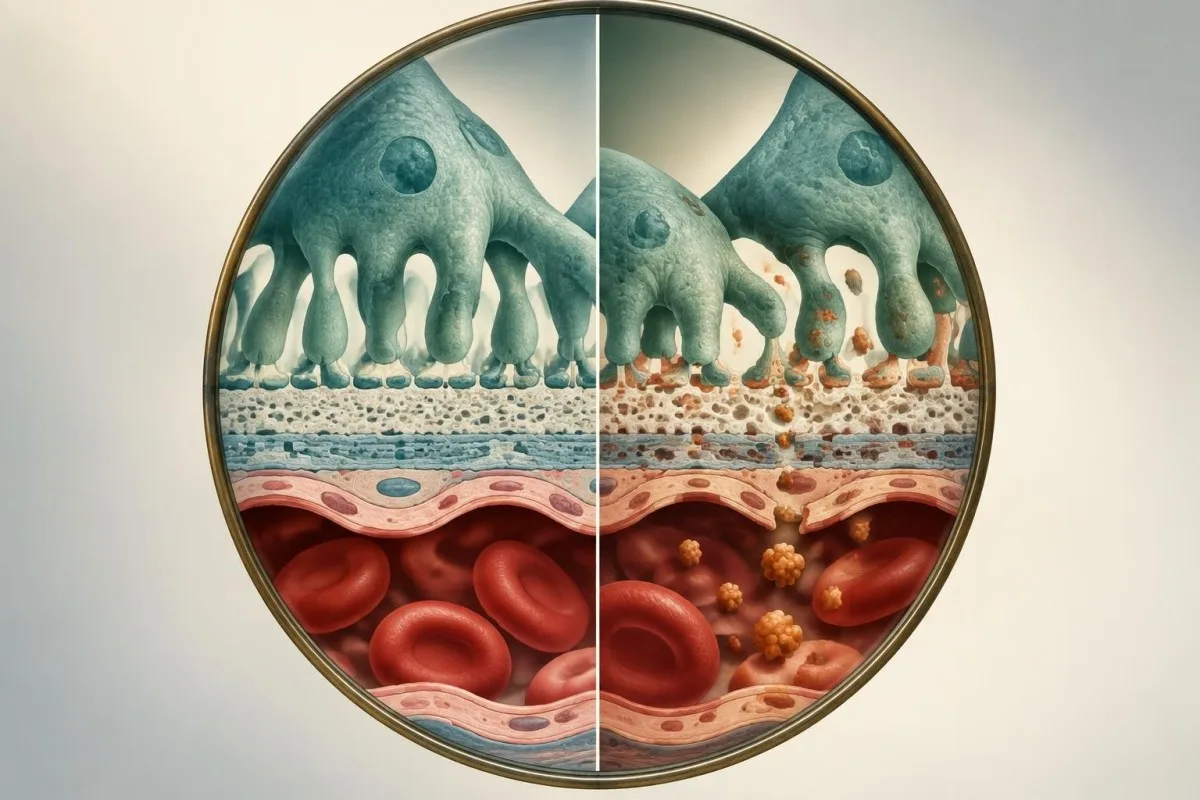
Serum creatinine can appear reassuring in a person with low muscle mass because creatinine production is lower, while a muscular adult may have a higher baseline without kidney disease. An eGFR of 58 mL/min/1.73 m² and PCR of 800 mg/g create a more concerning combination than either result viewed alone.
Low serum albumin below approximately 3.0 g/dL alongside PCR above 3,500 mg/g suggests that protein loss may be physiologically significant, although liver disease, nutrition and inflammation can also lower albumin. The reason clinicians ask about swelling is that reduced plasma oncotic pressure can shift fluid into tissues.
BUN and creatinine are influenced by hydration, diet and muscle turnover, so they do not quantify urinary protein. Our ڕێنمایی نێوان BUN و کرێاتینین explains why those blood markers should not be substituted for a urine protein measurement.
What the ratio means during pregnancy
During pregnancy, a urine protein creatinine ratio of 0.3 g/g, or 300 mg/g, is commonly used as a threshold for significant proteinuria when assessing hypertensive disorders. The ratio must be interpreted with blood pressure, symptoms, platelet count, liver enzymes, creatinine and gestational age rather than used alone.
A pregnant person with blood pressure of 145/95 mmHg and PCR of 0.34 g/g needs prompt clinical assessment, even if the urine appearance is normal. Severe headache, visual change, upper abdominal pain, sudden swelling or shortness of breath require urgent maternity advice because they can indicate maternal organ involvement.
The evidence on the exact spot-ratio threshold is not perfectly uniform, especially near 0.3 g/g and in different populations. A systematic review by Côté and colleagues in the BMJ found that spot protein-to-creatinine testing can reduce the need for timed collection, but clinical context still determines whether additional testing is needed (Côté et al., 2008).
Pregnancy changes kidney filtration and can alter the meaning of creatinine-based estimates, so non-pregnant reference assumptions may mislead. The related ڕێنمایی pregnancy GFR describes why pregnancy-specific review is preferable to applying adult cutoffs mechanically.
How age and muscle mass influence the ratio
The creatinine denominator makes a spot urine protein ratio less straightforward in children, frail older adults, highly muscular people and those with low muscle mass. Two people with the same protein excretion can receive different ratios if their daily creatinine production differs substantially.

In small children, clinicians often adjust interpretation for age and body surface area rather than applying adult limits such as 150 mg/g. A toddler result of 0.2 mg/mg cannot be interpreted in the same way as a healthy adult result of 0.2 mg/mg without pediatric reference data.
An older adult with low muscle mass may have low urine creatinine and an apparently high ratio from a modest protein concentration. Conversely, a heavily muscled adult may have a larger creatinine denominator that makes the ratio look lower than the absolute protein concentration might suggest.
A family history of kidney disease, especially with ancestry-associated risk variants, can alter the threshold for investigation. Our overview of تاقیکردنەوەی جینی APOL1 explains one example of inherited risk without implying that a ratio alone identifies a genetic cause.
Symptoms that make a high ratio more urgent
A high urine protein creatinine ratio needs faster medical review when it occurs with swelling, breathlessness, markedly reduced urine output, visible blood in urine, severe headache or very high blood pressure. Many kidney conditions cause no symptoms at ratios below 1,000 mg/g, so feeling well does not rule out persistent protein loss.
Sudden facial or ankle swelling with PCR above 3,500 mg/g may indicate heavy protein loss, especially when serum albumin is below 3.0 g/dL. New breathlessness can reflect fluid accumulation and should not be attributed to the urine result without prompt assessment.
Visible tea-colored or pink urine, reduced urine output over 12 hours, confusion or severe flank pain needs urgent care regardless of whether PCR is 100 mg/g or 1,000 mg/g. The ratio can be modest when blood or inflammation is the dominant clue.
Persistent protein with an eGFR below 30 mL/min/1.73 m² generally warrants specialist involvement under many referral pathways, though local criteria differ. Our low-eGFR warning guide explains why symptoms and filtration level can change the speed of evaluation.
What further investigations may follow
Persistent or substantial proteinuria may lead to repeat ACR and PCR, urine microscopy, kidney ultrasound, immune testing, protein electrophoresis or specialist review. The specific sequence depends on whether the pattern is albumin-dominant, blood-associated, nephrotic-range, tubular or linked to another illness.
Albumin-dominant protein with red-cell casts may prompt assessment for glomerular inflammation, including complement levels and autoimmune antibodies. Marked protein with little blood may point clinicians toward diabetes, membranous disease or another filtration-barrier disorder, but these patterns are not diagnostic by themselves.
A kidney ultrasound can assess size, obstruction and structural features, while a biopsy is reserved for selected cases where tissue information would change treatment. A PCR of 2.0 g/g does not automatically mean biopsy; age, eGFR, ACR, sediment and treatment options all influence that decision.
Anti-PLA2R antibodies can support evaluation of some membranous nephropathy patterns, but a positive result still requires clinical interpretation. Our article on PLA2R antibody results explains why one specialized test cannot replace the wider kidney assessment.
How medicines and health conditions affect follow-up
Management of an elevated urine protein creatinine ratio targets the underlying cause and often includes blood-pressure control, diabetes care, medication review and avoidance of preventable kidney stress. Treatment decisions should follow confirmation and clinical assessment rather than a self-calculated ratio alone.

Clinicians may review non-steroidal anti-inflammatory drugs, contrast exposure, supplements and medicines that alter kidney filtration or potassium balance. An adult with PCR of 900 mg/g, eGFR of 52 and potassium of 5.5 mmol/L needs a different plan from someone with PCR of 900 mg/g and stable potassium of 4.2 mmol/L.
Angiotensin-converting enzyme inhibitors, angiotensin receptor blockers and selected newer kidney-protective medicines can reduce albuminuria in appropriate patients, but they require individualized monitoring. A change in serum creatinine or potassium after starting treatment may be clinically expected in some situations yet unsafe in others.
Kantesti is an AI blood test interpretation platform that can place repeated creatinine, eGFR, potassium, albumin and glucose results into a trend view; it does not prescribe treatment or decide whether a medicine is safe. Medication changes should be discussed with the prescriber, particularly when eGFR is below 60 mL/min/1.73 m².
How to organize your urine and blood results
A urine protein ratio is easiest to interpret when the report includes its unit, collection date, urine creatinine concentration, laboratory reference interval and related blood results. A structured timeline can reveal whether a value of 250 mg/g is isolated, recurring or rising over 6 months.
Before interpreting a report, record whether the sample was first-morning, whether you had fever or strenuous exercise, and whether urinary symptoms or menstruation were present. Also record serum creatinine, eGFR, ACR, albumin, potassium and blood pressure from the same period when available.
Kantesti is an AI-powered blood test analysis tool that helps explain related blood biomarkers in context, but a urine ratio may not be available in every blood-test report. Our ڕێنمایی تەکنەلۆژیای AI describes why automated interpretation can organize data while still leaving clinical decisions to qualified professionals.
Do not compare 0.25 g/g from one laboratory directly with 25 mg/mmol from another without conversion; those values are approximately 250 mg/g and 25 mg/mmol, respectively. If the report lacks a unit or appears internally inconsistent, ask the laboratory or clinician to verify the original result before drawing conclusions.
When to contact a clinician about your result
Contact a clinician about a urine protein creatinine ratio above the laboratory range, especially if it exceeds 500 mg/g or persists on repeat testing. Seek urgent advice for heavy protein-range results with swelling, breathlessness, very high blood pressure, visible urine discoloration or markedly reduced urine output.
A result of 160 mg/g without symptoms may be handled differently from 1,600 mg/g with blood in urine, but both should be interpreted rather than ignored. The first may need a clean repeat sample; the second may need blood tests, microscopy and timely kidney review.
Bring the complete report rather than only the flagged number, including units, reference interval and urine creatinine. A clinician also needs medication doses, recent illness, exercise history and pregnancy status because those details can alter the probability of a transient or clinically significant result.
Kantesti can help users organize blood-test trends before an appointment, while our زانیاری تائیدکردنی پزیشکی (medical validation information) explains the role of clinical standards and oversight in automated interpretation. AI-generated context should support, not delay, care when warning symptoms are present.
پرسیاره باوهكان
ڕێژەی ئاسایی پرۆتینی میز بۆ کرێئاتینین چەندە؟
ڕێژەی پرۆتینی میز بۆ کرێاتینین کە لە 150 mg/g، یان 0.15 g/g، کەمتر بێت، بە شێوەیەکی گشتی لە نێوانی ئاسایی بۆ گەورەساڵانی ناحامڵدا دادەنرێت. هەندێک تاقیگە ماوەی پێوەری جیاواز بەکاردەهێنن، و ئەنجامێک کە ئاسایی دیارە، نەخۆشی گورچیلە ڕەت ناکاتەوە ئەگەر خوێن، کەست، eGFRی کەمبوو یان فشاری خوێنی بەرز هەبێت. بەردەوامبوونی نائاسایییەکان بۆ لانیکەم 3 مانگ گرنگییەکی زیاتر لە یەک ئەنجامی سنووری و تاکەدا هەیە.
ئایا ڕێژەی پرۆتینی میز بۆ کرێاتینین 0.3 بەرزە؟
ڕێژەی 0.3 g/g یەکسانە بە 300 mg/g و لە خاڵی ئاماژەی باوی 150 mg/g بۆ گەورەساڵان بەرزترە. لە کاتی دووگیانیدا، 0.3 g/g سنوورێکی باوە بۆ پرۆتینوریای بەرچاو، کاتێک پەستانی خوێن هەڵدەسەنگێندرێت؛ بۆیە پێویستی بە هەڵسەنگاندنی پزیشکیی خێرا هەیە. لە دەرەوەی دووگیانیدا، پزیشکان زۆرجار ئەنجامەکە دووبارە دەکەنەوە و eGFR، میکرۆسکۆپیی میز، پەستانی خوێن و ئەلبومین پێداچوونەوەیان بۆ دەکەن، پێش ئەوەی بڕیار بدەن واتای چییە.
بەرزبوونەوەی ڕێژەی کرێئاتینینی پرۆتینی میز واتای چییە؟
بەرزبوونی ڕێژەی پرۆتین بە کرێاتینینی میز واتە بە بەراورد بە کرێاتینینی میز، پرۆتینی زیاتر لە ئاسایی لە میزدا هەیە، بەڵام بە تەنها هۆکارەکە دیاری ناکات. بەهای سەرووی 500 mg/g زۆرجار دەبێتە هۆی پێداچوونەوەیەکی تایبەت بە گورچیلە، لە کاتێکدا بەهای سەرووی 3,500 mg/g لە مەودای نەفرۆتیکدایە. وەرزش، تا، تووشبوون، وشکبوونی جەستە، نەخۆشیی گڵۆمێرولی، نەخۆشیی تیووبیولاری و پرۆتینەکانی سەرڕێژ هەموویان دەتوانن ئەنجامی بەرز دروست بکەن.
ئایا ڕێژەی پرۆتین بە کرێئاتینین لە میزدا جێگەی کۆکردنەوەی میزی ٢٤ کاتژمێری دەگرێتەوە؟
ڕێژەی کرێاتینینی پرۆتینی پێشاوێکی تاکەجار زۆرجار بەبێ پێویستی بە کۆکردنەوەی ٢٤ کاتژمێری، لەدەستدانی ڕۆژانەی پرۆتین مەزەندە دەکات؛ ١ g/g بە نزیکەیی هاوتای ١ g لە ڕۆژێکدایە. ئەم ڕێژەیە کەمتر جێی متمانەیە کاتێک کرێاتینینی پێشاو بە شێوەیەکی نائاسایی نزم یان بەرز بێت، مەرجەکانی کۆکردنەوە نائاسایی بن، یان دەرچوونی پرۆتین بە خێرایی بگۆڕێت. پزیشکان هێشتا لەوانەیە داوای کۆکردنەوەی پێشاو بۆ ماوەیەکی دیاریکراو بکەن، کاتێک ئەنجامی پێشاوە تاکەجارەکە لەگەڵ نیشانەکان، ئاستی ئەلبومین یان تاقیکردنەوەکانی دیکە ناگونجێت.
چەند زووێک دەبێت ڕێژەی بەرزی پرۆتینی میز دووبارە بپشکنرێتەوە؟
ئەنجامێکی سنووریی چاوەڕواننەکراو لە نێوان 150 و 500 mg/g زۆرجار دووبارە دەکرێتەوە، دوای ئەوەی هۆکارە کاتییەکان وەک تا، نیشانەکانی میزڕەوی یان ڕاهێنانی جەستەیی توند چارەسەر بوون؛ بە پێی ڕاوێژی پزیشکی، ئەمە زۆرجار لە ماوەی چەند ڕۆژ تا چەند هەفتەدا دەبێت. نەخۆشیی درێژخایەنی گورچیلە پێویستی بە بەردەوامبوونی نائاسایییەکی گورچیلە بۆ لانیکەم 3 مانگ هەیە، بۆیە یەک ئەنجام ناتوانێت درێژخایەنییەکە بسەلمێنێت. ڕێژە زۆر بەرزەکان، ئاوسان، گۆڕانی ڕەنگی میز کە بە ئاشکرا دەبینرێت یان کەمبوونەوەی بڕی میز، پێویستیان بە هەڵسەنگاندنی پزیشکی هەیە، نەک چاوەڕوانبوون بۆ دووبارەکردنەوەی ئاساییی تاقیکردنەوە.
جیاوازی نێوان PCR و ACR لە میزدا چییە؟
PCR measures total urine protein, whereas ACR measures albumin specifically. A PCR of 1,000 mg/g with an ACR of 80 mg/g suggests a different protein pattern from a PCR and ACR that are both near 1,000 mg/g. Clinicians use the comparison to consider glomerular albumin leakage, tubular proteins, overflow proteins or urinary tract contributions.
ئەنجامەکانی تاقیکردنەوەی خوێنت ڕوون بکەرەوە
ڕاپۆرتی تاقیگەکەت باربکە و AIی Kantesti لە چەند چرکەیەکدا هەر بایۆمارکەرێک بە زمانی سادە ڕوون دەکاتەوە. زیاتر لە 2 ملیۆن کەس لە سەرانسەری جیهان بەکاری دەهێنن.
Referans
- کلاین، تی.، میچڵ، ئێس.، و وێبەر، ھ. (٢٠٢٦). ئوروبیلینۆجین لە تاقیکردنەوەی ئورینە: ڕێنمایی تەواوی ئورینالیز 2026. توێژینەوەی پزیشکیی AIی Kantesti. DOI
- کلاین، تی.، میچڵ، ئێس.، و وێبەر، ھ. (٢٠٢٦). ڕێبەری پشکنینی ئاسن: TIBC، تێربوونی ئاسن و توانای بەستن. توێژینەوەی پزیشکیی AIی Kantesti. DOI
- KDIGO (2024). ڕێبەری پراکتیسی کلینیکی KDIGO 2024 بۆ هەڵسەنگاندن و بەڕێوەبردنی نەخۆشیی درێژخایەنی گورچیلە. Kidney International. DOI
- KDIGO (2021). KDIGO 2021 Clinical Practice Guideline for the Management of Glomerular Diseases. Kidney International. DOI
- Côté AM et al. (2008). Diagnostic accuracy of urinary spot protein:creatinine ratio for proteinuria in hypertensive pregnant women: systematic review. BMJ. DOI PubMed
- 2M+تاقیکردنەوە شیکراوەکان
- 127+Welat
- 100+Ziman
دەربارەی تیمی پزیشکی


سەنگەری باوەڕپێکردن E-E-A-T
Tecribe
ڕەوی پشکنینی کلینیکی لەلایەن پزیشکەوە بۆ ڕێکخستنی ڕووداوەکانی لێکدانەوەی ئازمایش.
Pisporî
گرێدانی لابراتۆرییەی پزیشکی بەوەی چۆن بایۆمارکەرەکان لە کۆنتێکستی کلینیکی دەگۆڕن.
Desthilatdarî
پێداچوونەوەی پزیشکی بۆ کراوە لەلایەن دکتۆر توماس کلاینەوە، بە بەشداریی دکتۆر سارا میچڵ و پرۆفیسۆر دکتۆر هانس ڤێبەر.
Bawerî
لێکدانەوە بە بنەمای دڵنیابوون (Evidence-based) بە ڕێڕەوی دوایینەوەی ڕوون بۆ کەمکردنەوەی هەست بە ترس/هەڵوەشاندن.

ڕاگەیاندنی بەرپرسیاریەتی پزیشکی
ئەم مادەیە تەنها بۆ. I think I must continue but user expects all items.
بڵاوکراوهتهوه · پەیوەندی بکە بە تیمی دەستەنووس
بڵاوکراوەتەوە لەلایەن Kantesti Ltd، تۆمارکراو لە ئینگلتەرا و وێڵز، ژمارەی کۆمپانیا. 17090423, ، لەندەن، شانشینی یەکگرتوو.
