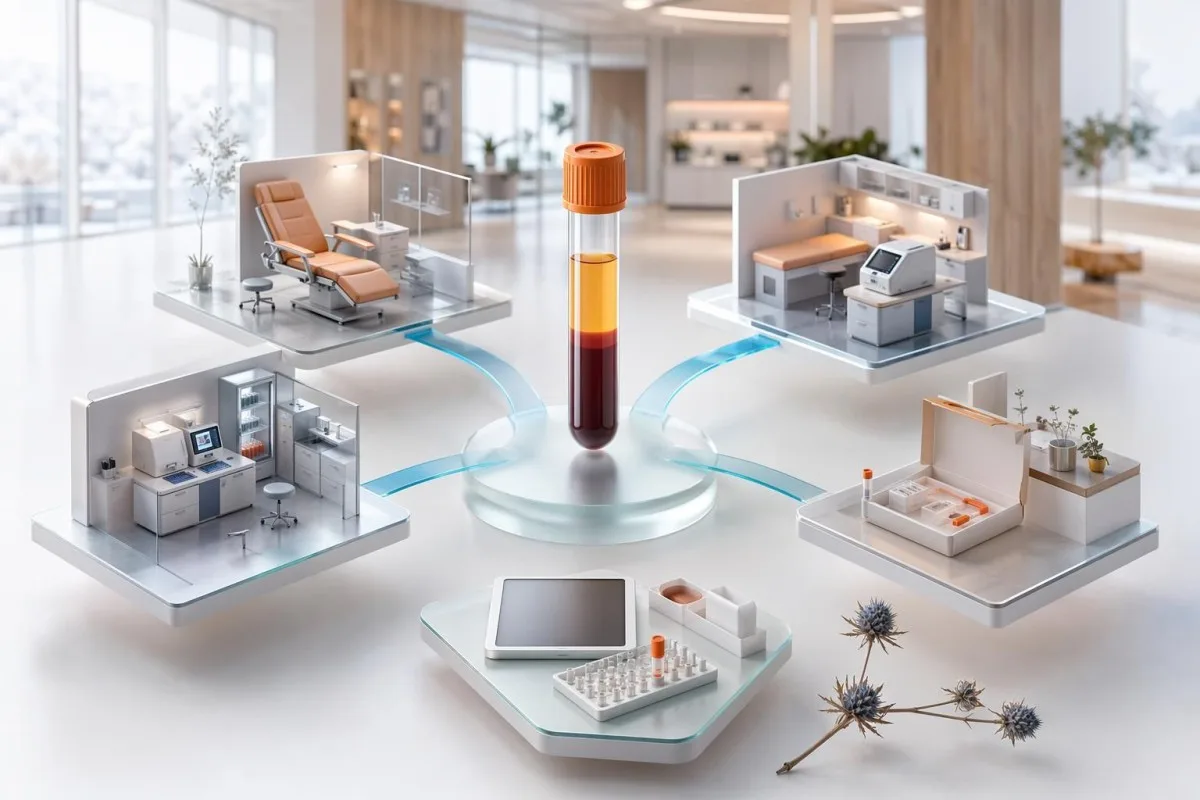
For most routine blood work, independent labs beat urgent care and ER pricing by a wide margin. The right choice depends on symptoms, turnaround time, and whether you need a doctor now or just a draw.


- Cheapest setting Independent labs usually charge $15-$50 for common self-pay routine tests, while urgent care often lands at $120-$300 total.
- ER pricing Emergency department blood work commonly exceeds $500 and may reach $1,500-$6,000+ once facility and physician fees are added.
- CBC cash rate ’S e CBC gu tric a’ cosg $15-$35 at an outpatient lab.
- CMP cash rate A CMP mar as trice a’ ruith $15-$40 cash at a local lab.
- HbA1c value An A1c de 6.5% corresponds to an estimated average glucose near fo thar ùine.
- Capillary limits Home kits are more error-prone for potasium, CBC, agus coagulation testing because tiny samples clot and hemolyze more easily.
- Direct-access rule Online blood test ordering is common in many states but remains restricted or modified in New York, New Jersey, agus Rhode Island.
- Best first stop If you are stable and need routine monitoring, choose an outpatient lab first; reserve the ER for chest pain, stroke signs, sepsis, or severe dehydration.
Which setting has the lowest blood test cost?
Independent outpatient labs are usually the lowest-cost place for a routine blood test. A self-pay CBC commonly runs $15-$35, tha CMP $15-$40, agus pannal lipid $20-$50. cùram èiginneach adds convenience and clinician time, so the same visit often lands at $120-$300 total. Emergency rooms are built for urgent care, not bargain pricing; with facility fees, even simple blood work can cost $500-$3,000+. If you are shopping for blood test cost rather than emergency treatment, start with Kantesti AI.
The lowest invoice is not always the lowest final cost. A walk-in lab may quote a $29 CBC, while urgent care folds that same test into a visit charge and a handling fee; if you want the billing anatomy, see our breakdown of why lab prices vary.
I am Thomas Klein, MD, and the mistake I see most often is a patient using the ER for stable fatigue, hair loss, or annual monitoring because it feels faster. It is faster for STAT medicine, but once the facility fee, clinician fee, and repeat testing are added, a routine workup can jump from under $100 gu well over $1,000.
Cheap is the wrong goal when symptoms are dangerous. Chest pain, severe shortness of breath, one-sided weakness, fainting, or confusion belong in emergency care even if the bill stings; a low price is meaningless if the setting cannot rule out a heart attack, sepsis, or a major electrolyte disturbance.
What people actually pay in 2026
Real-world blood test cost in 2026 falls into predictable bands: outpatient labs are usually lowest, direct online ordering is similar, urgent care is mid-priced, and ERs are highest by a wide margin. As of May 17, 2026, most self-pay patients in the US see common routine panels land between $15 and $70 per test at local labs, before any clinician visit fee.
A CBC gu tric a’ ruith $15-$35, tha CMP $15-$40, HbA1c $20-$45, TSH $25-$60, agus ferritin $25-$70 at cash-pay rates. If you are uninsured or on a high deductible plan, our guide to routine lab prices without insurance gives the most common sticker ranges patients actually report.
Urgent care changes the math because the visit is the product. Most centers charge roughly $90-$200 to be seen, then add onsite or send-out labs, so a simple blood test near me visit often totals $120-$300, and sometimes more if IV fluids, imaging, or repeat vitals are added.
Emergency departments bill differently again: facility fee, physician fee, and often separate laboratory and ECG charges. In my experience, a chest-pain workup with CBC, BMP, troponin, and ECG can land anywhere from $1,500 to $6,000+ for a self-pay patient, even when the final diagnosis is benign reflux or dehydration.
Why independent labs usually win on price
Independent labs usually give the best price-to-quality ratio for a routine blood test. They are built for high volume, low overhead, and standardized specimen handling, which is why a local lab is usually the first place I send stable patients who need a CBC, CMP, lipid panel, A1c, TSH, or ferritin.
If you are typing blood test near me into your phone, look for an outpatient draw center that posts cash prices, honors timed appointments, and has experienced phlebotomy staff. Our checklist on taghadh obair-lann ionadail earbsach is the one I wish more patients read before walking into the closest storefront.
Here is a practical detail most price lists hide: courier cutoff times matter. Miss a 3 pm pickup and your ferritin, vitamin D, or hormone panel may not even leave the building until the next morning, which turns a same-day draw into a 24-48 hour reporting delay.
Quality problems at outpatient labs are usually pre-analytic, not analytic. A difficult collection, a tube that clots, or a sample that hemolyzes can falsely raise potasium, AST, agus LDH; when I see an isolated potassium of 5.8 mmol/L in an otherwise well patient, I often ask how the sample was collected before I assume true hyperkalemia.
When urgent care is worth the extra fee
Urgent care is worth the extra money when you need a clinician today and the question is still low to moderate acuity. It is not the cheapest place for routine monitoring, but it can be the right middle ground for dizziness, dehydration, urinary symptoms, mild infection, or medication side effects when blood work changes same-day treatment.
Most urgent care bills are driven by the visit, not the vial. A center may advertise fast labs, but the real cost is usually visit fee plus test fee, which is why a single BMP can cost five to ten times more than the same chemistry panel at an independent lab.
Another nuance: not every urgent care runs the same assays onsite. Many can perform glucose, pregnancy, influenza, or a limited chemistry panel immediately, but a full CMP, thyroid testing, iron studies, or autoimmune work often go out to a reference lab; if you are not sure what is included, review the difference between CMP and BMP testing before you pay for a bigger panel than you need.
I do use urgent care for certain patients. A healthy 29-year-old with vomiting and lightheadedness may benefit from a BMP, urine test, and fluids today, whereas that same patient going to the ER without red flags usually pays hospital pricing for a problem urgent care can safely manage.
When the ER price is justified
The ER is the most expensive setting, and that price is justified only when time-sensitive disease is on the table. If you have chest pain, severe abdominal pain, high fever with confusion, major weakness, or symptoms of stroke or sepsis, the emergency department is where blood tests become part of lifesaving triage rather than shopping.
Emergency labs are different because they are STAT and protocol driven. A potassium, lactate, troponin, CBC, and blood cultures can be processed in minutes to hours, and those results may trigger oxygen, fluids, antibiotics, anticoagulation, or catheterization before an outpatient lab would even finish accessioning the sample.
Cardiac testing is the classic example. High-sensitivity troponin is usually interpreted as a series, not a one-off number, which is why patients with concerning chest symptoms need repeat measurements over 1-3 hours and ECG correlation; our guide to troponin and cardiac enzymes explains why a single cheap test cannot safely replace an ER rule-out.
Most patients underestimate the cost of observation. One extra repeat troponin, a saline bolus, and a few monitored hours can turn a basic ER visit into a far bigger bill, but when the question is myocardial infarction, pulmonary embolism, sepsis, or GI bleeding, that is still the right spend.
How online blood test ordering changes cost
Online blood test ordering is often one of the cheapest ways to get routine labs if your state allows direct access testing. The price is usually transparent up front, and for straightforward follow-up like HbA1c, lipidean, TSH, no bhiotamain D, it often lands close to independent-lab cash rates.
The main advantage of an deuchainn fala air-loidhne is not magic pricing; it is price visibility. You pick the exact markers, pay before the draw, then use a partner collection site, and our walkthrough on òrdachadh deuchainnean obair-lann gun dotair shows where that model works well.
State law still matters. Direct-access testing remains restricted or modified in a few places, most notably New York, New Jersey, agus Rhode Island, so the same online order flow that works in Texas or Florida may require an added physician authorization or may not be offered at all.
The catch is fragmentation. If the result is abnormal, you may still need a clinician to interpret it, repeat it, or connect it to symptoms, so online ordering is best for planned monitoring rather than brand-new chest pain, jaundice, or rapidly worsening fatigue.
At-home kits: good for some markers, bad for others
At-home kits are convenient, but they are not interchangeable with a venous lab draw. They work reasonably well for some markers such as HbA1c, cuid lipid measurements, and selected antibodies, but they are weaker for tests that depend on fast processing, larger sample volume, or pristine cell counts.
In my experience, the most common mistake is using an at-home kit for the wrong job. Our review of cruinneas agus crìochan deuchainn fala aig an taigh a’ mìneachadh carson a tha potasium, CBC le diofaraichte, deuchainn clotting, and many hormone panels are more vulnerable to collection error outside a controlled lab.
Capillary sampling sounds simple, but tiny tubes clot more easily and small samples hemolyze more easily. A partly clotted capillary specimen can distort plaidean, MCV, agus potasium, which is one reason a home kit that looks cheap at $49 may lead to a second venous draw a week later.
I do like at-home kits for follow-up when the question is narrow and non-urgent. If you are checking whether lifestyle changes moved HbA1c bho 6.0% to 5.7%, or whether an hs-CRP trend improved, they can be useful; if the result matters for medication dosing or ER triage, use a clinic or hospital sample.
Insurance, cash pay, and coding tricks that change the bill
Insurance changes blood test cost more than most patients realize. A preventive panel coded for an annual exam may cost $0 out of pocket, while the exact same lipid panel or glucose test coded for fatigue, chest discomfort, or obesity may hit your deductible or be denied.
Prep errors also create hidden costs. Fasting is not needed for every test, but showing up after coffee with cream or a workout can force a repeat draw for glucose, triglycerides, or liver enzymes, so it is worth checking which common tests really need fasting mus glèidh thu.
Diagnosis coding matters just as much. A clinician ordering HbA1c for diabetes screening, TSH for hair loss, or bhiotamain D for vague fatigue can trigger very different coverage rules, and a smart starting list from a new doctor visit lab checklist can stop you paying for seven add-ons that were never going to be covered; vitamin D is a common denial unless the diagnosis supports medical necessity.
High-deductible patients should always ask two questions before the sample is collected: what is the cash price today, and what is the contracted insurance rate. I have seen cash rates of $29 beat insurer-adjusted bills of $84, especially for common panels and follow-up monitoring. HSA and FSA cards usually work for eligible ordered testing, including many direct-access lab purchases.
Convenience and turnaround: who gets you results fastest?
Turnaround time depends more on urgency and lab workflow than on who collects the sample. ERs are fastest for STAT chemistry and troponin, independent labs are usually fastest for scheduled routine panels, urgent care sits in the middle, and at-home kits are usually slowest because shipping adds delay.
A hospital may return potasium no troponin ann an 30-90 mionaid, whereas an outpatient lab often posts CBC, BMP, no CMP later the same day or by the next morning. If timing matters to you, our guide to same-day results versus send-outs is more realistic than most marketing copy.
Urgent care can feel fast at the front desk and slow at the back end. A waived glucose or mononucleosis test may be ready in 15-30 mionaid, ach TSH, ferritin, B12, and most hormone tests are frequently sent out and take 1-3 latha gnìomhachais.
Weekend timing trips people up. A sample collected Friday at 5 pm may not be meaningfully different from a Monday morning draw if the reference lab batch runs on business days, which is why I tell patients not to pay urgent-care pricing purely for the illusion of speed.
Is test quality different at labs, urgent care, and ERs?
For common chemistry and hematology tests, analytic quality is often similar across good local labs, urgent care centers, and hospital labs. The bigger differences are specimen integrity, how quickly the sample reaches the analyzer, and whether someone interprets the result in clinical context.
That is why I care more about accreditation, specimen handling, and result review than glossy marketing. Our summary of inbhean dearbhaidh meidigeach explains the boring but crucial pieces: calibration, quality control, reference intervals, and critical value reporting, and Kantesti AI reads the uploaded PDF in that same context.
Biologic variation also matters. A creatinine shift from 0.90 to 0.96 mg/dL or an ALT shift from 22 to 28 U/L is often less meaningful than patients think, and our piece on when lab changes really matter explains why a tiny movement can be normal noise rather than disease; some European labs also report lipids in mmol/L an àite mg/dL, which creates needless panic if units are ignored. Thomas Klein, MD sees this with creatinine more often than patients expect.
Some tests reward simplicity. An A1c de 6.5% a’ freagairt ri cuibheasachd glùcois tuairmseach de mu fo over time, which is why a basic, inexpensive diabetes screen is often enough for first-line risk assessment (Nathan et al., 2008). And for lipids, the 2018 AHA/ACC guideline still bases most treatment decisions on LDL-C, non-HDL-C, and overall risk rather than exotic add-ons for the average adult (Grundy et al., 2019).
Best place to get common routine blood tests
Most routine blood tests belong at an independent lab or a direct-access draw center, not urgent care or the ER. The best-value setting for CBC, CMP, pannal lipid, HbA1c, TSH, ferritin, B12, agus bhiotamain D is usually a standard outpatient collection site unless your symptoms are acute or a clinician needs the answer today.
Here is the short version. Use local labs for stable monitoring, urgent care for same-day evaluation plus limited labs, and the ER for troponin, lactate, blood cultures, or severe electrolyte concerns; if you want a broader menu, our stiùireadh bith-chomharran shows just how many tests can be ordered without needing hospital-level overhead.
Typical cash bands are remarkably consistent: CBC $15-$35, CMP $15-$40, lipid panel $20-$50, HbA1c $20-$45, TSH $25-$60, agus ferritin $25-$70 at outpatient rates. For most healthy adults, that handful of markers covers far more useful territory than a branded wellness bundle, and our guide to the most important blood tests lays out why. A nonfasting lipid panel is usually acceptable unless triglycerides are expected to be very high, and on Kantesti these core markers are still the panels most users upload first.
Kidney testing is the one place I urge patients not to buy the cheapest panel blindly. Creatinine without eGFR is incomplete, and the newer CKD-EPI equations changed classification for a meaningful number of patients, especially near decision cut points such as eGFR 60 mL/min/1.73 m² (Inker et al., 2021).
What to do after the blood draw
After the draw, the smartest move is to organize the report, compare it with your last result, and interpret patterns rather than isolated flags. A single high or low value can mislead; the combination of markers, the trend over time, and your symptoms decide whether you need reassurance, a repeat draw, or a same-day call.
Start with the original report, not a cropped screenshot. Our guide to luchdachadh suas PDF deuchainn fala sàbhailte shows why units, reference intervals, specimen notes, and collection time can change the meaning of the same number.
Trend review is where many patients finally stop overpaying. In our analysis of more than 2 millean uploaded reports, the biggest billing mistake is repeat testing without checking whether the marker is already improving, and our piece on the graf gluasad obair-lann explains how slopes matter more than a one-day wobble.
Kantesti's clinical logic is reviewed by physicians on our Bòrd Comhairleachaidh Meidigeach, and our CE-marked workflows run under HIPAA, GDPR, and ISO 27001 controls. If you want the methods, our sgrùdadh dearbhaidh clionaigeach is public. The multilingual triage deployment paper is public as well.
Most borderline results do not need an ER visit or a second urgent-care bill. You can upload a PDF or phone photo to an anailisiche deuchainn fala AI againn for interpretation in about 60 diog, then decide whether the next step is monitoring, a scheduled appointment, or urgent care.
How to choose the lowest-cost appropriate setting today
Choose the setting by acuity first, then price. If you feel well and need routine monitoring, use a local lab or an online order; if you need a clinician today but are stable, urgent care can be worth it; if symptoms suggest heart attack, stroke, sepsis, or major dehydration, go to the ER and worry about the bill later.
For most adults, my quick rule is simple. Stable fatigue, cholesterol follow-up, thyroid follow-up, iron studies, diabetes screening, and medication monitoring can usually start with a planned outpatient draw, and our symptom-based lab guide helps narrow which tests to request before you pay for a giant panel.
If you want to know how we think about this clinically, you can read more about our team. As Thomas Klein, MD, I would rather see a patient spend $40 on the right outpatient test and a careful interpretation than $400 on convenience or $4,000 on hospital overhead for a non-emergency question.
Geàrr-chunntas: independent lab first for routine blood work, urgent care for same-day low-acuity decisions, ER only for red flags, at-home kits for selected follow-up, and online blood test ordering for transparent planned monitoring. If you already have results and want a fast second pass, try our demo deuchainn fala an-asgaidh before paying for a repeat draw you may not need.
Ceistean Bitheanta
Dè a chosgas deuchainn fala àbhaisteach gun àrachas?
A routine blood test without insurance usually costs $15-$35 airson CBC, $15-$40 airson CMP, $20-$50 for a lipid panel, and $20-$45 cumanta ann do HbA1c at an independent outpatient lab. Urgent care often turns that same request into a $120-$300 visit once exam fees are included. An ER is rarely the right place for routine monitoring because facility-based testing commonly exceeds $500 and may reach $1,500-$6,000+ if repeat tests are done.
A bheil cùram èiginneach nas saoire na an ER airson obair fala?
Yes, urgent care is almost always cheaper than the ER for blood work when the problem is stable enough for urgent care. A typical urgent care visit with limited labs runs about $120-$300 total, while an emergency department visit often starts above $500 before physician, ECG, imaging, or repeat lab charges. Urgent care is still more expensive than an independent lab, which is why routine cholesterol, thyroid, and diabetes screening usually belong at a local lab.
An urrainn dhomh deuchainnean fala a chur air dòigh dhomh fhìn air-loidhne?
In many US states, you can order your own blood tests online and then use a partner draw center for collection. Common self-ordered tests include CBC, CMP, lipid panel, HbA1c, TSH, ferritin, vitamin D, and STI screens, often at cash rates similar to outpatient labs. Direct-access testing is still restricted or modified in New York, New Jersey, agus Rhode Island, so availability depends on local rules and the company's medical oversight.
A bheil deuchainnean fala aig an taigh cho ceart ris an tarraing obair-lann?
At-home blood tests are reasonably accurate for some markers, but they are not equivalent to a standard venous draw for every test. Finger-prick or dried-sample kits can work for HbA1c, some lipid measures, and selected antibody tests, yet potasium, CBC le diofaraichte, deuchainnean coagulachaidh, and some hormone assays are more vulnerable to clotting, shipping delay, or sample damage. If an at-home result is abnormal or affects treatment, most clinicians confirm it with a venous laboratory sample.
Dè cho luath ’s as urrainn dhomh toraidhean deuchainn fala fhaighinn?
Same-day blood test results are realistic for hospital STAT testing and many routine outpatient panels, but not for every marker. A hospital may report potasium no troponin ann an 30-90 mionaid, while an outpatient CBC, BMP, no CMP often posts later the same day or by the next morning. Ferritin, B12, vitamin D, thyroid antibodies, and many hormone tests are frequently send-outs that take 1-3 latha gnìomhachais.
Cuin a bu chòir dhomh a dhol dhan t-Seòmar Èiginn (ER) an àite obair-lann ionadail airson obair fala?
You should choose the ER instead of a local lab if symptoms suggest a condition that can worsen over hours rather than days. Chest pain, severe shortness of breath, new confusion, one-sided weakness, fainting, major dehydration, or high fever with toxic appearance need emergency evaluation because blood tests may need serial repeats, ECG monitoring, imaging, or immediate treatment. A local lab can collect the sample, but it cannot safely manage a heart attack, stroke, sepsis, or a potassium emergency.
A bheil àrachas a’ còmhdach deuchainnean fala dìonach?
Insurance often covers preventive blood work differently from diagnostic blood work. A lipid panel, glucose test, or HbA1c ordered as part of an annual preventive visit may cost $0 out of pocket, while the same test ordered for fatigue, hair loss, chest discomfort, or obesity may be billed to deductible or coinsurance. Bhiotamain D testing is a common denial unless the diagnosis supports medical necessity, so patients should ask whether the panel is being billed as preventive or diagnostic before the sample is collected.
Faigh Mion-sgrùdadh Deuchainn Fala le Cumhachd AI an-diugh
Thig còmhla ri còrr is 2 mhillean neach air feadh an t-saoghail a tha a’ earbsa Kantesti airson mion-sgrùdadh sa bhad, ceart air deuchainnean obair-lann. Luchdaich suas na toraidhean deuchainn fala agad agus faigh mìneachadh coileanta air biomarcair 15,000+ ann an diogan.
📚 Foillseachaidhean Rannsachaidh le Iomraidhean
Klein, T., Mitchell, S., & Weber, H. (2026). Multilingual AI Assisted Clinical Decision Support for Early Hantavirus Triage: Design, Engineering Validation, and Real-World Deployment Across 50,000 Interpreted Blood Test Reports. Rannsachadh Leigheis AI Kantesti.
Klein, T., Mitchell, S., & Weber, H. (2026). Stiùireadh Deuchainn Fuil Co-fhreagairt C3 C4 & Tìtear ANA. Rannsachadh Leigheis AI Kantesti.
📖 Iomraidhean Meidigeach Taobh a-muigh
⚕️ Àicheadh Meidigeach
Tha an artaigil seo dìreach airson adhbharan foghlaim agus chan eil e a’ dèanamh comhairle mheidigeach. Cuir fios an-còmhnaidh gu solaraiche cùram slàinte teisteanasach airson co-dhùnaidhean breithneachaidh is leigheis.
Comharran earbsa E-E-A-T
Eòlas
Lèirmheas clionaigeach air a stiùireadh le lighiche air sruthan-obrach mìneachaidh obair-lann.
Eòlas
Fòcas air leigheas obair-lann air mar a bhios bith-chomharraidhean (biomarkers) a’ giùlan ann an co-theacsa clionaigeach.
Ùghdarrasachd
Air a sgrìobhadh le Dr. Thomas Klein le ath-sgrùdadh le Dr. Sarah Mitchell agus Prof. Dr. Hans Weber.
Earbsachd
Mìneachadh stèidhichte air fianais le slighean leanmhainn soilleir gus dragh a lughdachadh.